BREAKING: Target Test Prep releases Brand New 2026 On Demand GMAT prep course
RedeemHow to Tackle Every Single GMAT Problem (Seriously!) - Part 5
 Welcome to part 5 of our series on how to answer every single GMAT problem youll ever see. :) If you havent already read the earlier installments, start with part 1 and work your way back to me.
Last time, I left you with a Critical Reasoning question from the free questions that come with the GMATPrep software. Lets talk about it!
According to the Tristate Transportation Authority, making certain improvements to the main commuter rail line would increase ridership dramatically. The authority plans to finance these improvements over the course of five years by raising automobile tolls on the two highway bridges along the route the rail line serves. Although the proposed improvements are indeed needed, the authoritys plan for securing the necessary funds should be rejected because it would unfairly force drivers to absorb the entire cost of something from which they receive no benefit.Which of the following, if true, would cast the most doubt on the effectiveness of the authoritys plan to finance the proposed improvements by increasing bridge tolls?
(A) Before the authority increases tolls on any of the area bridges, it is required by law to hold public hearings at which objections to the proposed increase can be raised.
(B) Whenever bridge tolls are increased, the authority must pay a private contractor to adjust the automated toll-collecting machines.
(C) Between the time a proposed toll increase is announced and the time the increase is actually put into effect, many commuters buy more tokens than usual to postpone the effects of the increase.
(D) When tolls were last increased on the two bridges in question, almost 20 percent of the regular commuter traffic switched to a slightly longer alternative route that has since been improved.
(E) The chairman of the authority is a member of the Tristate Automobile Club that has registered strong opposition to the proposed toll increase.
Ready? Before we dive into the GRW process for CR, you might have already learned the 4-step process we use for CR questions:
Step 1: Identify the Question
Step 2: Deconstruct the Argument
Step 3: State the Goal
Step 4: Work from Wrong to Right
If youre now wondering why Im introducing a new process Im not! Those 4 steps actually go right along with the GRW model; we just didnt make that model explicit to you before.
Okay, where do you think you should Glance first on CR?
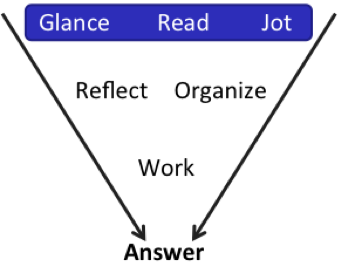
The question stem! CR questions can be split into a bunch of sub-types, and your first goal is to figure out which type this one is. What do you think?
The language if true, would cast the most doubt indicates that this is a Weaken the Argument question. As soon as you know this, you (should!) immediately know a bunch of other things:
- the kind of information to expect in the argument
- the kind of reasoning needed to answer the question
- the characteristics the correct answer should contain
- the kinds of traps the wrong answers will tend to contain
For a Weaken question:
- the argument will contain a conclusion; there will be at least one unstated assumption between the premise(s) and the conclusion
- to weaken, you need to find an answer that makes the argument at least a little less likely to be valid
- the correct answer should be a new piece of information that makes the argument at least a little less likely to be valid (but doesn't necessarily completely kill the argument)
- trap answers are likely to: strengthen instead of weaken; weaken a related idea or conclusion, but not the given argument; make an irrelevant distinction or comparison between groups discussed in the argument
Plus, theres a bonus on this particular question stem. Notice that it includes information about the specific argument. When this happens, that information is usually the conclusion or refers to the conclusion. Read it and try to understand what you can, but also make a mental note to read it again once youve read the argument.
All right, youve finished Step 1: Identify the Question. Whats next?
Read this thing, of course! While youre reading deconstruct the argument (Step 2!) and jot down any relevant notes to help yourself keep track. 
Okay, so repairs to the railway are neededbut, wait, theyre going to get the money by charging drivers? If I were a driver in this town, Id be pretty unhappy, just like the author. (See what Im doing there? If you can put yourself in the argument, itll be easier to remember the details and to think about possible assumptions and implications.)
Okay, so why is this unfair?
No, wait! Remember what we said before: the last step to reading and deconstructing the argument is to re-read the question stem (when the stem contains specific information about the argument).
Ah. Okay, the question is asking us to weaken the TTAs plan. (Youve now completed Step 2: Deconstruct the Argument.) What's next?
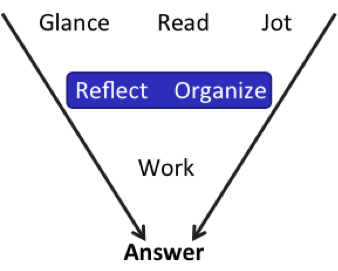
Reflect. Whats the plan? Theyre going to raise money by increasing a toll for drivers. Weve got to find something that indicates that this financing plan might not be such a great idea after all. (Weve just completed step 3: state the goal.) If youve already got any ideas about assumptions the TTA is making or where the weak points of the argument are, jot them down or star them in your notes.
One thing Im thinking: okay, youre going to raise money by imposing a toll on these drivers, but will it be enough money for all of the improvements you want to make?
Ready to Work on this thing? Its time to go to those answer choices and start crossing off the wrong ones in pursuit of the correct answer (step 4!).
(A) Before the authority increases tolls on any of the area bridges, it is required by law to hold public hearings at which objections to the proposed increase can be raised."
People are already raising objectionslook at the author of this argument! And notice that the authors objection is not about whether the plan will be effective; rather, he complains that it isnt fair. It isnt sufficient to say that someone raising an objection will be showing how the plan might not be effective. Eliminate.
(B) Whenever bridge tolls are increased, the authority must pay a private contractor to adjust the automated toll-collecting machines."
Sothese would be part of the improvements. This is an expense, yes, but this is just one of the things theyre raising this money for in the first place. This is mildly tempting, so Ill leave it in for now, but Im going to keep an eye out for something better.
(C) Between the time a proposed toll increase is announced and the time the increase is actually put into effect, many commuters buy more tokens than usual to postpone the effects of the increase."
That sounds smart; I think Id do that myself. This only postpones the effects, though; eventually, people will have to start to pay the increased tolls and the TTA will make money. So theres no reason t0 believe the plan wont work over 5 years. Eliminate.
(D) When tolls were last increased on the two bridges in question, almost 20 percent of the regular commuter traffic switched to a slightly longer alternative route that has since been improved."
Hmm. If 20% of the traffic switches, then thats 20% of toll revenue lost. And that other route has been improved since last time? Okay, then theres a good chance itd happen again this time. If lots of people stop taking the toll route, the TTA is going to be losing a bunch of expected revenue. This definitely weakens the argument.
Note: at this point, I would go back and look at answer (B) again. The adjustment of the machines is a one-time expense (even if it wasnt already planned for), but the loss of a customer who used to drive the toll route multiple times a day or week is a significant, ongoing loss. Answer (D) is stronger.
Check answer (E) to make sure!
(E) The chairman of the authority is a member of the Tristate Automobile Club that has registered strong opposition to the proposed toll increase.
This is kind of like answer (A): it might be a reason why the plan will struggle to be implemented (because too many people object for various reasons), but it doesnt touch on whether the plan itself is or could be effective. Remember what you were asked to analyze: not whether the plan will be implemented but whether the plan is effective. (Plus: just because hes a member doesnt mean he agrees with the Clubs opinion.)
The correct answer is (D).
What did you learn here? Come up with your own takeaways before you read mine below.
Key Takeaways for Every Problem You Will Ever Do:
(1) On CR, your first Glance is at the question stem: what kind of CR question is it? The question type gives you a wealth of knowledge regarding what youre about to do. Also note that, if the question stem contains specific information about the argument, plan to re-read that part once youve read the argument.
(2) Next Read and deconstruct the argument, Jotting down notes or a little diagram as you go. On Weaken questions, find the conclusion and, if possible, brainstorm any assumptions. Try to figure out where the weak points of the argument are.
(3) Pause for a moment and Reflect on what you know so far. Remind yourself of the goal of a Weaken question: to find something that makes the argument at least a little less likely to be valid. Then jump to those answers and start Working from wrong to right. Cross off the ones you know are definitely wrong, and compare any tempting answers against each other.
* GMATPrep questions courtesy of the Graduate Management Admissions Council. Usage of this question does not imply endorsement by GMAC.