BREAKING: Target Test Prep releases Brand New 2026 On Demand GMAT prep course
RedeemETS GRE General Test · Complete Guide
The GRE General Test, decoded from first section to final score.
Decide whether the GRE is your exam, learn the shorter test inside out, and build a four-week plan that fits a real schedule — everything in one reference.
The 1 hour 58 minute exam
Start here · Decision helper
Should you take the GRE?
Answer four quick questions. This is directional guidance, not admissions advice — always confirm which tests each target program accepts and prefers.
{{ g.label }}
{{ verdict.tag }}
{{ verdict.title }}
{{ verdict.body }}
The basics
What is the GRE General Test?
A 1-hour-58-minute admissions exam from ETS, accepted by graduate schools and more than 1,300 business schools. One scored essay, section-adaptive Verbal and Quant, and an on-screen calculator — the shorter GRE has been the standard since September 2023.
The essentials
{{ c.t }}
{{ c.d }}
Format · One sitting, essay + 4 sections
How the exam flows
The essay always comes first, then two Verbal and two Quant sections. No scheduled breaks, and the second section of each measure adapts to how you did on the first.
{{ f.order }}
{{ f.name }}
{{ f.meta }}
{{ f.note }}
Section-adaptive — the hidden mechanic
In Verbal and Quant, your first-section performance sets the difficulty of the second section. A strong first section unlocks harder, higher-value questions — so first-section accuracy directly gates your score. The essay is scored separately.
Mark & Review
Within any section you can skip, mark, return, and change answers freely until that section’s clock runs out. Once a section ends it locks. Each section runs its own clock with no pause between sections.
What's tested · 7 question types
Concepts tested — with real practice
The GRE tests vocabulary in context, evidence-based reading, and core quant — with an essay up front. Below is the full map by section, then a set of GRE-style questions you can try right now. Official ETS test content →
{{ detail.name }}
{{ detail.long }}
What you'll see on the exam
Quarterly units sold (thousands)
{{ detail.exQ }}
{{ sub.label }}
{{ sub.prompt }}
Answer{{ detail.exA }}
Practice these on Beat The GMAT
GRE skills overlap heavily with existing BTG forum boards. Go straight to the closest archive.
Recommended · Featured partner
The GRE course we recommend

Scoring · 130–170 per section
How GRE scoring works — and what's good
Verbal and Quant are each scored 130–170 in one-point steps, combining into a 260–340 total; the essay gets its own 0–6 score. Use the estimator below as directional program-tier guidance, not official cutoffs.
{{ c.t }}
{{ c.d }}
Score estimator
Drag to see where a Total Score lands against typical program tiers.
{{ band.label }}
{{ band.blurb }}
Section balance matters as much as total. A very low Quant score signals a gap to quantitative programs even alongside a strong total, and with ScoreSelect you choose exactly which test dates schools see. Scores are valid 5 years. Always confirm the expected range directly with your target program.
Comparison
GRE vs. GMAT vs. EA
The GRE is the most widely accepted of the three: business school plus nearly every other graduate program. The tradeoffs are real too — it is the only one with an essay and the only one that still tests geometry.
{{ cb.title }}
| Feature | Executive Assessment | GMAT | GRE |
|---|---|---|---|
| {{ row.f }} | {{ row.ea }} | {{ row.gmat }} | {{ row.gre }} |
How to prep · ~4 weeks
A realistic 4-week GRE study plan
Built for people with jobs: roughly 8–12 focused hours a week. If your baseline is far from your target, stretch each phase to two weeks — the sequence matters more than the calendar.
{{ week.title }}
{{ week.goal }}
Quant
- {{ i }}
Verbal
- {{ i }}
Analytical Writing
- {{ i }}
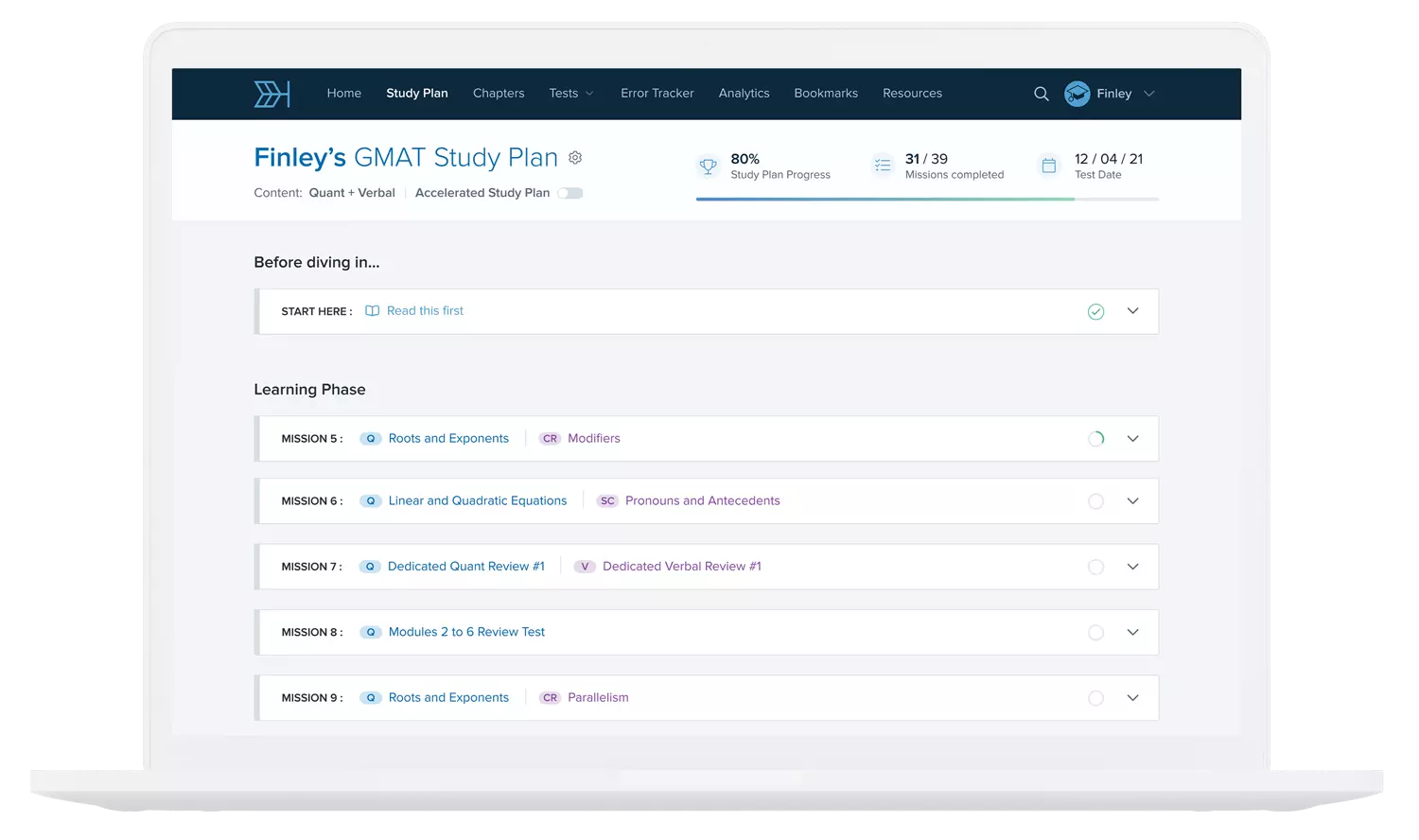
Want this plan pre-built? Target Test Prep's GRE coursemaps every study session for you — same four-week arc, with analytics that flag weak areas as you go.
Logistics
Registration & test day
Book online at ETS.org for a test center or an at-home appointment. Fees and windows change, so confirm current figures before you register.
{{ c.big }}
{{ c.t }}
{{ c.d }}
When to take it
{{ t.when }}
{{ t.what }}
GRE at home is not available in Mainland China or Iran — candidates there test at a center. At a center you get scratch paper; at home you use an erasable whiteboard or a transparent sheet with erasable marker. You can retake the GRE once every 21 days, up to five times in any rolling 12-month period. Practice with whatever you'll actually use on test day.
Where the GRE takes you
Featured programs that accept the GRE
Top business schools GRE candidates research first — every one accepts GRE scores. Filter by region and format, then head to each school's official admissions page.
Region
Format
Program details are directional; confirm requirements on each school's official page.
Recommended · Featured partner
The GRE course we recommend
Official sources
Official GRE resources
The ETS pages GRE candidates actually need — grouped by task.
{{ rg.title }}
Questions
Frequently asked
{{ f.q }}
Have a GRE question?
Ask the Beat The GMAT community — thousands of applicants and verified experts answer questions every day, free.