Tackling Max/Min Statistics on the GMAT – Part 3
 Welcome to our third and final installment dedicated to those pesky maximize/minimize quant problems. If you havent yet reviewed the earlier installments, start with part 1 and work your way back up to this post.
Id originally intended to do just a two-part series, but I found another GMATPrep problem (from the free tests) covering this topic, so here you go:
A set of 15 different integers has a median of 25 and a range of 25. What is the greatest possible integer that could be in this set?(A) 32
(B) 37
(C) 40
(D) 43
(E) 50
Heres the general process for answering quant questionsa process designed to make sure that you understand whats going on and come up with the best plan before you dive in and solve:
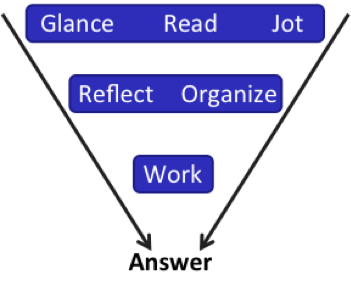
Fifteen integersthats a little annoying because I dont literally want to draw 15 blanks for 15 numbers. How can I shortcut this while still making sure that Im not missing anything or causing myself to make a careless mistake?
Hmm. I could just work backwards: start from the answers and see what works. In this case, Id want to start with answer (E), 50, since the problem asks for the greatest possible integer.
I could also use a similar process to the one discussed in the last installment of this series, but Id shortcut the process a bit by not actually drawing out all 15 blanks.
On the real test, you generally only have time to try one solution method, so try these both out now to see what you think would work best for you on the test. Ill show both solution methods below.
Working Backwards
Ordinarily, youd start with answer (B) or (D) when working backwards from the answer choices. In this case, though, the problem asks for the greatest possible value, so start with the largest answer choice.

The problem specified that the 15 numbers are all different. If thats the case, then 25 cant be both the smallest number and the median, or middle, number in the set. Eliminate answer (E) and try (D) next.

Can you make 25 the median? List it out. If there are 15 numbers, then 25 should be right in the middle, at position #8. There need to be 7 numbers smaller than 25.
18, 19, 20, 21, 22, 23, 24
Bingo! There are 7 different numbers all less than 25, so #8 can be 25. There are then another 7 numbers on the other side, the last of which has to be 43 (since the largest number has to be 25 more than the smallest number, 18).
The correct answer is (D).
Do the Algebra
Heres how to answer the question the way we did last week, by logic-ing it out via algebra. First, you need to draw out whats going on, but in some nicer way than drawing out 15 little lines. Heres what I came up with:

Next, the range is 25, so the difference between the largest and the smallest is 25. Set the largest to be x (since thats what they asked for) and the smallest to x 25:
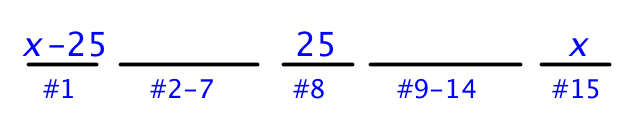
In order to maximize x, what do you need to do to the other numbers?
In order to maximize x, you need to maximize x 25 while still allowing it to be the first integer in a series of different integers with a median of 25. In other words, count down from 25, in position #8, to the largest number that you could put in position #1:
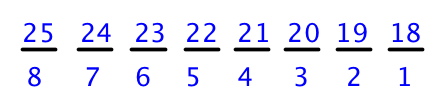
If you feel comfortable counting this out on your fingers, feel free. I think Id be at least somewhat likely to make a careless error doing that, so Id probably write out the bottom half (the 8 down to 1) and the first number (25). From there, Id probably just count it in my head while pointing to each blank.
Okay, so the first one is 18 = x 25, so x = 18 + 25 = 43. Done!
The correct answer is (D).
Key Takeaways for Max/Min Problems:
(1) Figure out what variables are in play: what can you manipulate in the problem? Some of those variables will need to be maximized and some minimized in order to get to the desired answer. Figure out which is which at each step along the way.
(2) Dont forget to consider other strategies, such as working backwards, when appropriate. On this one, Id argue that working backwards may be easier than going through the max/min steps (at least, it was for me), because the problem dealt with integers and the answer choices werent horrible numbers. It was a little lucky that we only had to try two answers, but it wouldnt have taken that much longer to try the others.
(3) Did you make a mistakemaximize when you should have minimized or vice versa? Go through the logic again, step by step, to figure out where you were led astray and why you should have done the opposite of what you did. (This is a good process in general whenever you make a mistake: figure out why you made the mistake you made, as well as how to do the work correctly next time.)
* GMATPrep questions courtesy of the Graduate Management Admissions Council. Usage of this question does not imply endorsement by GMAC.