BREAKING: Target Test Prep releases Brand New 2026 On Demand GMAT prep course

Redeem

The figure above represents a box that has the shape of a

Expert replies
by AbeNeedsAnswers » Wed May 08, 2019 7:42 pm

Timer

00:00

Answers

A

B

C

D

E

Stats

Difficulty

Image

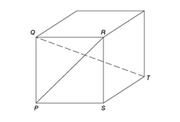
The figure above represents a box that has the shape of a cube. What is the volume of the box?

(1) PR = 10 cm
(2) QT = 5√6 cm

D

Source: Official Guide 2020
Join the discussion
Source: — Data Sufficiency |

by Brent@GMATPrepNow » Thu May 09, 2019 6:15 am
AbeNeedsAnswers wrote:Image

The figure above represents a box that has the shape of a cube. What is the volume of the box?

(1) PR = 10 cm
(2) QT = 5√6 cm

D

Source: Official Guide 2020
Target question: What is the volume of the box?

IMPORTANT: For geometry Data Sufficiency questions, we are typically checking to see whether the statements "lock" a particular angle, length, or shape into having just one possible measurement.
This concept is discussed in much greater detail in the following video: https://www.gmatprepnow.com/module/gmat ... /video/884

This technique can save a lot of time.

Notice that there are infinitely-many cubes...
Image
...and, for each cube, we have different measurements for PR and QT, AND each one of these unique cubes has its very own volume.
So, if a statement LOCKS in the precise measurements of the cube, then that statement must be sufficient.

Statement 1: PR = 10 cm
Among the infinitely-many cubes that exist in the universe, ONLY ONE cube is such that PR = 10 cm
Since statement 1 locks in the size of the cube, it is SUFFICIENT

Statement 2: QT = 5√6 cm
Among the infinitely-many cubes that exist in the universe, ONLY ONE cube is such that QT = 5√6 cmcm
Since statement 2 locks in the size of the cube, it is SUFFICIENT

Answer: D

Here are a few more DS Geometry questions to practice with:
- https://www.beatthegmat.com/good-ds-ques ... 70971.html
- https://www.beatthegmat.com/what-is-the- ... 74620.html
- https://www.beatthegmat.com/what-is-the- ... 77326.html
- https://www.beatthegmat.com/geometry-tri ... 71836.html
- https://www.beatthegmat.com/ds-2-t278892.html
- https://www.beatthegmat.com/coordinate-g ... 77659.html
Brent Hanneson - Creator of GMATPrepNow.com
Image
Join the discussion

by [email protected] » Thu May 09, 2019 3:58 pm
Hi All,

We're told that the figure above represents a box that has the shape of a CUBE. We're asked for the is the volume of the cube. While this question might appear a bit 'scary', there's a great 'logic shortcut' built into it - since we're dealing with a CUBE, we know that all of the dimensions are EQUAL. By extension, if we know ANY length connecting two of the 8 vertices on the cube, then we can figure out ALL of the other lengths (using other Geometry formulas, although we won't actually have to do any of that math here) - and ultimately determine the volume.

1) PR = 10 cm

Length PR is a diagonal that forms on each face of the cube, so it would be the hypotenuse of a 45/45/90 right triangle. With that measurement, we could calculate the exact values of the sides and calculate the volume. There would be only one answer.

Fact 1 is SUFFICIENT

2) QT = 5√6 cm

When dealing with a 'rectangular solid', the formula for calculating the length from one 'corner' of the shape to the 'opposite opposite' corner is:
√(L^2 + W^2 + H^2)

Since we're dealing with a cube, we know that the length, width and height are the SAME. We can refer to all of those lengths as "X", which gives us:
√(X^2 + X^2 + X^2) = √(3X^2) = 5√6

With one variable and one equation, we CAN solve for the value of X - and there would be just one value, so we could calculate the volume of the cube.
Fact 2 is SUFFICIENT

Final Answer: D

GMAT assassins aren't born, they're made,
Rich
Contact Rich at [email protected]
Image
Join the discussion

by deloitte247 » Sun May 12, 2019 9:31 am
Question=> What is the volume of the box?
$$Volume=s^3,\ and\ s^2+s^2+s^2=d^2$$
Where s= side and d=diagonal
$$d=S\sqrt{3}$$
Statement 1: PR=10 cm where PR=diagonal
$$10=S\sqrt{3}$$
$$S=\frac{10}{\sqrt{3}}$$
$$Volume=s^3=\left(\frac{10}{\sqrt{3}}\right)^3$$
$$Statement\ 1\ is\ thus\ SUFFICIENT$$

Statement 2:
$$QT=5\sqrt{6}\ where\ QT=diagonal$$
$$5\sqrt{6}=s\sqrt{3}\ $$
$$\frac{\left(5\sqrt{6}\right)}{\sqrt{3}}=s$$
$$volume=s^3=\left(\frac{5\sqrt{6}}{9}\right)^3$$
$$Statement\ 2\ is\ also\ SUFFICIENT$$

Answer = option D
Join the discussion

AbeNeedsAnswers wrote:
Wed May 08, 2019 7:42 pm
Image

The figure above represents a box that has the shape of a cube. What is the volume of the box?

(1) PR = 10 cm
(2) QT = 5√6 cm

D

Source: Official Guide 2020
Solution:

Question Stem Analysis:


We need to determine the volume of the box shown. Notice that if we can determine the side length of the cube, then we can determine the volume of the cube.

Statement One Alone:

Since we are given the length of a face diagonal of the cube (i.e. the diagonal of a face of the cube), we can determine the side length of the cube and hence the volume of the cube. Statement one alone is sufficient.

Statement Two Alone:

Since we are given the length of a space diagonal of the cube (i.e. the diagonal that passes through the center of the cube), we can determine the side length of the cube and hence the volume of the cube. Statement two alone is sufficient.

(Note: either statement will yield 5√2 as a side length of the cube and hence the volume of the cube is (5√2)^3 = 250√2 cm^3.)

Answer: D

Scott Woodbury-Stewart
Founder and CEO
[email protected]

Image

See why Target Test Prep is rated 5 out of 5 stars on BEAT the GMAT. Read our reviews

ImageImage
Join the discussion