buoyant wrote:For triangle ABC, angle ABC = 90 degrees, and side AC has a length of 15. if point D lies on side AC, and a line is drawn from point B to point D, what is the length of line segment BD?
(1) Triangle ABC is isosceles.
(2) Line segment BD is perpendicular to side AC.
IMPORTANT: For geometry DS questions, we are typically checking to see whether the statements "lock" a particular angle or length into having just one value. This concept is discussed in much greater detail in our free video:
https://www.gmatprepnow.com/module/gmat- ... cy?id=1103
This technique can save a lot of time.
Target question: What is the length of line segment BD?
Given: For triangle ABC, angle ABC = 90 degrees, and side AC has a length of 15.
So, we have a shape that looks something like this . . .
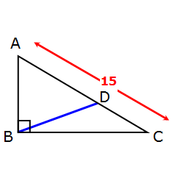
. . . where the legs of the triangle can vary AND the location of point D can vary.
Statement 1: Triangle ABC is isosceles.
Since there is ONLY ONE isosceles right triangle with hypotenuse 15, this statement LOCKS triangle ABC into having one and only one shape.
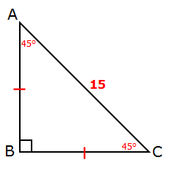
However, statement 1 does NOT lock in the location of point D.
Since this statement does not lock in the location of point D, the length of BD is NOT LOCKED IN.
Consider these two examples.
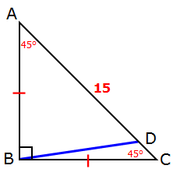
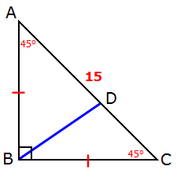
Notice the
different lengths of line segment BD
Since statement 1 does not lock in the length of line segment BD, it is NOT SUFFICIENT
Statement 2: Line segment BD is perpendicular to side AC.
This statement locks in the location of point D (in relation to the triangle's hypotenuse), but it does NOT lock in the shape of the triangle.
Consider these two examples:
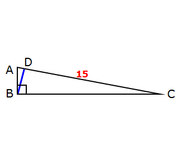
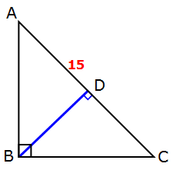
Notice the
different lengths of line segment BD
Since statement 2 does not lock in the length of line segment BD, it is NOT SUFFICIENT
Statements 1 and 2 combined
Statement 1 locks in the shape of triangle ABC.
Statement 2 then locks in the location of point D as follows:
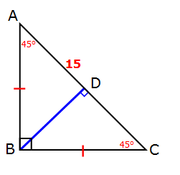
Since there's only one diagram that can be drawn with the given information,
there can be ONLY ONE length of line segment BD
Are we required to find this length? No. We need only recognize that there can be only one length.
Since we can answer the
target question with certainty, the combined statements are SUFFICIENT
Answer =
C
Cheers,
Brent
























