ankitbagla wrote:AB is the diameter of the circle. CD is parallel to AB. What is the length of minor arc CD?
(1) The radius of the circle is 12.
(2) The measure of ∠CAB is 30º
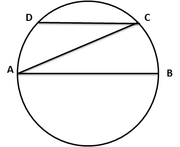
Answer
C
We can answer this question without performing any calculations. Instead, we can use some visualization.
IMPORTANT: For geometry DS questions, we are typically checking to see whether the statements "lock" a particular angle or length into having just one value. This concept is discussed in much greater detail in our free video:
https://www.gmatprepnow.com/module/gmat- ... cy?id=1103
This technique can save a lot of time.
Target question: What is the length of minor arc CD?
Statement 1: The radius of the circle is 12.
This information LOCKS in the size of the circle . . .
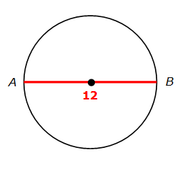
. . . but it does
not lock in the placement of line DC.
So, we could have something like this. . .
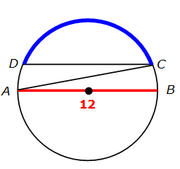
. . . or something like this.
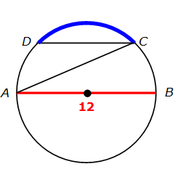
Notice that
the length of minor arc CD is different for each example.
In other words,
statement 1 does not lock in the length of minor arc CD
So, statement 1 is NOT SUFFICIENT
Statement 2: The measure of ∠CAB is 30º
IMPORTANT: If we are not given ANY lengths, then we cannot find a certain length (e.g., the length of minor arc CD).
Since we are not given any lengths, statement 2 is NOT SUFFICIENT
Statements 1 and 2 combined
Statement 1 LOCKS in the size of the circle.
Statement 2 LOCKS in the placement of line AC (since there's only one way to draw AC such that the angle is 30º)
So, we have this.
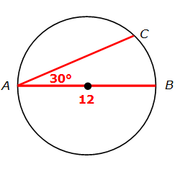
Since DC is parallel to AB, there's only one way to add DC to this diagram.
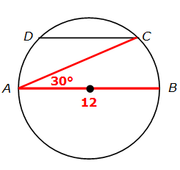
So, as you can see, there's ONLY ONE WAY to draw this diagram. So,
there's only one possible length of minor arc CD.
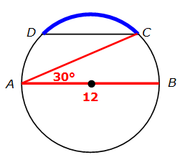
Do we need to find that length? No.
We need only recognize that statements 1 and 2 combined create a situation in which
there's only one possible length of minor arc CD.
As such, the combined statements are SUFFICIENT
Answer = C
Cheers,
Brent





 . I wonder who have recorded them. Specially SC part is funny at times. I have seen the same problem in gmatclub but they have tried to solve it with angle properties and all.


















