Live GMAT classes with Target Test Prep start Nov 21 and Nov 22. First class free.

See classes
Target Test Prep · GMAT

Choose how you want to prepare

Learn live with an expert or move at your own pace. Every option includes the complete TTP study system.

Newsweek Readers’ Choice Awards 2026 winner: Target Test Prep, #1 Test Prep

Target Test Prep was voted #1 Best Test Prep in the 2026 Newsweek Readers’ Choice™ Awards.

★★★★★5.0563 reviews
GMATLiveTeachStarts Nov 22
Josh Braslow, Target Test Prep GMAT expert
LIVE ONLINE CLASSES

Get Ready for GMAT Test Day Faster with Live Online Classes

with Josh Braslow, 20+ years in test prep

Nov 22 · Josh Braslow
Sun · 9:30 AM to 12:30 PM ET
Included
40 hours of live online classes + 6 months of TTP OnDemand
  • Attend the first class for free
  • Every class is recorded, so you never fall behind
View classes & enroll
Limited seats availableTarget Test Prep
EALiveTeachOnDemandStart anytime
EXECUTIVE ASSESSMENT

Target Test Prep EA OnDemand

Self-paced EA prep. Study on your schedule.

EXECUTIVE ASSESSMENT

with

165+ EA score guarantee
$05-day trial no automatic billing
Schedule
Included
40 hours of live online classes plus six months of access to the complete TTP EA OnDemand course.
  • 165+ EA Score Guarantee
  • 4,100+ Quant, Verbal, and Integrated Reasoning practice questions
  • 400+ hours of in-depth video lessons
  • 3,000+ step-by-step video solutions
View EA class & enroll Start free 5-day trial
Limited cohort · enrollment openTrial includes full course accessTarget Test Prep
GMATOnDemandStart anytime
SELF-PACED MASTERCLASS

Target Test Prep GMAT OnDemand

Complete access from day one. Study on your schedule.

715+ score guarantee
$0to start then $127/mo
  • Personalized study plan and analytics
  • Thousands of lessons and practice questions

OG 18 - DS- Q362 - How to solve it quickest?

Problem Solving — algebra and arithmetic
Expert replies
by baalok88 » Sun Mar 25, 2018 1:54 am
Is the number of members of Club X greater than the number of members of Club Y?
1. Of the members of Club X, 20% are also members of club Y
2. Of the members of Club Y, 30% are also members of club X

The OG is explanation is too long and complex to understand. Is there a simpler method using Venn diagram?

Thanks!
Join the discussion
Source: — Quantitative Reasoning |

baalok88 wrote:Is the number of members of Club X greater than the number of members of Club Y?

1. Of the members of Club X, 20% are also members of club Y
2. Of the members of Club Y, 30% are also members of club X
One approach is to use the Double Matrix Method. This technique can be used for most questions featuring a population in which each member has two characteristics associated with it.
Here, we have a population of people, and the two characteristics are:
- member of Club X or not a member of Club X
- member of Club Y or not a member of Club Y
So, we can set up our diagram as follows:
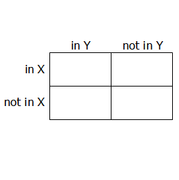
Image

Since we're not told any populations, let's assign some variables.
Let X = # of Club X members
Let Y = # of Club Y members
So, we now have a diagram that looks like this:
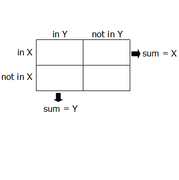
Image

Okay, now let's solve the question...

Target question: Is X greater than Y?

Statement 1: Of the members of Club X, 20 percent are also members of Club Y.
If X people are in Club X, then the number of THESE people whose are ALSO in Club Y = 20% of X (aka 0.2X)
So, let's add this to our diagram:
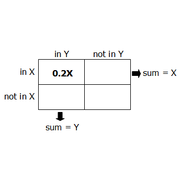
Image

Does this provide enough information to determine whether or not X is greater than Y?
No. The reason is that we have no information about the bottom-left box:
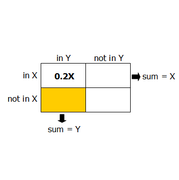
Image

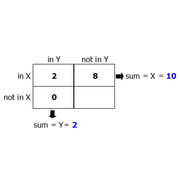
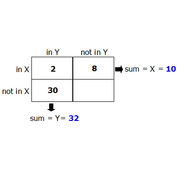
Since there are no restrictions on the bottom-left box, there are many possible ways to complete the diagram so that we get CONFLICTING answers to the target question. Here are two:
Case a:
Image
In this case X = 10 and Y = 2, which means X is GREATER THAN Y

Case b:
Image
In this case X = 10 and Y = 32, which means X is LESS THAN Y

Since we cannot answer the target question with certainty, statement 1 is NOT SUFFICIENT

Statement 2: Of the members of Club Y, 30 percent are also members of Club X.
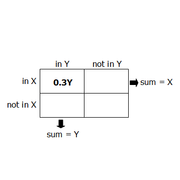
If Y people are in Club Y, then the number of THESE people whose are ALSO in Club X = 30% of Y (aka 0.3Y)
So, let's add this to our diagram:
Image

Using logic similar to the logic we used in statement 1, we can conclude that statement 2 is NOT SUFFICIENT

Statements 1 and 2 combined
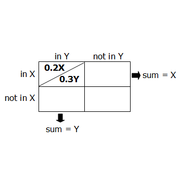
When we combine the information we get TWO POSSIBLE expressions for the top-left corner:
Image
So, these two expressions must be equal.
In other words, 0.2X = 0.3Y
Divide both sides by 0.2 to get: X = (0.3/0.2)Y
Simplify to get: X = 1.5Y
Since X and Y must be positive integers, the expression X = 1.5Y tells us that X is 1.5 TIMES as big as Y
In other words, X is definitely greater than Y
Since we can answer the target question with certainty, the combined statements are SUFFICIENT

Answer: C

Cheers,
Brent


----------------------------
To learn more about the Double Matrix Method, watch our free video: https://www.gmatprepnow.com/module/gmat- ... ems?id=919

Once you’re familiar with the technique, you can attempt these additional practice questions:

Easy Problem Solving questions
- https://www.beatthegmat.com/the-aam-aad ... 72242.html
- https://www.beatthegmat.com/finance-maj ... 67425.html

Medium Problem Solving questions
- https://www.beatthegmat.com/probability ... 73360.html
- https://www.beatthegmat.com/posted-spee ... 72374.html
- https://www.beatthegmat.com/motel-t271938.html
- https://www.beatthegmat.com/of-the-appl ... 70255.html
- https://www.beatthegmat.com/opening-nig ... 64869.html
- https://www.beatthegmat.com/ds-french-j ... 22297.html

Difficult Problem Solving questions
- https://www.beatthegmat.com/ratio-problem-t268339.html
- https://www.beatthegmat.com/overlapping ... 65223.html
- https://www.beatthegmat.com/fractions-t264254.html
- https://www.beatthegmat.com/overlapping ... 64092.html
- https://www.beatthegmat.com/mba/2011/05 ... question-2

Easy Data Sufficiency questions
- https://www.beatthegmat.com/for-what-pe ... 70596.html
- https://www.beatthegmat.com/ds-quest-t187706.html

Medium Data Sufficiency questions
- https://www.beatthegmat.com/sets-matrix-ds-t271914.html
- https://www.beatthegmat.com/each-of-peo ... 71375.html
- https://www.beatthegmat.com/a-manufacturer-t270331.html
- https://www.beatthegmat.com/in-costume- ... 69355.html
- https://www.beatthegmat.com/mba/2011/05 ... question-1

Difficult Data Sufficiency questions
- https://www.beatthegmat.com/double-set- ... 71423.html
- https://www.beatthegmat.com/sets-t269449.html
- https://www.beatthegmat.com/mba/2011/05 ... question-3

Brent Hanneson - Creator of GMATPrepNow.com
Image
Join the discussion

by [email protected] » Sun Mar 25, 2018 2:37 pm
Hi All,

This DS question can be solved by TESTing VALUES.

We're asked if the number of members of Club X is greater than the number of members of Club Y? This is a YES/NO question. In these sorts of situations, it's common for some members to belong to BOTH Clubs, so we have to keep careful track of the numbers and possibilities....

Fact 1: 20% of the members of Club X are ALSO members of Club Y

IF...
Club X has 100 members, then 20 of those members ALSO belong to Club Y.
IF Club Y has 0 unique members, then the answer to the question is YES.
IF Club Y as 1,000 unique members, then the answer to the question is NO.
Fact 1 is INSUFFICIENT

Fact 2: 30% of the members of Club Y are ALSO members of Club X

This Fact offers the same general logic as Fact 1 (above). Without knowing the number of unique members in Club X, the answer to the question could be either YES or NO.
Fact 2 is INSUFFICIENT

Combined, we know...
20% of the members of Club X are ALSO members of Club Y
30% of the members of Club Y are ALSO members of Club X
These specific members are the SAME PEOPLE...

This means that .2(X) = .3(Y)

2X = 3Y
X = (3/2)(Y)

This means that X MUST be greater than Y, so the answer to the question is ALWAYS YES.
Combined, SUFFICIENT

Final Answer: C

GMAT assassins aren't born, they're made,
Rich
Contact Rich at [email protected]
Image
Join the discussion

by Jake@ThePrincetonReview » Tue Apr 10, 2018 1:21 pm
Hi!

The absolute simplest way to solve this problem is to realize that the two statements are talking about the SAME people. That is, the people who are in both groups. So while I think it's fairly clear that neither statement individually will allow you to answer the question (but if not, other explanations here shows you why), it should be also fairly clear that because the two statements are talking about the same people that 20% of X is equal to 30% of Y, meaning that Club X has the greater number of people.


Image
Jake Schiff
GMAT Instructor and Master Trainer
Image
Curious How You’ll Score? Take a FREE GMAT® practice test or sample class
Ready to Prep? Exclusive discounts for Beat The GMAT® members HERE
Join the discussion

Here is how you want to approach

by jaetpu » Tue Jun 19, 2018 11:30 pm
baalok88 wrote:Is the number of members of Club X greater than the number of members of Club Y?
1. Of the members of Club X, 20% are also members of club Y
2. Of the members of Club Y, 30% are also members of club X

The OG is explanation is too long and complex to understand. Is there a simpler method using Venn diagram?

Thanks!

let x = members in club X
let y = members in club Y


1. Of the members of Club X, 20% are also members of club Y
⅕x. x and y are still unknown, so we don’t know which is greater. Insufficient.
2. Of the members of Club Y, 30% are also members of club X
(3/10)y. Insufficient for the same reasons as 1).


if we combine 1 and 2, we can set 2/10x = 3/10y
2x=3y
x=3/2y
Thus, x>y

C
Join the discussion