BTGModeratorVI wrote: ↑Thu Jun 18, 2020 5:48 am
Is the number of members of Club X greater than the number of members of Club Y ?
(1) Of the members of Club X, 20 percent are also members of Club Y.
(2) Of the members of Club Y, 30 percent are also members of Club X.
Answer:
C
Source: Official guide
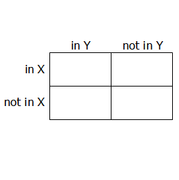
One approach is to use the Double Matrix Method. This technique can be used for most questions featuring a population in which each member has two characteristics associated with it.
Here, we have a population of people, and the two characteristics are:
- member of Club X or not a member of Club X
- member of Club Y or not a member of Club Y
So, we can set up our diagram as follows:
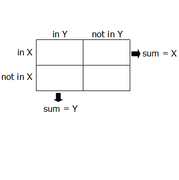
Since we're not told any populations, let's assign some variables.
Let X = # of Club X members
Let Y = # of Club Y members
So, we now have a diagram that looks like this:
Okay, now let's solve the question...
Target question: Is X greater than Y?
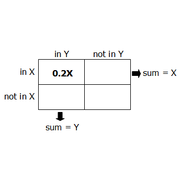
Statement 1: Of the members of Club X, 20 percent are also members of Club Y.
If X people are in Club X, then the number of THESE people whose are ALSO in Club Y = 20% of X (aka 0.2X)
So, let's add this to our diagram:
Does this provide enough information to determine
whether or not X is greater than Y?
No. The reason is that we have no information about the bottom-left box:
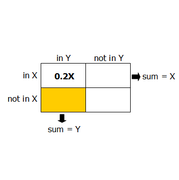
Since there are no restrictions on the bottom-left box, there are many possible ways to complete the diagram so that we get CONFLICTING answers to the
target question. Here are two:
Case a:
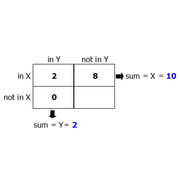
In this case X = 10 and Y = 2, which means
X is GREATER THAN Y
Case b:
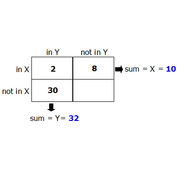
In this case X = 10 and Y = 32, which means
X is LESS THAN Y
Since we cannot answer the
target question with certainty, statement 1 is NOT SUFFICIENT
Statement 2: Of the members of Club Y, 30 percent are also members of Club X.
If Y people are in Club Y, then the number of THESE people whose are ALSO in Club X = 30% of Y (aka 0.3Y)
So, let's add this to our diagram:
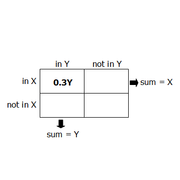
Using logic similar to the logic we used in statement 1, we can conclude that statement 2 is NOT SUFFICIENT
Statements 1 and 2 combined
When we combine the information we get TWO POSSIBLE expressions for the top-left corner:
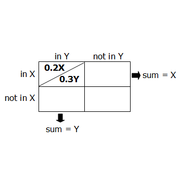
So, these two expressions must be equal.
In other words, 0.2X = 0.3Y
Divide both sides by 0.2 to get: X = (0.3/0.2)Y
Simplify to get: X = 1.5Y
Since X and Y must be positive integers, the expression X = 1.5Y tells us that X is 1.5 TIMES as big as Y
In other words,
X is definitely greater than Y
Since we can answer the
target question with certainty, the combined statements are SUFFICIENT
Answer: C
This question type is
VERY COMMON on the GMAT, so be sure to master the technique.
To learn more about the Double Matrix Method, watch this video:
https://www.gmatprepnow.com/module/gmat- ... ems?id=919
Once you’re familiar with this technique, you can attempt these additional practice questions:
Easy Problem Solving questions
-
https://www.beatthegmat.com/finance-majo ... 67425.html
Medium Problem Solving questions
-
https://www.gmatprepnow.com/module/gmat- ... /video/920
-
https://www.beatthegmat.com/posted-speed ... 72374.html
-
https://www.beatthegmat.com/motel-t271938.html
-
https://www.beatthegmat.com/of-the-appli ... 70255.html
-
https://www.beatthegmat.com/opening-nigh ... 64869.html
-
https://www.beatthegmat.com/at-least-100 ... 74669.html
-
https://www.beatthegmat.com/prblem-solving-t279424.html
Difficult Problem Solving questions
-
https://www.gmatprepnow.com/module/gmat- ... /video/946
-
https://www.beatthegmat.com/ratio-problem-t268339.html
-
https://www.beatthegmat.com/overlapping- ... 65223.html
-
https://www.beatthegmat.com/fractions-t264254.html
-
https://www.beatthegmat.com/overlapping- ... 64092.html
-
https://www.beatthegmat.com/mba/2011/05/ ... question-2
Easy Data Sufficiency questions
-
https://www.gmatprepnow.com/module/gmat- ... /video/943
-
https://www.beatthegmat.com/for-what-per ... 70596.html
-
https://www.beatthegmat.com/ds-quest-t187706.html
Medium Data Sufficiency questions
-
https://www.beatthegmat.com/sets-matrix-ds-t271914.html
-
https://www.beatthegmat.com/each-of-peop ... 71375.html
-
https://www.beatthegmat.com/a-manufacturer-t270331.html
-
https://www.beatthegmat.com/in-costume-f ... 69355.html
-
https://www.beatthegmat.com/mba/2011/05/ ... question-1
Difficult Data Sufficiency questions
-
https://youtu.be/dsCeqF9Kbk8
-
https://www.beatthegmat.com/double-set-m ... 71423.html
-
https://youtu.be/dOZ9KM1m5Hs
-
https://www.beatthegmat.com/sets-t269449.html
-
https://www.beatthegmat.com/mba/2011/05/ ... question-3
Cheers,
Brent

















