infiniti007 wrote: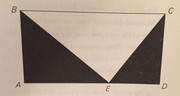
What is the area of the shaded region in the figure shown?
1.) The area of the rectangle ABCD is 54.
2.) AE = 2ED
As Mitch and Rich point out, the area of the shaded region will be HALF of the area of the entire rectangle. HOWEVER, if you didn't spot that, you can still solve the question as follows:
Target question: What is the area of the shaded region
Statement 1: The area of the rectangle ABCD is 54
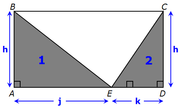
Let's label the two shaded triangles as ∆1 and ∆2.
Also, let j be the length of the base of ∆1 and k be the length of the base of ∆2.
Let h = the height of both triangles (since ABCD is a RECTANGLE, the height is consistent for both ∆s)
 Area of ∆ = (1/2)(base)(height)
So, (area of ∆1) + (area of ∆2) = [(1/2)(j)(h)] + [(1/2)(k)(h)]
= (1/2)(h)[
j + k]
[I factored out the (1/2)(h)]
IMPORTANT:
j + k = the length of the
BASE of rectangle ABCD.
In other words, (area of ∆1) + (area of ∆2) = (1/2)(h)
[BASE of rectangle ABCD]
Since (h)(the BASE of rectangle ABCD) = the area rectangle ABCD, we can say that.....
(area of ∆1) + (area of ∆2) = HALF the area of rectangle ABCD
Since statement 1 tells us that the area of the rectangle ABCD is
54, we can conclude that
(area of ∆1) + (area of ∆2) = (1/2)(54) = 27
Since we can answer the
target question with certainty, statement 1 is SUFFICIENT
Statement 2: AE = 2ED
IMPORTANT: For geometry Data Sufficiency questions, we are typically checking to see whether the statements "lock" a particular angle, length, or shape into having just one possible measurement. This concept is discussed in much greater detail in our free video:
https://www.gmatprepnow.com/module/gmat- ... cy?id=1103
This technique can save a lot of time.
Here, we are told that line segment AE is TWICE the length of line segment ED.
Is this enough information to LOCK IN the combined areas of the two shaded triangles? NO.
Notice that statement 2 does not prohibit us from making rectangle ABCD are TALL or as SHORT as we want.

By making rectangle ABCD are TALL or as SHORT as we want,
we can make the shaded area as large or as small as we wish.
Since we cannot answer the
target question with certainty, statement 2 is NOT SUFFICIENT
Answer: A
--------------------------------------
ASIDE: Here are a few more DS Geometry questions to practice with:
-
https://www.beatthegmat.com/good-ds-ques ... 70971.html
-
https://www.beatthegmat.com/what-is-the- ... 74620.html
-
https://www.beatthegmat.com/what-is-the- ... 77326.html
-
https://www.beatthegmat.com/geometry-tri ... 71836.html
-
https://www.beatthegmat.com/ds-2-t278892.html
-
https://www.beatthegmat.com/coordinate-g ... 77659.html
--------------------------------------
Cheers,
Brent


























