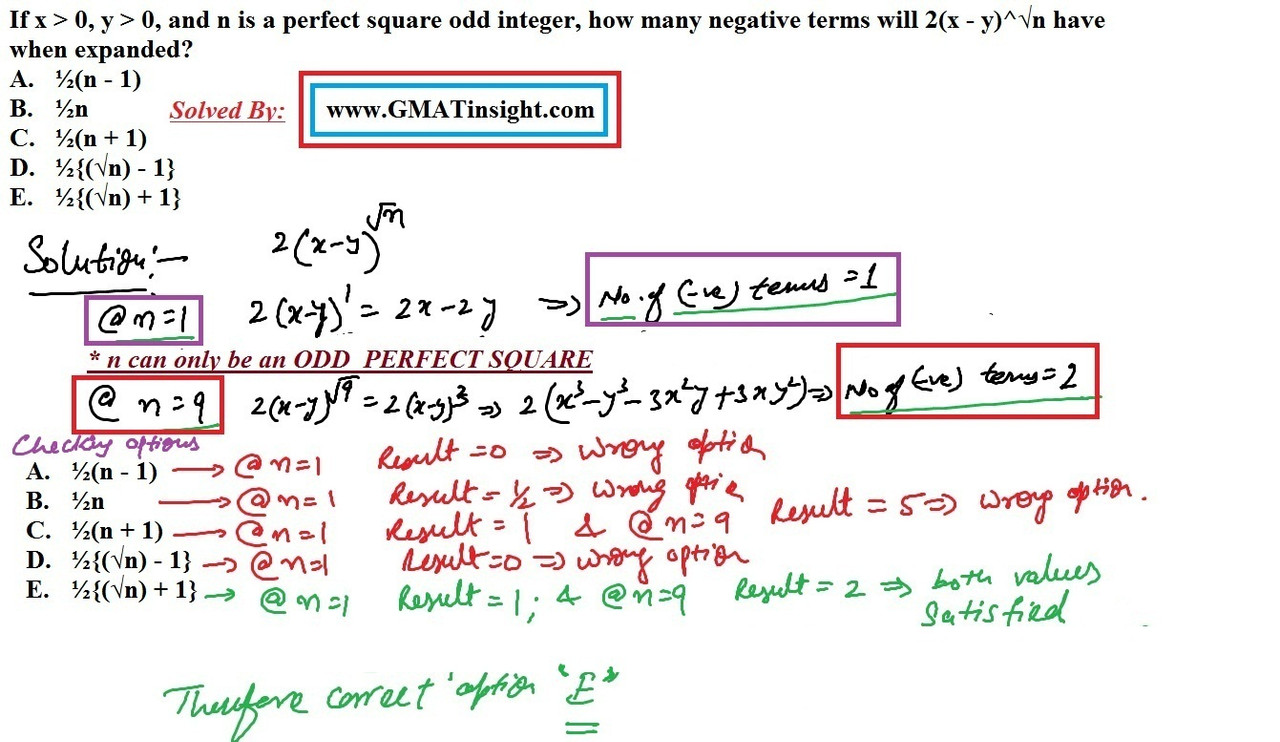
If x > 0, y > 0, and n is a perfect square odd integer, how many negative terms will 2(x – y)^√n have when expanded?
A. ½(n – 1)
B. ½n
C. ½(n + 1)
D. ½{(√n) – 1}
E. ½{(√n) + 1}
Made Up!
A. ½(n – 1)
B. ½n
C. ½(n + 1)
D. ½{(√n) – 1}
E. ½{(√n) + 1}
Made Up!
You do not have the required permissions to view the files attached to this post.
The mind is everything. What you think you become. –Lord Buddha
Sanjeev K Saxena
Quantitative Instructor
The Princeton Review - Manya Abroad
Lucknow-226001
www.manyagroup.com
Sanjeev K Saxena
Quantitative Instructor
The Princeton Review - Manya Abroad
Lucknow-226001
www.manyagroup.com