BREAKING: Target Test Prep releases Brand New 2026 On Demand GMAT prep course

Redeem

Target Test Prep · GMAT

Choose how you want to prepare

Learn live with an expert or move at your own pace. Every option includes the complete TTP study system.

★★★★★5.0559 reviews
GMATLiveTeach 7 seats left
Chris Peckover
NEXT LIVE COHORT

Oct 13 to Jan 7, 2027

with Chris Peckover

Schedule
Tue, Thu · 8:00 to 10:00 PM ET
Included
40 live hours + 6 months of GMAT OnDemand
  • Live instruction and real-time questions
  • Class recordings and assigned practice
View class & enroll
Limited cohort · enrollment openTarget Test Prep
EALiveTeach 5 seats left
Logan Thompson
EXECUTIVE ASSESSMENT

Sep 6 to Dec 6, 2026

with Logan Thompson

Schedule
Sun · 9:30 AM to 12:30 PM ET
Included
40 hours of live online classes plus six months of access to the complete TTP EA OnDemand course.
  • 165+ EA Score Guarantee
  • 4,100+ Quant, Verbal, and Integrated Reasoning practice questions
  • 400+ hours of in-depth video lessons
  • 3,000+ step-by-step video solutions
View EA class & enroll
Limited cohort · enrollment openTarget Test Prep
GMATOnDemand Start anytime
SELF-PACED MASTERCLASS

Target Test Prep GMAT OnDemand

Complete access from day one. Study on your schedule.

715+ score guarantee
$0to start then $127/mo
  • Personalized study plan and analytics
  • Thousands of lessons and practice questions

Compare the format, schedule, and included access before enrolling. Prices and seat counts shown reflect the supplied offer details.

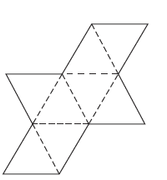
When the figure above is cut along the solid lines, folded a

Expert replies
by alanforde800Maximus » Mon May 14, 2018 3:24 pm

Timer

00:00

Answers

A

B

C

D

E

Stats

Difficulty

When the figure above is cut along the solid lines, folded along the dashed lines, and taped along the solid lines, the result is a model of a geometric solid. This geometric solid consists of 2 pyramids, each with a square base that they share. What is the sum of the number of edges and the number of faces of this geometric solid?
(A) 10
(B) 18
(C) 20
(D) 24
(E) 25
Image
Join the discussion
Source: — Problem Solving |

by alanforde800Maximus » Mon May 14, 2018 3:47 pm
Hello Experts,


Kindly explain this question.
Join the discussion

answer

by [email protected] » Tue May 15, 2018 1:34 pm
Hi alanforde800Maximus,

We're told to cut along the solid lines, fold along the dashed lines, and tape along the solid lines to form a model of a geometric solid. This geometric solid consists of 2 pyramids, each with a square base that they share. We're asked for the sum of the number of edges and the number of faces of this geometric solid. This question has a number of built-in shortcuts that you can use to avoid doing lots of complex math.

To start, form the drawing, you can see that the shape will have 8 sides. When folded and taped together, each "edge" will be 'shared' by two of the sides. Thus, while there are 8 triangles in this shape (with 3 edges each), EVERY edge will be shared by 2 triangles, so we cannot count those edges twice. In simple terms, we have to divide the total number of edges by 2.... (8 triangles)(3 edges each)/(2... since each edge is counted twice) = 24/2 = 12 edges in the final shape.

12+8 = 20

Final Answer: C

GMAT assassins aren't born, they're made,
Rich
Last edited by [email protected] on Wed May 16, 2018 8:15 pm, edited 1 time in total.
Contact Rich at [email protected]
Image
Join the discussion

by alanforde800Maximus » Tue May 15, 2018 4:21 pm
[email protected] wrote:Hi alanforde800Maximus,

We're told to cut along the solid lines, fold along the dashed lines, and tape along the solid lines to form a model of a geometric solid. This geometric solid consists of 2 pyramids, each with a square base that they share. We're asked for the sum of the number of edges and the number of faces of this geometric solid. This question has a number of built-in shortcuts that you can use to avoid doing lots of complex math.

To start, form the drawing, you can see that the shape will have 8 sides. When folded and taped together, each "edge" will be 'shared' by two of the sides. Thus, while there are 8 triangles in this shape (with 3 edges each), EVERY edge will be shared by 2 triangles, so we cannot count those edges twice. In simple terms, we have to divide the total number of edges by 2.... (8 triangles)(3 edges each)/(2... since each edge is counted twice) = 24/2 = 12 edges in the final shape.

12+2 = 20

Final Answer: C

GMAT assassins aren't born, they're made,
Rich
Hello Rich,

Thanks for your reply. Is there any diagrammatic approach that can be deployed on these questions?
Join the discussion

by [email protected] » Wed May 16, 2018 8:20 pm
Hi alanforde800Maximus,

If you're thinking about drawing this shape, then you could potentially do that - but if you focused too much on the drawing (and not on the description in the prompt) then you might find it a little tough to draw an appropriate sketch. For the sake of argument, could you draw one pyramid with triangle sides and a square base? How many sides and edges would that one pyramid have? Now, imagine/draw two of those pyramids, but in such as way that they share the SAME square base (the 2nd pyramid would be 'inverted', underneath the first pyramid).

With that drawing, you would see the 8 triangle sides and could count up the edges.

GMAT assassins aren't born, they're made,
Rich
Contact Rich at [email protected]
Image
Join the discussion