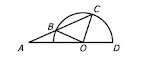
from official guide
You do not have the required permissions to view the files attached to this post.
Live GMAT classes with Target Test Prep start Nov 30 and Dec 6. First class free.
See classesLearn live with an expert or move at your own pace. Every option includes the complete TTP study system.

Target Test Prep was voted #1 Best Test Prep in the 2026 Newsweek Readers’ Choice™ Awards.

with Josh Braslow, 20+ years in test prep

Self-paced EA prep. Study on your schedule.
with
Complete access from day one. Study on your schedule.

In the figure shown, point O is the center of the semicircle and points B, C, and D lie on the semicircle. If the length of line segment AB is equal to the length of line sement OC, what is the degree measure of angle BAO?
(1) The degree measure of angle COD is 60º
(2) The degree measure of angle BCO is 40º


It is given that AB=OC.
In the figure shown, point O is the center of the semicircle and points B, C, and D lie on the semicircle. If the length of line segment AB is equal to the length of line sement OC, what is the degree measure of angle BAO?
(1) The degree measure of angle COD is 60.
(2) The degree measure of angle BCO is 40.


Hi MitchGMATGuruNY wrote:It is given that AB=OC.
In the figure shown, point O is the center of the semicircle and points B, C, and D lie on the semicircle. If the length of line segment AB is equal to the length of line sement OC, what is the degree measure of angle BAO?
(1) The degree measure of angle COD is 60.
(2) The degree measure of angle BCO is 40.
Since OC and OB are both radii, OC=OB.
Thus:
EVALUATE THE EASIER STATEMENT FIRST.
Since statement 2 gives information about one of the equal angles, start with statement 2.
Statement 2: The degree measure of angle BCO is 40.
The result is the following combination of angles:
Thus, angle BAO = 20.
SUFFICIENT.
Statement 1: The degree measure of angle COD is 60.
In the combination of angles yielded by statement 2, angle COD = 60.
Thus, statement 1 implies the same combination of angles as does statement 2.
SUFFICIENT.
The correct answer is D.
Statement 2: ∠BCO = 40ºTurksonaaron wrote:Hi Mitch
I get the fact that the answer is D. I was looking at your solution to get a faster route to solve it. However, I don't really understand your explanation of statement 1 which makes it sufficient.
Thanks


Alright. Thank youGMATGuruNY wrote:Statement 2: ∠BCO = 40ºTurksonaaron wrote:Hi Mitch
I get the fact that the answer is D. I was looking at your solution to get a faster route to solve it. However, I don't really understand your explanation of statement 1 which makes it sufficient.
Thanks
Here, the following figure is yielded:
In the figure above, ∠BAO = 20º.
SUFFICIENT.
Statement 1: ∠COD = 60º
The figure yielded by Statement 2 indicates the following:
If ∠BCO = 40º, then ∠COD = 60º.
Strategy:
Test whether it's possible for ∠BCO to be less than or greater than 40º.
Case 2: ∠BCO = 30º
Here, the following figure is yielded:
In this case, ∠COD is LESS THAN 60º.
Case 3: ∠BCO = 50º
Here, the following figure is yielded:
In this case, ∠COD is GREATER THAN 60º.
If ∠BCO is less than or greater than 40º, then ∠COD ≠ 60º.
Implication:
To satisfy the constraint that COD = 60º, it must be true that ∠BCO = 40º, as indicated in Statement 2.
In other words, Statement 1 implies the SAME COMBINATION OF ANGLES as Statement 2.
Thus, ∠BAO = 20º.
SUFFICIENT.
The correct answer is D.