
BREAKING: Target Test Prep releases Brand New 2026 On Demand GMAT prep course

Redeem

Target Test Prep · GMAT

Choose how you want to prepare

Learn live with an expert or move at your own pace. Every option includes the complete TTP study system.

★★★★★5.0559 reviews
Vote for Target Test Prep, Newsweek Readers’ Choice Awards 2026
NEWSWEEK READERS’ CHOICE 2026

BIG NEWS! Target Test Prep has been nominated, and they’d love your vote!

TTP has worked incredibly hard to build the best test prep experience possible, and winning Newsweek’s 2026 Readers’ Choice Award for Best Test Prep would mean a lot to them. If TTP has helped you, they’d be incredibly grateful for your vote. You can vote once each day through September 9.

Vote for TTP
GMATLiveTeach 7 seats left
Chris Peckover
NEXT LIVE COHORT

Oct 13 to Jan 7, 2027

with Chris Peckover

Schedule
Tue, Thu · 8:00 to 10:00 PM ET
Included
40 live hours + 6 months of GMAT OnDemand
  • Live instruction and real-time questions
  • Class recordings and assigned practice
View class & enroll
Limited cohort · enrollment openTarget Test Prep
EALiveTeach 5 seats left
Logan Thompson
EXECUTIVE ASSESSMENT

Sep 6 to Dec 6, 2026

with Logan Thompson

Schedule
Sun · 9:30 AM to 12:30 PM ET
Included
40 hours of live online classes plus six months of access to the complete TTP EA OnDemand course.
  • 165+ EA Score Guarantee
  • 4,100+ Quant, Verbal, and Integrated Reasoning practice questions
  • 400+ hours of in-depth video lessons
  • 3,000+ step-by-step video solutions
View EA class & enroll
Limited cohort · enrollment openTarget Test Prep
GMATOnDemand Start anytime
SELF-PACED MASTERCLASS

Target Test Prep GMAT OnDemand

Complete access from day one. Study on your schedule.

715+ score guarantee
$0to start then $127/mo
  • Personalized study plan and analytics
  • Thousands of lessons and practice questions

Compare the format, schedule, and included access before enrolling. Prices and seat counts shown reflect the supplied offer details.

Veritas Prep Question: Doubt

Expert replies
by tanvis1120 » Sat Sep 13, 2014 3:53 pm
I do not quite understand the explanation provided to support A (O.A).
From the part of argument, "..though it is useless to people whose hearing loss stems from a neurological malfunction. This procedure will benefit a relatively small percentage of the hearing-impaired population." I elicited the reasoning/conclusion below:
As most hearing loss is not due to neurological damage, this procedure will stand significantly useless.
So, answered B. I tried the denial test on this option too and still found B.
"C" also makes sense though.

Experts, could you please better explain the reasoning behind the OA?

Thanks,
TS
Image
Join the discussion
Source: — Critical Reasoning |

by David@VeritasPrep » Sat Sep 13, 2014 5:04 pm
Here is the text of the question:

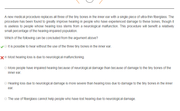
A new medical procedure replaces all three of the tiny bones in the inner ear with a single piece of ultra-thin fiberglass. The procedure has been found to greatly improve hearing in people who have experienced damage to these bones, though it is useless to people whose hearing loss stems from a neurological malfunction. This procedure will benefit a relatively small percentage of the hearing-impaired population

Which of the following can be concluded from the argument above?

A)It is possible to hear without the use of the three tiny bones in the inner ear.
B)Most hearing loss is due to neurological malfunctioning.
C)More people have impaired hearing because of neurological damage than because of damage to the tiny bones of the inner ear.
D)Hearing loss due to neurological damage is more severe than hearing loss due to damage to the tiny bones in the inner ear.
E)The use of fiberglass cannot help people who have lost hearing due to neurological damage.
Veritas Prep | GMAT Instructor

Veritas Prep Reviews
Save $100 off any live Veritas Prep GMAT Course
Join the discussion

by David@VeritasPrep » Sat Sep 13, 2014 5:06 pm
Notice that the question stem says "Which of the following can be concluded from the argument above?"

This is an inference question. Which means that you are looking for the answer choice that must be true.

If we look at choices B and C that you favored, you can see that these are not "must be true."

Choice B "Most hearing loss is due to neurological malfunctioning." There is no quantification of causes of hearing loss in the stimulus. It may be true that neurological malfunctioning is the top cause, but then it may also be that the biggest cause of hearing loss is damage from loud noise. The point is that this is not "must be true."

Choice C "More people have impaired hearing because of neurological damage than because of damage to the tiny bones of the inner ear." is wrong for exactly the same reason. There is no indication of the number of people suffering do to the various causes.

Choice A, on the other hand, MUST BE TRUE, "A)It is possible to hear without the use of the three tiny bones in the inner ear."

We know this because the stimulus says, "A new medical procedure replaces all three of the tiny bones in the inner ear with a single piece of ultra-thin fiberglass. The procedure has been found to greatly improve hearing in people who have experienced damage to these bones" If replacing the bones with fiberglass works and people can hear after the surgery it must mean that the 3 tiny bones are not 100% necessary for hearing.

So you see approaching this question as an inference really helps point directly to choice A as the correct answer.
Veritas Prep | GMAT Instructor

Veritas Prep Reviews
Save $100 off any live Veritas Prep GMAT Course
Join the discussion

by binit » Sat Apr 25, 2015 10:52 pm
Thanks David, for the wonderful explanation. I too reached at (A), though my reasoning was to break passage into parts: The passage starts with an introduction to "A new medical procedure replaces all three of the tiny bones in the inner ear with a single piece of ultra-thin fiberglass". The middle part elaborates the success and failure stats of the "new medical procedure". The conclusion: expected to announce some final stand about the new invention.
Choice E was an eyecatcher but E merely repeats a sentence from the passage, so that can't be the conclusion. Choice A only fits our expectation.
Is that reasoning okay? Or I just arrived at the right place with a wrong map?

~Binit.
Join the discussion

















