BREAKING: Target Test Prep releases Brand New 2026 On Demand GMAT prep course

Redeem

Target Test Prep · GMAT

Choose how you want to prepare

Learn live with an expert or move at your own pace. Every option includes the complete TTP study system.

★★★★★5.0559 reviews
GMATLiveTeach 7 seats left
Chris Peckover
NEXT LIVE COHORT

Oct 13 to Jan 7, 2027

with Chris Peckover

Schedule
Tue, Thu · 8:00 to 10:00 PM ET
Included
40 live hours + 6 months of GMAT OnDemand
  • Live instruction and real-time questions
  • Class recordings and assigned practice
View class & enroll
Limited cohort · enrollment openTarget Test Prep
EALiveTeach 5 seats left
Logan Thompson
EXECUTIVE ASSESSMENT

Sep 6 to Dec 6, 2026

with Logan Thompson

Schedule
Sun · 9:30 AM to 12:30 PM ET
Included
Live EA class + 6 months of EA OnDemand
  • Expert-led weekly online sessions
  • EA Masterclass access between classes
View EA class & enroll
Limited cohort · enrollment openTarget Test Prep
GMATOnDemand Start anytime
SELF-PACED MASTERCLASS

Target Test Prep GMAT OnDemand

Complete access from day one. Study on your schedule.

130-point score guarantee
$0to start then $127/mo
  • Personalized study plan and analytics
  • Thousands of lessons and practice questions

Compare the format, schedule, and included access before enrolling. Prices and seat counts shown reflect the supplied offer details.

Verb-ed and Verb-ing modifier

Expert replies
by dassabyasachi14 » Sat Jun 04, 2016 1:43 am
Image


I understand that Verb-ed Modifier modifies the closest noun but Verb-ing modifier can modify closest noun if used without a comma and it modifies the preceding clause if used after a comma. But here I am unable to understand how to get this question right using these concepts. Please Help.

Official Answer- D[/img]
Join the discussion
Source: — Sentence Correction |

by MartyMurray » Sat Jun 04, 2016 3:52 am
dassabyasachi14 wrote:I understand that Verb-ed Modifier modifies the closest noun but Verb-ing modifier can modify closest noun if used without a comma and it modifies the preceding clause if used after a comma. But here I am unable to understand how to get this question right using these concepts. Please Help.
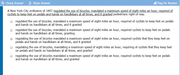
A New York City ordinance of 1897 regulated the use of bicycles, mandated a maximum speed of eight miles an hour, required of cyclists to keep feet on pedals and hands on handlebars at all times, and it granted pedestrians right-of-way.

(A) regulated the use of bicycles, mandated a maximum speed of eight miles an hour, required of cyclists to keep feet on pedals and hands on handlebars at all times, and it granted

This version does not have any participle, or verb-ing or verb-ed, modifiers. regulated, mandated, required and granted are all items in a list of main verbs of the sentence.

There are flaws in this version though.

First, required of cyclists to keep is not idiomatically correct. The idiomatically correct version is required cyclists to keep.

Also, it granted does not match the other parts of the list. regulated, mandated and required go with the subject ordinance, but suddenly granted has it for a subject. The resulting list is not parallel.


(B) regulated the use of bicycles, mandated a maximum speed of eight miles an hour, required cyclists to keep feet on pedals and hands on handlebars at all times, granting

In this version there is once again an issue in the list. There is no and in the list. Rather the list includes regulated, mandated, and required, without an and, and then jumps to the use of participle modifier granting.

(C) regulating the use of bicycles mandated a maximum speed of eight miles an hour, required cyclists that they keep feet on pedals and hands on handlebars at all times, and it granted

In this version the meaning is actually improved via the change of regulated, a verb, to regulating, a participle modifier modifying ordinance.

There are issues however. required cyclists that they keep is not idiomatically correct, and once again the use of it before granted results in the creation of a non parallel list.


(D) regulating the use of bicycles, mandating a maximum speed of eight miles an hour, requiring of cyclists that they keep feet on pedals and hands on handlebars at all times, and granted

In this version the list is changed from a list of main verbs to a list of participle modifiers. The problem is that now there is no main verb, well unless you call granted the main verb, but granted is part of the list. So the list, since it includes three participle modifiers, regulating, mandating and requiring, and one verb, granted, is not parallel.

(E) regulating the use of bicycles mandated a maximum speed of eight miles an hour, required cyclists to keep feet on pedals and hands on handlebars at all times, and granted

This version starts off by correctly using regulating to modify ordinance. Then it continues with an idiomatically correct, parallel list of main verbs.

The correct answer is E.
Marty Murray
Perfect Scoring Tutor With Over a Decade of Experience
MartyMurrayCoaching.com
Contact me at [email protected] for a free consultation.
Join the discussion

by dassabyasachi14 » Sat Jun 04, 2016 5:57 am
Thanks Marty for your prompt response and giving an explanation to this question. I have a small doubt though.

From your explanation, I understood that here the list of verbs- mandated, required and regulated are used as main verbs and not as verb-ed modifier. Is there any way to understand where verb-ed modifier is used and where a main verb is used??

Thanks!!
Join the discussion

by MartyMurray » Sat Jun 04, 2016 7:26 am
dassabyasachi14 wrote:Thanks Marty for your prompt response and giving an explanation to this question. I have a small doubt though.

From your explanation, I understood that here the list of verbs- mandated, required and regulated are used as main verbs and not as verb-ed modifier. Is there any way to understand where verb-ed modifier is used and where a main verb is used??

Thanks!!
Since the words themselves look the same whether they serve as verbs or verb-ed modifiers, in order to determine whether a particular verb form word that ends in ed is serving as a verb or a modifier you have to consider placement, structure and, maybe most importantly, meaning.

For one thing, the fact that you are seeing a sentence in the GMAT verbal section does not mean that suddenly you should handle that sentence as if it's from some alien world and therefore none of the normal things having to do with sentences matter.

Often people doing GMAT SC questions don't even look at the sentences as sentences. They look at little bits of the sentences, seeking to find specific errors.

To score high on GMAT SC, look at the entire sentences end to end and determine whether in the real world they are effective.

In the real world you know the difference between the main verb of a sentence and the modifiers in a sentence. The verb is what's going on. The modifiers describe things.

That having been said, here are some specific things that you could notice.

- Verb-ed modifiers often come before rather than after the word that they modify.

The freshly washed vegetables sat on the counter.

- Verb-ed modifiers that are non restrictive and that come after a noun are separated from what they modify by commas.

John's bike , now repaired and painted, worked as if it were brand new.

- In a sentence in which the word ending in ed is the main verb, the word can't be a modifier, because there will be no verb.

Sasha, having missed a key deadline, berated the man who had forgotten to deliver the package.

A verb-ed modifier will often be followed by by. This one is restrictive. So notice that there is no comma between the modifier and what it modifies.

The water tainted by plastic related chemicals was discarded.

Marty Murray
Perfect Scoring Tutor With Over a Decade of Experience
MartyMurrayCoaching.com
Contact me at [email protected] for a free consultation.
Join the discussion

by GMATGuruNY » Sun Jun 05, 2016 2:11 am
A New York City ordinance of 1897 regulated the use of bicycles, mandated a maximum speed of eight miles an hour, required of cyclists to keep feet on pedals and hands on handlebars at all times, and it granted pedestrians right-of-way.

A. regulated the use of bicycles, mandated a maximum speed of eight miles an hour, required of cyclists to keep feet on pedals and hands on handlebars at all times, and it granted

B. regulated the use of bicycles, mandated a maximum speed of eight miles an hour, required cyclists to keep feet on pedals and hands on handlebars at all times, granting

C. regulating the use of bicycles mandated a maximum speed of eight miles an hour, required cyclists that they keep feet on pedals and hands on handlebars at all times, and it granted

D. regulating the use of bicycles, mandating a maximum speed of eight miles an hour, requiring of cyclists that they keep feet on pedals and hands on handlebars at all times, and granted

E. regulating the use of bicycles mandated a maximum speed of eight miles an hour, required cyclists to keep feet on pedals and hands on handlebars at all times, and granted
PARALLEL FORMS must serve the SAME FUNCTION.

A and B: A New York City ordinance of 1897 regulated the use of bicycles, mandated a maximum speed of eight miles an hour, required....
D: A New York City ordinance of 1897 regulating the use of bicycles, mandating a maximum speed of eight miles an hour, requiring...
In these options, the red portions and the blue portions are parallel, implying that both portions serve the same function.
Not so.
In each case, the blue portion serves to give EXAMPLES of the red portion (the regulating of bike use).
Since the red portions and the blue portions do not serve the same function, the parallelism is illogical and does not convey the intended meaning.
Eliminate A, B and D.

C: required cyclists that they keep
Here, they and cyclists are redundant.
Correct:
required cyclists to keep
required that cyclists keep


The correct answer is E.
Private tutor exclusively for the GMAT and GRE, with over 20 years of experience.
Followed here and elsewhere by over 1900 test-takers.
I have worked with students based in the US, Australia, Taiwan, China, Tajikistan, Kuwait, Saudi Arabia -- a long list of countries.
My students have been admitted to HBS, CBS, Tuck, Yale, Stern, Fuqua -- a long list of top programs.

As a tutor, I don't simply teach you how I would approach problems.
I unlock the best way for YOU to solve problems.

For more information, please email me (Mitch Hunt) at [email protected].
Student Review #1
Student Review #2
Student Review #3
Join the discussion

• Page 1 of 1