BREAKING: Target Test Prep releases Brand New 2026 On Demand GMAT prep course

Redeem


Value of s

Expert replies
Source: — Problem Solving |

by Brent@GMATPrepNow » Mon Dec 07, 2015 6:16 pm
Image

In the figure above, points P and Q lie on the circle with center O. What is the value of S?

a) 1/2
b) 1
c) √2
d) √3
e) (√2)/2
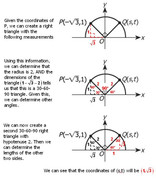
Here's one approach:
Image

So, s = 1
Answer: B

Cheers,
Brent
Brent Hanneson - Creator of GMATPrepNow.com
Image
Join the discussion

by MartyMurray » Mon Dec 07, 2015 6:55 pm
vrn2vw wrote:Image

In the figure above, points P and Q lie on the circle with center O. What is the value of s?

a) 1/2
b) 1
c) √2
d) √3
e) (√2)/2
The slopes of perpendicular lines are the negative reciprocals of each other.

So the slope of segment OQ is the negative reciprocal of the slope of segment OP.

Since point O is the origin, and has coordinates (0, 0), we can easily calculate the slope of OP, which is -1/√3. So the slope of OQ is √3/1.

Since OP and OQ are both radii of a circle, they are the same length.

So, if OP goes across -√3 and up 1 in that length, then OQ, which lies in the first quadrant and has a slope the negative reciprocal of the slope of OP, must go across 1 and up √3.

So the correct answer is B.
Marty Murray
Perfect Scoring Tutor With Over a Decade of Experience
MartyMurrayCoaching.com
Contact me at [email protected] for a free consultation.
Join the discussion

by ararjun » Tue Dec 08, 2015 7:31 pm
I took the long road using the distance formula

Since OPQ is a right triangle

OP^2 + OQ^2 = PQ^2
(√3^2 + 1^2) + (s^2 + t^2) = (s + √3)^2 + (t - 1)^2
4 + s^2 + t^2 = (s^2 + 3 + 2s√3) + (t^2 + 1 - 2t)
0 = 2s√3 - 2t
s√3 = t
s/t = 1/√3
s = 1

Answer B
Join the discussion

by [email protected] » Tue Dec 08, 2015 10:31 pm
Hi vrn2vw,

Brent's approach to solving this question is exactly how I would have done it, so I won't rehash that explanation. Instead I'll point out the patterns and "hints" that were in the original drawing (and that you should be on the lookout for when dealing with similar questions).

1) Any time you see a diagonal line segment on a graph, you can draw a right triangle using that line as the hypoteneuse.

2) Right triangles on the GMAT are almost always pattern-based (angles or sides; at the very least, the Pythagorean Theorem). Here, we have a 1 and a √3, so we should be thinking 30/60/90.

3) Radii have the same length no matter what direction they go in.

4) Lines "add up" to 180 degrees.

GMAT assassins aren't born, they're made,
Rich
Last edited by [email protected] on Wed Dec 09, 2015 10:00 am, edited 1 time in total.
Contact Rich at [email protected]
Image
Join the discussion

by Brent@GMATPrepNow » Wed Dec 09, 2015 7:44 am
[email protected] wrote:
Brent's approach to solving this question is exactly how I wouldn't have done it, so I .....
I think/hope you mean "would" :-)
Brent Hanneson - Creator of GMATPrepNow.com
Image
Join the discussion

by [email protected] » Wed Dec 09, 2015 10:04 am
Hi Brent,

HA. Yes, I did mean 'would' - I was clearly typing too fast!

GMAT assassins aren't born, they're made,
Rich
Contact Rich at [email protected]
Image
Join the discussion

by Matt@VeritasPrep » Fri Dec 11, 2015 2:47 pm
If I had a nickel for every time I've done that ...

You haven't lived until you've written 2 + 2 = 22 on a board in front of 20+ talented students who've paid over $1000 to take your class! ._.
Join the discussion