BREAKING: Target Test Prep releases Brand New 2026 On Demand GMAT prep course

Redeem

Right Circular Cone

Expert replies
by stevennu » Sat Jun 08, 2013 8:08 pm
I know there are solutions to this question posted https://www.beatthegmat.com/cone-is-insc ... 33925.html, however I have a follow-up clarifying question.

A right circular cone is inscribed in a hemisphere so that the base of the cone coincides with the base of the hemisphere. What is the ratio of the height of the cone to the radius of the hemisphere?

Answer is 1:1

My question is, if you have a cone with a radius of 5 and a height of 1, how could the ratio be 1:1? You could have a very wide and short hemisphere. Am I missing something with regards to the cone being designated as a "right circular cone"? Can someone please explain?
Join the discussion
Source: — Problem Solving |

by stevennu » Sat Jun 08, 2013 8:21 pm
I believe I just figured it out. One of the properties of a sphere is that it is perfectly symmetrical. As such, the radius will also equal the height. If you have a right cone inscribed inside the hemisphere, the height of the cone will equal the radius of the hemisphere due to the symmetrical properties of spheres and hemispheres.

Is that right?
Join the discussion

by GMATGuruNY » Sat Jun 08, 2013 8:43 pm
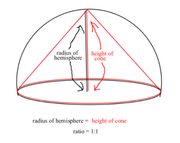
Draw the figure:

Image

As the figure illustrates, the height of the cone = the radius of the hemisphere.
Thus:
(height of cone) : (radius of hemisphere) = 1:1.
Private tutor exclusively for the GMAT and GRE, with over 20 years of experience.
Followed here and elsewhere by over 1900 test-takers.
I have worked with students based in the US, Australia, Taiwan, China, Tajikistan, Kuwait, Saudi Arabia -- a long list of countries.
My students have been admitted to HBS, CBS, Tuck, Yale, Stern, Fuqua -- a long list of top programs.

As a tutor, I don't simply teach you how I would approach problems.
I unlock the best way for YOU to solve problems.

For more information, please email me (Mitch Hunt) at [email protected].
Student Review #1
Student Review #2
Student Review #3
Join the discussion

by inigohrey » Sat Jun 17, 2017 11:37 am
I don't know if necroing is allowed on Beat The GMAT, feel free to delete my post and I'll make another one if required.

This explanation isn't sufficient to me. It doesn't address the OP's question: what in the formulation of the question prevents a cone with a base of radius r and a height of h where h≠r? Is it the fact that it is inscribed? If so, what does inscribed actually mean in this context?
Join the discussion

by DavidG@VeritasPrep » Sat Jun 17, 2017 11:56 am
This explanation isn't sufficient to me. It doesn't address the OP's question: what in the formulation of the question prevents a cone with a base of radius r and a height of h where h≠r? Is it the fact that it is inscribed? If so, what does inscribed actually mean in this context?
You answered your own question :) Yes, it's the fact that the cone is inscribed that necessitates that h = r. "Inscribed" simply means that one figure is inside of another and that the two figures are touching at as many points as possible.

Veritas Prep | GMAT Instructor

Veritas Prep Reviews
Save $100 off any live Veritas Prep GMAT Course
Join the discussion

by inigohrey » Sat Jun 17, 2017 12:08 pm
and that the two figures are touching at as many points as possible
That's the part I was missing, thank you very much :D
Join the discussion

by Matt@VeritasPrep » Thu Jun 22, 2017 10:05 pm
inigohrey wrote:I don't know if necroing is allowed on Beat The GMAT, feel free to delete my post and I'll make another one if required.

This explanation isn't sufficient to me. It doesn't address the OP's question: what in the formulation of the question prevents a cone with a base of radius r and a height of h where h≠r? Is it the fact that it is inscribed? If so, what does inscribed actually mean in this context?
In the 2D world, a polygon inscribed in a circle has each vertex on that circle's circumference, while a circle inscribed in a polygon is tangent to each side of the polygon. (See some images here.)

From there, you can probably guess how to generalize this to 3D, 4D, etc.
Join the discussion

by Matt@VeritasPrep » Thu Jun 22, 2017 10:05 pm
inigohrey wrote:I don't know if necroing is allowed on Beat The GMAT, feel free to delete my post and I'll make another one if required.
It's definitely allowed, at least in practice - it seems to happen almost every day.
Join the discussion

by Matt@VeritasPrep » Thu Jun 22, 2017 10:12 pm
I almost forgot the most salient point (no pun intended): cones are the white whale of the GMAT. I've heard them mentioned and seen them in problems from a few test prep providers, but I've never seen an official problem that required you to know anything specific to cones. (I can't even remember seeing one that involved cones at all, but I'm sure someone here can correct me.)
Join the discussion