
BREAKING: Target Test Prep releases Brand New 2026 On Demand GMAT prep course

Redeem

region enclosed by the y-axis

Expert replies
by TheAnuja55 » Wed Nov 07, 2012 10:31 pm
12. If the region enclosed by the y-axis, the line y=2 , and the curve y=sqrt(2) is revolved about the y-axis, the volume of the solid generated is

(A) 32PI/5
(B) 16PI/3
(C) 16PI/5
(D) 8PI/3
(E) PI
Join the discussion
Source: — Problem Solving |

by FLUID » Wed Nov 07, 2012 11:39 pm
TheAnuja55 wrote:12. If the region enclosed by the y-axis, the line y=2 , and the curve y=sqrt(2) is revolved about the y-axis, the volume of the solid generated is

(A) 32PI/5
(B) 16PI/3
(C) 16PI/5
(D) 8PI/3
(E) PI
I am thinking it would be a Hemisphere with radius 2.

=> 2/3 * pi * (2)^3 = 16PI/3 (Choice B).

can you comment on right answer
Thanks,

"Take Risks in Your Life.
If you Win, you can Lead!
If you Loose, you can Guide!".
Join the discussion

by jkaustubh » Thu Nov 08, 2012 1:28 am
TheAnuja55 wrote:12. If the region enclosed by the y-axis, the line y=2 , and the curve y=sqrt(2) is revolved about the y-axis, the volume of the solid generated is

(A) 32PI/5
(B) 16PI/3
(C) 16PI/5
(D) 8PI/3
(E) PI
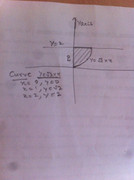
I think there is some information missing in the question

Y axis is X=0

Y=2 and Y=sqrt(2) both are straight lines.

these three lines don't form any enclosed region.

Please clarify.
Join the discussion

by TheAnuja55 » Thu Nov 08, 2012 1:34 am
Sorry, I don't have the right answer for this, this is y I posted, to get to know.
Join the discussion

by jkaustubh » Thu Nov 08, 2012 2:02 am
TheAnuja55 wrote:Sorry, I don't have the right answer for this, this is y I posted, to get to know.
But my question is...

Y=2 and Y=sqrt(2) both are straight lines.
also the Y axis dont have any enclosed boundry.

Then how can three infinite lines with no enclosed boundary, form a three dimensional space with finite volume on rotation along the Y axis.

Hope you understand my question.
Join the discussion

by TheAnuja55 » Thu Nov 08, 2012 5:07 am
jkaustubh wrote:
TheAnuja55 wrote:Sorry, I don't have the right answer for this, this is y I posted, to get to know.
But my question is...

Y=2 and Y=sqrt(2) both are straight lines.
also the Y axis don't have any enclosed boundary.

Then how can three infinite lines with no enclosed boundary, form a three dimensional space with finite volume on rotation along the Y axis.

Hope you understand my question.
Yes, there are only two infinite lines, which never gonna enclose the boundaries. So I found that question flawed. But this was given in the list of 700+ questions from gmatclub, that's why I needed opinion about it.
Join the discussion

by Brent@GMATPrepNow » Thu Nov 08, 2012 6:58 am
This looks like a classic integral calculus question (unless I'm missing something).
As such, it is WAYYYYYYYYYYYYYYYYYYYY out of scope for the GMAT.
I suggest that you ignore this question and move on to questions that you may actually see on test day.

Cheers,
Brent
Brent Hanneson - Creator of GMATPrepNow.com
Image
Join the discussion

by jkaustubh » Thu Nov 08, 2012 10:43 am
Brent@GMATPrepNow wrote:This looks like a classic integral calculus question (unless I'm missing something).
As such, it is WAYYYYYYYYYYYYYYYYYYYY out of scope for the GMAT.
I suggest that you ignore this question and move on to questions that you may actually see on test day.

Cheers,
Brent
Hi Brent,

Can you put some light on the question, I mean what should one do if one gets such a question??

Also, if we consider a small part of width dx...located at a distance x from the Y axis then we need to integrate the following expression from -infinite to +infinite:


pi*h*x*x*dx

on integrating we get

[pi*h*(x^3)/3] with limits as -infinite to +infinite.

how to proceed from here??

Thanks
KJ
Last edited by jkaustubh on Thu Nov 08, 2012 10:50 am, edited 1 time in total.
Join the discussion

by Brent@GMATPrepNow » Thu Nov 08, 2012 10:45 am
jkaustubh wrote:
Brent@GMATPrepNow wrote:This looks like a classic integral calculus question (unless I'm missing something).
As such, it is WAYYYYYYYYYYYYYYYYYYYY out of scope for the GMAT.
I suggest that you ignore this question and move on to questions that you may actually see on test day.

Cheers,
Brent
Hi Brent,

Can you put some light on the question, I mean what should one do if one gets such a question??

Thanks
KJ
Hi KJ,

My point in all of this is that you won't get a question like this on the GMAT. The skills required to solve this question are beyond the scope of the GMAT.

Cheers,
Brent
Brent Hanneson - Creator of GMATPrepNow.com
Image
Join the discussion

by cwilliams66 » Thu Apr 21, 2016 9:58 am
jkaustubh wrote:
TheAnuja55 wrote:12. If the region enclosed by the y-axis, the line y=2 , and the curve y=sqrt(2) is revolved about the y-axis, the volume of the solid generated is

(A) 32PI/5
(B) 16PI/3
(C) 16PI/5
(D) 8PI/3
(E) PI

I think there is some information missing in the question

Y axis is X=0

Y=2 and Y=sqrt(2) both are straight lines.

these three lines don't form any enclosed region.

Please clarify.
y=sqrt(2) is not a straight line. There is an enclosed region formed and you have to use the calculus equation for the revolution of shapes in terms of Y (since it is revolved around the y-axis). Volume of the solid = pi x INTEGRAL(from 0 to 2) of (y^2)^2 dy and it will give you answer A. 32pi/5
Join the discussion

by regor60 » Thu Apr 21, 2016 10:19 am
cwilliams66 wrote:


y=sqrt(2) is not a straight line. There is an enclosed region formed and you have to use the calculus equation for the revolution of shapes in terms of Y (since it is revolved around the y-axis). Volume of the solid = pi x INTEGRAL(from 0 to 2) of (y^2)^2 dy and it will give you answer A. 32pi/5
If you were asked to plot x= sqrt(2) what would it look like ?
Join the discussion

by regor60 » Thu Apr 21, 2016 10:23 am
Let me help you out:

https://www4f.wolframalpha.com/Calculat ... ge/gif&s=8

This is a plot of y=sqrt(2) from Wolfram Alpha
Join the discussion

by cwilliams66 » Thu Apr 21, 2016 8:55 pm
regor60 wrote:Let me help you out:

https://www4f.wolframalpha.com/Calculat ... ge/gif&s=8

This is a plot of y=sqrt(2) from Wolfram Alpha
Ahhh yes, my (embarassing) mistake. I was reading the question off of my worksheet which says y= sqrt(x) rather than sqrt(2) as suggested in this post.. Now I understand the confusion. I believe the problem was supposed to read sqrt(x) and not sqrt(2). Thanks for calling out my mistake.
Join the discussion

by chetan.sharma » Fri Apr 22, 2016 7:25 pm
TheAnuja55 wrote:12. If the region enclosed by the y-axis, the line y=2 , and the curve y=sqrt(2) is revolved about the y-axis, the volume of the solid generated is

(A) 32PI/5
(B) 16PI/3
(C) 16PI/5
(D) 8PI/3
(E) PI
Hi,
firstly the Q is incomplete as also mentioned above by kaustabh..
y=square root 2, is not a curve..
I believe it should be y = sqroot2 * x...
so, when you draw the three lines..
one end is y-axis..
second end is y=2
and third is curve y= sqroot2*x..

Image

so answer is 1/4 of a sphere..
ans is 1/3 pi r^3 = 8/3 pi r^3
Join the discussion
















