BREAKING: Target Test Prep releases Brand New 2026 On Demand GMAT prep course

Redeem

Problem with possible use for venn diagrams !!

Expert replies
by utkalnayak » Wed Jan 21, 2015 11:17 am
At a certain dealership, every car on the lot has at least one of the three modest options: windows, brakes and radio. 40 cars have windows, 30 have brakes, and 50 have a radio. 21 cars have brakes and radio, 13 have windows and brakes. 17 have windows and radio. If 11 cars have all 3 options, what is the total number of cars on the lot ?

A. 69
B. 70
C. 80
D. 91
E. 120

OA: C

Why can we not apply the following formula on the above problem? Are the numbers given in the problem statement not calculated accurately ?

(A + B + C ) = A + B + C - (AB + BC + CA) - 2(ABC)
Join the discussion
Source: — Problem Solving |

by GMATGuruNY » Wed Jan 21, 2015 11:46 am
utkalnayak wrote:At a certain dealership, every car on the lot has at least one of the three modest options: windows, brakes and radio. 40 cars have windows, 30 have brakes, and 50 have a radio. 21 cars have brakes and radio, 13 have windows and brakes. 17 have windows and radio. If 11 cars have all 3 options, what is the total number of cars on the lot ?

A. 69
B. 70
C. 80
D. 91
E. 120
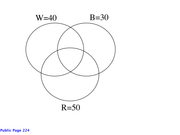
Draw a VENN DIAGRAM representing the following:
40 cars have windows.
30 cars have brakes.
50 cars have radios
.
Image

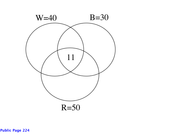
Complete the Venn diagram by working from the INSIDE OUT.

11 cars have all 3 options.
Image

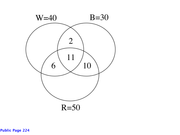
21 cars have brakes and radio.
13 have windows and brakes.
17 have windows and radio.

Subtracting from these figures the 11 cars with all 3 options, we get:
Image

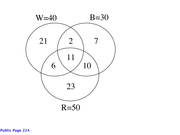
Subtracting the values in the diagram from W=40, B=30, and R=50, we get:
Image

What is the total number of cars on the lot?
Adding together the values in the Venn Diagram, we get:
T = 21+2+7+6+11+10+23 = 80.

The correct answer is C.
Why can we not apply the following formula on the above problem? Are the numbers given in the problem statement not calculated accurately ?

(A + B + C ) = A + B + C - (AB + BC + CA) - 2(ABC)
In this formula:
AB = the elements in ONLY A AND B.
BC = the elements in ONLY B AND C.
CA = the elements in ONLY C AND A.
The prompt does not provide these values.

In the prompt:
The 21 cars with brakes and radio include both the cars with ONLY brakes and radio AND the cars will ALL 3 OPTIONS.
The 13 cars with windows and brakes include both the cars with ONLY windows and brakes AND the cars will ALL 3 OPTIONS.
The 17 cars with windows and radio include both the cars with ONLY windows and radio AND the cars will ALL 3 OPTIONS.

For this reason, I would solve with a Venn Diagram, as shown above.
Private tutor exclusively for the GMAT and GRE, with over 20 years of experience.
Followed here and elsewhere by over 1900 test-takers.
I have worked with students based in the US, Australia, Taiwan, China, Tajikistan, Kuwait, Saudi Arabia -- a long list of countries.
My students have been admitted to HBS, CBS, Tuck, Yale, Stern, Fuqua -- a long list of top programs.

As a tutor, I don't simply teach you how I would approach problems.
I unlock the best way for YOU to solve problems.

For more information, please email me (Mitch Hunt) at [email protected].
Student Review #1
Student Review #2
Student Review #3
Join the discussion

by GMATGuruNY » Wed Jan 21, 2015 12:03 pm
utkalnayak wrote:At a certain dealership, every car on the lot has at least one of the three modest options: windows, brakes and radio. 40 cars have windows, 30 have brakes, and 50 have a radio. 21 cars have brakes and radio, 13 have windows and brakes. 17 have windows and radio. If 11 cars have all 3 options, what is the total number of cars on the lot ?

A. 69
B. 70
C. 80
D. 91
E. 120
An alternate approach is to use the following formula:
T = (everyone in at least 1 group) - (everyone in at least 2 groups) + (everyone in all 3 groups).

In the problem above:
At least 1 group = windows + brakes + radio = 40 + 30 + 50.
At least 2 groups = (brakes and radio) + (windows and brakes) + (windows and radio) = 21 + 13 + 17.
All 3 groups = 11.

Plugging these values in the formula, we get:
T = (40 + 30 + 50) - (21 + 13 + 17) + 11 = 120 - 51 + 11 = 80.

The correct answer is C.
Private tutor exclusively for the GMAT and GRE, with over 20 years of experience.
Followed here and elsewhere by over 1900 test-takers.
I have worked with students based in the US, Australia, Taiwan, China, Tajikistan, Kuwait, Saudi Arabia -- a long list of countries.
My students have been admitted to HBS, CBS, Tuck, Yale, Stern, Fuqua -- a long list of top programs.

As a tutor, I don't simply teach you how I would approach problems.
I unlock the best way for YOU to solve problems.

For more information, please email me (Mitch Hunt) at [email protected].
Student Review #1
Student Review #2
Student Review #3

Join the discussion

by utkalnayak » Wed Jan 21, 2015 1:30 pm
GMATGuruNY wrote: An alternate approach is to use the following formula:
T = (everyone in at least 1 group) - (everyone in at least 2 groups) + (everyone in all 3 groups).

In the problem above:
At least 1 group = windows + brakes + radio = 40 + 30 + 50.
At least 2 groups = (brakes and radio) + (windows and brakes) + (windows and radio) = 21 + 13 + 17.
All 3 groups = 11.

Plugging these values in the formula, we get:
T = (40 + 30 + 50) - (21 + 13 + 17) + 11 = 120 - 51 + 11 = 80.

The correct answer is C.
Thank you Mitch. Some how it did not occur to me that the AB, BC and CA numbers are also including the value of ABC, how did you figure that out from the question? it does not say explicitly.
Join the discussion

by GMATGuruNY » Thu Jan 22, 2015 3:39 am
utkalnayak wrote: Thank you Mitch. Some how it did not occur to me that the AB, BC and CA numbers are also including the value of ABC, how did you figure that out from the question? it does not say explicitly.
If a data point is constrained to only one or two of the three groups, the wording will make the intent crystal clear:
15 people have visited ONLY Japan.
10 students study chemistry and history BUT NOT language arts.

12 members are in EXACTLY TWO clubs.

No such wording appears in the posted problem.
Thus:
The 21 cars that have brakes and radio are composed of the cars with ONLY brakes and a radio AND those will ALL 3 OPTIONS.
The 13 cars that have windows and brakes are composed of the cars with ONLY windows and brakes AND those will ALL 3 OPTIONS.
The 17 cars that have windows and radio are composed of the cars with ONLY windows and a radio AND those will ALL 3 OPTIONS.

Important:
Under no circumstances should you buy a car from this dealership.
Any dealership willing to sell a car WITHOUT brakes is not to be trusted.
Private tutor exclusively for the GMAT and GRE, with over 20 years of experience.
Followed here and elsewhere by over 1900 test-takers.
I have worked with students based in the US, Australia, Taiwan, China, Tajikistan, Kuwait, Saudi Arabia -- a long list of countries.
My students have been admitted to HBS, CBS, Tuck, Yale, Stern, Fuqua -- a long list of top programs.

As a tutor, I don't simply teach you how I would approach problems.
I unlock the best way for YOU to solve problems.

For more information, please email me (Mitch Hunt) at [email protected].
Student Review #1
Student Review #2
Student Review #3
Join the discussion

by Matt@VeritasPrep » Sun Jan 25, 2015 3:50 pm
GMATGuruNY wrote: Important:
Under no circumstances should you buy a car from this dealership.
Any dealership willing to sell a car WITHOUT brakes is not to be trusted.
... and anyone unable to make that last deduction is a strong contender for a Darwin Award. :D
Join the discussion