AIM TO CRACK GMAT wrote:A square wooden plaque has a square brass inlay in the centre, leaving a wooden strip of uniform width around the brass square. If the ratio of the brass area to the wooden area is 25 to 39, which of the following could be the width in inches of the woooden strip?
A) 1
B) 3
C) 4
i) A only
ii) B only
iii) A and B only
iv) A and C only
v) A, B and C
Hi AIM TO CRACK GMAT!
This is a fairly tricky problem and the ease will depend on HOW we set it up. So let's think about the picture of this scenario.
We have a choice to make.
Option 1:
We can define the dimensions of the small brass inlay as (b), and then add some unknown (x) to all sides for the width of the border and then use that new measure for the large plaque:
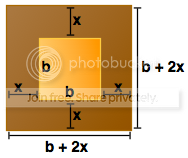
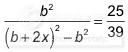
But our ratio between the area of the brass inlay (b^2) and the area of the border is difficult because we have to define the area of that border region. And it would be the difference between the area of the larger wooden square (b+2x)^2 and the brass inlay (b^2).
 Option 2:
Or we can define the dimensions of the small brass inlay as (b) and the dimensions of the outer plaque as (p):
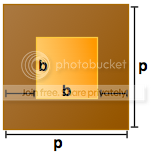
In this case our ratio between the area of the brass inlay (b^2) and the area of the border (which is the area of the large area (p^2) minus the area of the brass inlay (b^2)) would be:

And the width of the border (x) would be half of the difference between the dimension of the big and small squares (p-b)/2.
Which do we choose??
So which of these is easier to deal with? Well, solving for the ratio in the first case would involve squaring the binomial (b+2x) so that might get ugly. Might be nice to see if we can simplify the ratio in the second equation simply by cross-multiplying and combining like terms:
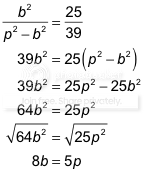
So we see that we get a relationship between the dimensions of 8b=5p, or that at long as b=(5/8)p, our ratio works out. So what does this mean for the possible widths of the wooden strip? Because the problem never specifies that all measurements are integers, we can show that ANY positive value will work as the width of the border - it will just depend on the sides of plaque and brass inlay we choose.
Remember that what we want to find is the width = (p-b)/2. Sub in for b...
(p-(5/8)p)/2 = [(3/8)p]/2 = (3/16)p.
So as long as the border values given can be equal to (3/16)p for SOME value of p, we are fine (so we can choose any of them -
the answer is E.)
But to prove it:
x=(3/16)p
can x=1?
1=(3/16)p ... p=16/3 (so if the outer dimension is 16/3 and the inner is b=(5/8)(p)=(5/8)(16/3) = 10/3, the width of the wooden strip could equal 1)
can x=3?
3=(3/16)p ... p=16 (so if the outer dimension is 16 and the inner is b=(5/8)(p)=(5/8)(16) = 10, the width of the wooden strip could equal 3)
can x=4?
4=(3/16)p ... p=64/3 (so if the outer dimension is 64/3 and the inner is b=(5/8)(p)=(5/8)(64/3) = 40/3, the width of the wooden strip could equal 4)
Hope this helps!

Whit