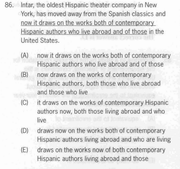
Choices B, D, and E, which remove the unnecessary pronoun "it" as Vivian said, have differences in their approach to what is being drawn upon. In the original sentence, the meaning is 'both of those who live abroad and of those in the US.' This is awkward with a double used "of", and is more easily written 'draws on authors, who live both abroad and in the US.' Choice B most recognizably follows this pattern. However, there are other obvious flaws with D and E.
Choice D begins with "draws now on", which is more awkward than 'now draws on,' and ends with 'both of authors living abroad and who are living in the US.' This structure implies that it draws on both Authors and 'something else.' The difference is between the authors, not two sources.
Choice E again implies that two sources are drawn upon, but this option at least informs us that it's those living abroad and those living in the US that are being compared. However it does not simplify to our original prediction of authors with a difference between them. It also say "draws on the works now" which is even more awkward than Choice D about 'now draws on.'
Choice B is the only option that implies Intar draws on authors, abroad and in the US, while other choices imply that Intar draws on both authors and something else.