BREAKING: Target Test Prep releases Brand New 2026 On Demand GMAT prep course

Redeem

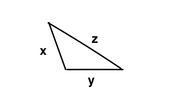
OG Is the area of the triangular region above less than 20?

Expert replies
by AbeNeedsAnswers » Sat Aug 19, 2017 2:25 pm

Timer

00:00

Answers

A

B

C

D

E

Stats

Difficulty

Image

Is the area of the triangular region above less than 20?

(1) x^2 + y^2 not= z^2
(2) x + y < 13

E
Join the discussion
Source: — Data Sufficiency |

by Scott@TargetTestPrep » Thu Nov 16, 2017 7:19 am
AbeNeedsAnswers wrote:Image

Is the area of the triangular region above less than 20?

(1) x^2 + y^2 not= z^2
(2) x + y < 13
We need to determine whether the area of the triangular region is less than 20.

Statement One Alone:

x^2 + y^2 ≠ z^2

Because we don't know anything about the values of x, y, and z, statement one alone is not enough information to answer the question.

Statement Two Alone:

x + y < 13

Again, we can't determine the values of x and y (and z), so statement two alone is not enough information to answer the question.

Statements One and Two Together:

Using both statements, we still can't determine the value of x and y (and z). For example, if we take y as the base of the triangle, we see that the height of the triangle, h, has to be less than x. So, let's say y = 10, x = 2.5, and h = 2; then, the area of the triangle is ½ x 10 x 2 = 10, which is less than 20. However, let's say y = 6.4, x = 6.5, and h = 6.4; then, the area of the triangle is ½ x 6.4 x 6.4 = 20.48, which is greater than 20.

Answer: E

Scott Woodbury-Stewart
Founder and CEO
[email protected]

Image

See why Target Test Prep is rated 5 out of 5 stars on BEAT the GMAT. Read our reviews

ImageImage
Join the discussion

by [email protected] » Sun May 20, 2018 3:31 pm
Hi All,

We're asked if the area of the triangular region above is LESS than 20. This is a YES/NO question and can be solved by TESTing VALUES and using some specific Geometry rules. When dealing with Geometry questions, it's important to remember that we CANNOT trust the picture. We know that we have a triangle with sides X, Y and Z, but we know NOTHING about the side lengths nor the angles.

1) X^2 + Y^2 ≠ Z^2

Fact 1 tells us that this triangle is NOT a right triangle (if it WAS a right triangle, the X^2 + Y^2 would equal Z^2). However, we don't know anything about the 3 sides, so there's no way to determine whether the area is less than 20, exactly 20 or greater than 20.
Fact 1 is INSUFFICIENT.

2) X + Y < 13

Fact 2 is fairly easy to deal with if the triangle was a right triangle (note: that restriction only applied in Fact 1 - it does not apply here)...
IF we have a right triangle, Y is the base and X is the height and...
Y=10 and X=1, then the area = (1/2)(10)(1) = 5 and the answer to the question is YES
Y= almost 6.5 and X= almost 6.5, then the area = (1/2)(almost 6.5)(almost 6.5) = about 21 and the answer to the question is NO.
Fact 2 is INSUFFICIENT.

Combined, we know:
The triangle is NOT a right triangle
X + Y < 13

Using the work that we did in Fact 2, we have enough proof to answer the question. We know that we don't actually have a right triangle, but we can still make a triangle that is 'really, really close' to being a right triangle, such that the areas would actually be just a tiny bit less than the ones we already calculated:
IF... the triangle is really close to being a right triangle and....
Y=10 and X=1, then the area = (1/2)(10)(1) = a little less than 5 and the answer to the question is YES
Y= almost 6.5 and X= almost 6.5, then the area = (1/2)(almost 6.5)(almost 6.5) = a little less than "about 21" and the answer to the question is NO.
Combined, INSUFFICIENT

Final Answer: E

GMAT assassins aren't born, they're made,
Rich
Contact Rich at [email protected]
Image
Join the discussion

by Scott@TargetTestPrep » Sun Aug 25, 2019 6:09 pm
AbeNeedsAnswers wrote:Image

Is the area of the triangular region above less than 20?

(1) x^2 + y^2 not= z^2
(2) x + y < 13

E

We need to determine whether the area of the triangular region is less than 20.

Statement One Alone:

x^2 + y^2 ≠ z^2

Because we don't know anything about the values of x, y, and z, statement one alone is not enough information to answer the question.

Statement Two Alone:

x + y < 13

Again, we can't determine the values of x and y (and z), so statement two alone is not enough information to answer the question.

Statements One and Two Together:

Using both statements, we still can't determine the value of x and y (and z). For example, if we take y as the base of the triangle, we see that the height of the triangle, h, has to be less than x. So, let's say y = 10, x = 2.5, and h = 2; then, the area of the triangle is ½ x 10 x 2 = 10, which is less than 20. However, let's say y = 6.4, x = 6.5, and h = 6.4; then, the area of the triangle is ½ x 6.4 x 6.4 = 20.48, which is greater than 20.

Answer: E

Scott Woodbury-Stewart
Founder and CEO
[email protected]

Image

See why Target Test Prep is rated 5 out of 5 stars on BEAT the GMAT. Read our reviews

ImageImage
Join the discussion

by Brent@GMATPrepNow » Mon Aug 26, 2019 4:47 am
Looks like you were copying and pasting pretty quickly last night, Scott! <i class="em em-grinning"></i>
Brent Hanneson - Creator of GMATPrepNow.com
Image
Join the discussion

AbeNeedsAnswers wrote:
Sat Aug 19, 2017 2:25 pm
Image

Is the area of the triangular region above less than 20?

(1) x^2 + y^2 not= z^2
(2) x + y < 13

E
To determine the area of the triangle we need its base and height.
1) doesn't give any info about base or height. just tells us that it isn't a right angle triangle.
Statement 1) alone is not sufficient.
2) no usable information about base or height.
Statement 2) alone is also not sufficient.
Combining 1) and 2)
We can't determine the area.
Hence option E is correct.
Join the discussion