BREAKING: Target Test Prep releases Brand New 2026 On Demand GMAT prep course

Redeem

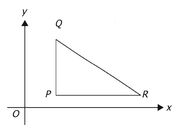
OG In the xy-plane above is angle QPR a right angle

Expert replies
by AbeNeedsAnswers » Sun Aug 20, 2017 9:06 pm

Timer

00:00

Answers

A

B

C

D

E

Stats

Difficulty

Image

In the xy-plane above, is angle QPR a right angle?

(1) Points P and Q have the same x-coordinate.
(2) Points P and R have the same y-coordinate.

C

Join the discussion
Source: — Data Sufficiency |

by uce08 » Mon Oct 02, 2017 8:50 am
AbeNeedsAnswers wrote:Image

In the xy-plane above, is angle QPR a right angle?

(1) Points P and Q have the same x-coordinate.
(2) Points P and R have the same y-coordinate.

C

BOTH ARE NECESARRY
Join the discussion

by ErikaPrepScholar » Tue Oct 03, 2017 10:10 am
Remember: on the GMAT, we cannot trust that figures are drawn accurately. So even though the diagram makes it look like QPR is a right angle, we need to definitively prove it.

Statement 1

If P and Q have the same x-coordinate, we know that P is directly above Q, making PQ parallel to the y-axis and perpendicular to the x-axis. However, this statement tells us nothing about point R. Point R could be directly horizontal from P, making PR parallel to the x-axis, perpendicular to the y-axis, and thus perpendicular to PQ. This would mean that QPR is a right angle. HOWEVER, given that we can't trust the figure to be drawn accurately, point R could be way higher than P (making QPR acute) or way lower than P (making QPR obtuse). We don't know. Insufficient.

Statement 2

If P and R have the same y-coordinate, making PR parallel to the x-axis and perpendicular to the y-axis ... but now we don't know anything about point Q - Q could be far to either the right or left of P, making our angle either acute or obtuse respectively. Insufficient.

BOTH

When we combine the two statements, we have what we need to know: PQ and PR are perpendicular, which means that the angle they form (PQR) is 90 degrees. Sufficient.
Image

Erika John - Content Manager/Lead Instructor
https://gmat.prepscholar.com/gmat/s/

Get tutoring from me or another PrepScholar GMAT expert: https://gmat.prepscholar.com/gmat/s/tutoring/

Learn about our exclusive savings for BTG members (up to 25% off) and our 5 day free trial

Check out our PrepScholar GMAT YouTube channel, and read our expert guides on the PrepScholar GMAT blog
Join the discussion

by [email protected] » Mon Apr 02, 2018 4:06 pm
Hi All,

We're given a triangle in the xy-plane. We're asked if the angle QPR a right angle. This is a YES/NO question. When dealing with pictures in DS questions, it's important to note that the picture is NOT NECESSARILY drawn to scale. Thus, we have to rely on FACTS to answer the given question - and not the picture that we've been given.

1) Points P and Q have the same X-coordinate.

With the information in Fact 1, we know that segment PQ is parallel to the Y-axis (the segment goes 'straight-up-and-down'), but we don't know where point R is relative to this segment, so there's no way to know whether we have a right angle or not.
Fact 1 is INSUFFICIENT

2) Points P and R have the same Y-coordinate.

With the information in Fact 2, we know that segment PR is parallel to the X-axis (the segment goes 'straight-left-to-right'), but we don't know where point Q is relative to this segment, so there's no way to know whether we have a right angle or not.
Fact 2 is INSUFFICIENT

Combined, we know:
-PQ is parallel to the Y-axis
-PR is parallel to the X-axis
By definition, since we have a triangle with legs that are parallel to the 2 axes on a graph (and thus, perpendicular to one another), then we ARE dealing with a right triangle - so the answer to the question is ALWAYS YES.
Combined, SUFFICIENT

Final Answer: C

GMAT assassins aren't born, they're made,
Rich
Contact Rich at [email protected]
Image
Join the discussion