BREAKING: Target Test Prep releases Brand New 2026 On Demand GMAT prep course

Redeem

Target Test Prep · GMAT

Choose how you want to prepare

Learn live with an expert or move at your own pace. Every option includes the complete TTP study system.

★★★★★5.0563 reviews
Newsweek Readers’ Choice Awards 2026 winner: Target Test Prep, #1 Test Prep
NEWSWEEK READERS’ CHOICE AWARDS 2026

Target Test Prep was voted #1 Best Test Prep in the 2026 Newsweek Readers’ Choice™ Awards.

GMATLiveTeach Starts Oct 17
Chris Peckover, Target Test Prep GMAT expert
LIVE ONLINE CLASSES

Get Ready for GMAT Test Day Faster with Live Online Classes

with Chris Peckover, 100th-Percentile GMAT Scorer

Oct 17 · Chris Peckover
Sat · 11:00 AM to 2:00 PM ET
Oct 20 · Chris Peckover
Tue, Thu · 8:00 to 10:00 PM ET
Oct 25 · Josh Braslow
Sun · 1:00 to 4:00 PM ET
Included
40 hours of live online classes + 6 months of TTP OnDemand
  • Attend the first class for free
  • Every class is recorded, so you never fall behind
View classes & enroll
Limited seats availableTarget Test Prep
EALiveTeachOnDemand 5 seats left Start anytime
EXECUTIVE ASSESSMENT

Target Test Prep EA OnDemand

Self-paced EA prep. Study on your schedule.

Logan Thompson
EXECUTIVE ASSESSMENT

Sep 6 to Dec 6, 2026

with Logan Thompson

165+ EA score guarantee
$05-day trial no automatic billing
Schedule
Sun · 9:30 AM to 12:30 PM ET
Included
40 hours of live online classes plus six months of access to the complete TTP EA OnDemand course.
  • 165+ EA Score Guarantee
  • 4,100+ Quant, Verbal, and Integrated Reasoning practice questions
  • 400+ hours of in-depth video lessons
  • 3,000+ step-by-step video solutions
View EA class & enroll Start free 5-day trial
Limited cohort · enrollment openTrial includes full course accessTarget Test Prep
GMATOnDemand Start anytime
SELF-PACED MASTERCLASS

Target Test Prep GMAT OnDemand

Complete access from day one. Study on your schedule.

715+ score guarantee
$0to start then $127/mo
  • Personalized study plan and analytics
  • Thousands of lessons and practice questions

Compare the format, schedule, and included access before enrolling. Prices and seat counts shown reflect the supplied offer details.

Multi-party proposed legislations

Expert replies
by pareekbharat86 » Sun Nov 10, 2013 3:55 am
Multi-party initiatives are becoming increasingly popular among the members of the parliament of Country W. Although legislation proposed under the auspices of more than one party may not adhere as strictly to the agenda of each of the parties involved as legislation proposed by only one party, the political backing of the voting blocs represented by the cooperating parties make such proposals more likely to pass than proposals that come from a single faction alone. The benefit of multi-party initiatives is that legislation important to the general welfare of Country W that might otherwise have foundered in inter-party disagreements can effectively be enacted.

Which of the following statements by a minister of Party C in the government of Country W is most consistent with the beliefs of an individual political party in the situation described above?

a. "Our party would rather compromise on some of our issues and also see other parties compromise on their issues than run the risk of not having legislation that we propose pass."
b. "Our party would rather give up a few minor points of ideology than risk having the issues important to our constituents not be addressed as a result of the government's inability to pass any new laws."
c. "Our party would rather participate in an environment that fosters inter-party cooperation than persist in constant conflict with other parties."
d. "Our party would rather have other parties join in support of our legislation than join in supporting the proposals of other parties."
e. "Our party would rather have our proposals passed because they represent what is best for the welfare of our country than to become engaged in the agendas of other parties."

OA is B. Why not A?

I didn't quite understand the second sentence in the stimulus.
Thanks,
Bharat.
Join the discussion
Source: — Critical Reasoning |

by David@VeritasPrep » Sun Nov 10, 2013 8:52 am
WARNING: There are different versions of question based on the same stimulus. I just found an inference question with the same stimulus. Be sure to look at these answer choices and realize that this may be different than a version of this question that you have seen before.

The second sentence is the key to understanding this problem. It is a quite a sentence!
Although legislation proposed under the auspices of more than one party may not adhere as strictly to the agenda of each of the parties involved as legislation proposed by only one party, the political backing of the voting blocs represented by the cooperating parties make such proposals more likely to pass than proposals that come from a single faction alone.
Basically this means that the legislation will not be exactly what each of the particular parties would have written if they were totally in charge, however, the compromise legislation is much more likely to pass compared to perfect legislation (in the opinion of a party that sponsored the legislation alone) backed by just one party.

This is what leads us to choice B. If the party gives up a few points of ideology on this particular issue then the law might be passed. So it is each issue that is a compromise. This is why the sponsored law is a "multi-party initiative."

Choice A is something called "log-rolling" which is you support my bill and I will support your bill. In this case the compromise is not on each individual bill. Rather the parties take turns passing their legislation and then supporting the other parties as they pass the legislation. These would not be "multi-party initiatives" but rather lots of single-party initiatives from various parties agreeing to support each other's favorite bills.
Veritas Prep | GMAT Instructor

Veritas Prep Reviews
Save $100 off any live Veritas Prep GMAT Course
Join the discussion

by pareekbharat86 » Mon Nov 11, 2013 1:37 am
David@VeritasPrep wrote:WARNING: There are different versions of question based on the same stimulus. I just found an inference question with the same stimulus. Be sure to look at these answer choices and realize that this may be different than a version of this question that you have seen before.

The second sentence is the key to understanding this problem. It is a quite a sentence!
Although legislation proposed under the auspices of more than one party may not adhere as strictly to the agenda of each of the parties involved as legislation proposed by only one party, the political backing of the voting blocs represented by the cooperating parties make such proposals more likely to pass than proposals that come from a single faction alone.
Basically this means that the legislation will not be exactly what each of the particular parties would have written if they were totally in charge, however, the compromise legislation is much more likely to pass compared to perfect legislation (in the opinion of a party that sponsored the legislation alone) backed by just one party.

This is what leads us to choice B. If the party gives up a few points of ideology on this particular issue then the law might be passed. So it is each issue that is a compromise. This is why the sponsored law is a "multi-party initiative."

Choice A is something called "log-rolling" which is you support my bill and I will support your bill. In this case the compromise is not on each individual bill. Rather the parties take turns passing their legislation and then supporting the other parties as they pass the legislation. These would not be "multi-party initiatives" but rather lots of single-party initiatives from various parties agreeing to support each other's favorite bills.
Wow! Thanks for introducing the term 'log-rolling' to my knowledge. I love law and politics. For some reason had to drop out of LLB (equivalent of JD in India).

Thanks for the explanation.
Thanks,
Bharat.
Join the discussion

by conquistador » Sat Aug 29, 2015 8:02 am
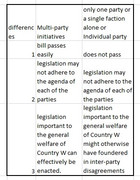
differences between Multi-party initiatives and only one party or a single faction alone or Individual party are shown in table below.
Image
Which of the following statements by a minister of Party C in the government of Country W is most consistent with the beliefs of an individual political party in the situation described above?

what does he refer when he said individual political party, is it a part of Multi-party(Left hand side of the table) or individual party(Right hand side of the table) on its own?
Join the discussion