BREAKING: Target Test Prep releases Brand New 2026 On Demand GMAT prep course

Redeem

Target Test Prep · GMAT

Choose how you want to prepare

Learn live with an expert or move at your own pace. Every option includes the complete TTP study system.

★★★★★5.0559 reviews
GMATLiveTeach 7 seats left
Chris Peckover
NEXT LIVE COHORT

Oct 13 to Jan 7, 2027

with Chris Peckover

Schedule
Tue, Thu · 8:00 to 10:00 PM ET
Included
40 live hours + 6 months of GMAT OnDemand
  • Live instruction and real-time questions
  • Class recordings and assigned practice
View class & enroll
Limited cohort · enrollment openTarget Test Prep
EALiveTeach 5 seats left
Logan Thompson
EXECUTIVE ASSESSMENT

Sep 6 to Dec 6, 2026

with Logan Thompson

Schedule
Sun · 9:30 AM to 12:30 PM ET
Included
40 hours of live online classes plus six months of access to the complete TTP EA OnDemand course.
  • 165+ EA Score Guarantee
  • 4,100+ Quant, Verbal, and Integrated Reasoning practice questions
  • 400+ hours of in-depth video lessons
  • 3,000+ step-by-step video solutions
View EA class & enroll
Limited cohort · enrollment openTarget Test Prep
GMATOnDemand Start anytime
SELF-PACED MASTERCLASS

Target Test Prep GMAT OnDemand

Complete access from day one. Study on your schedule.

715+ score guarantee
$0to start then $127/mo
  • Personalized study plan and analytics
  • Thousands of lessons and practice questions

Compare the format, schedule, and included access before enrolling. Prices and seat counts shown reflect the supplied offer details.

Mouse pellets

Expert replies
by EricKryk » Thu Feb 20, 2014 8:32 am
Image
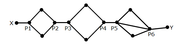
The diagram above shows the various paths along which a mouse can travel from point X, where it is released, to point Y, where it is rewarded with a food pellet. How many different paths from X to Y can the mouse take if it goes directly from X to Y without retracing any point along a path?

A) 6
B) 7
C) 12
D) 14
E) 17
Join the discussion
Source: — Problem Solving |

by Patrick_GMATFix » Thu Feb 20, 2014 9:00 am
Moving from X to Y is equivalent to going through a series of decision points. Every time we have two options, the number of paths will double. Every time we have three options, the number of paths will triple...

The full solution below is taken from the GMATFix App.

Image

-Patrick
  • Ask me about tutoring.
Join the discussion

by Brent@GMATPrepNow » Thu Feb 20, 2014 9:15 am
EricKryk wrote:Image
The diagram above shows the various paths along which a mouse can travel from point X, where it is released, to point Y, where it is rewarded with a food pellet. How many different paths from X to Y can the mouse take if it goes directly from X to Y without retracing any point along a path?

A) 6
B) 7
C) 12
D) 14
E) 17
Image

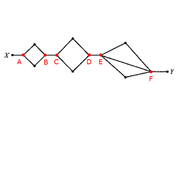
First recognize that, in order to get from point X to point Y, we MUST travel through points A,B,C,D,E and F.

So, we can take the task of getting from point X to Y and break it into stages.

Stage 1: Move from point X to point A
There's only 1 possible route, so we can complete stage 1 in 1 way.

Stage 2: Move from point A to point B
There are 2 possible routes, so we can complete stage 2 in 2 ways.

Stage 3: Move from point B to point C
There's only 1 possible route, so we can complete stage 3 in 1 way.

Stage 4: Move from point C to point D
There are 2 possible routes, so we can complete stage 4 in 2 ways.

Stage 5: Move from point D to point E
There's only 1 possible route, so we can complete stage 5 in 1 way.

Stage 6: Move from point E to point F
There are 3 possible routes, so we can complete stage 6 in 3 ways.

Stage 7: Move from point F to point Y
There's only 1 possible route, so we can complete stage 7 in 1 way.

By the Fundamental Counting Principle (FCP), we can complete all 7 stages (and thus move from point X to point Y) in (1)(2)(1)(2)(1)(3)(1) ways ([spoiler]= 12 ways[/spoiler])

Answer: C

Cheers,
Brent

Aside: For more information about the FCP, watch our free video: https://www.gmatprepnow.com/module/gmat-counting?id=775

Brent Hanneson - Creator of GMATPrepNow.com
Image
Join the discussion

by GMATGuruNY » Thu Feb 20, 2014 12:33 pm
EricKryk wrote:Image
The diagram above shows the various paths along which a mouse can travel from point X, where it is released, to point Y, where it is rewarded with a food pellet. How many different paths from X to Y can the mouse take if it goes directly from X to Y without retracing any point along a path?

A) 6
B) 7
C) 12
D) 14
E) 17
Number of ways to travel across the leftmost diamond = 2. (Either of the 2 paths.)
Number of ways to travel across the middle diamond = 2. (Either of the 2 paths.)
Number of ways to travel across the rightmost diamond = 3. (Any of the 3 paths.)
To combine these options, we multiply:
2*2*3 = 12.

The correct answer is C.
Private tutor exclusively for the GMAT and GRE, with over 20 years of experience.
Followed here and elsewhere by over 1900 test-takers.
I have worked with students based in the US, Australia, Taiwan, China, Tajikistan, Kuwait, Saudi Arabia -- a long list of countries.
My students have been admitted to HBS, CBS, Tuck, Yale, Stern, Fuqua -- a long list of top programs.

As a tutor, I don't simply teach you how I would approach problems.
I unlock the best way for YOU to solve problems.

For more information, please email me (Mitch Hunt) at [email protected].
Student Review #1
Student Review #2
Student Review #3
Join the discussion

by Jeff@TargetTestPrep » Mon Jun 29, 2015 6:59 am
EricKryk wrote:Image
The diagram above shows the various paths along which a mouse can travel from point X, where it is released, to point Y, where it is rewarded with a food pellet. How many different paths from X to Y can the mouse take if it goes directly from X to Y without retracing any point along a path?

A) 6
B) 7
C) 12
D) 14
E) 17
Solution:

Image

A good way to solve this problem is to use the idea of the fundamental counting principle. In a more standard form you could be asked a question, such as if Tom as 3 belts, 4 ties, and 6 shirts, how many outfits could he make with those items? We can consider each item a decision point, i.e., belts, ties, and shirts. To solve this, we just need to multiply the number of decisions Tom can make together, so:

3 x 4 x 6 = 72 ways.

Tom has 72 options when dressing with those items.

The same logic can be applied to this problem. We first determine the number of ways the mouse can go from one point to the next. Notice we added in "decision points" to our diagram.

X to P1 = 1

P1 to P2 = 2

P2 to P3= 1

P3 to P4= 2

P4 to P5= 1

P5 to P6 = 3

P6 to Y = 1

Therefore, to determine the total number of ways from X to Y, we multiply all these numbers together:

1 x 2 x 1 x 2 x 1 x 3 x 1 = 12 ways.

There are 12 different paths.

Answer:C

Jeffrey Miller
Head of GMAT Instruction
[email protected]

Image

See why Target Test Prep is rated 5 out of 5 stars on BEAT the GMAT. Read our reviews
Join the discussion

by stephanieh » Mon Jun 29, 2015 9:58 pm
GMATGuruNY wrote:
EricKryk wrote:Image
The diagram above shows the various paths along which a mouse can travel from point X, where it is released, to point Y, where it is rewarded with a food pellet. How many different paths from X to Y can the mouse take if it goes directly from X to Y without retracing any point along a path?

A) 6
B) 7
C) 12
D) 14
E) 17
Number of ways to travel across the leftmost diamond = 2. (Either of the 2 paths.)
Number of ways to travel across the middle diamond = 2. (Either of the 2 paths.)
Number of ways to travel across the rightmost diamond = 3. (Any of the 3 paths.)
To combine these options, we multiply:
2*2*3 = 12.

The correct answer is C.
Awesome break down Mitch! Thank you. I don't know how you're able to make it so simple! Do you have a thought process system as you're taking in the question?
Join the discussion

by nikhilgmat31 » Thu Jul 02, 2015 10:50 pm
please attached the image.
Join the discussion