BREAKING: Target Test Prep releases Brand New 2026 On Demand GMAT prep course
RedeemFinancing Your MBA - Part I
 Getting into a top-ranked MBA program is no small feat. With application deadlines recently posted at several leading schools, many prospective applicants are laser focused now on preparing for the GMAT, submitting undergraduate transcripts and crafting perfect essays. But every bit as critical as gaining acceptance to these top programs is figuring out how youll managefinancing your MBAonce you do.
If youve got a spare couple hundred thousand dollars in your bank account, then you can probably skip this series. For everyone else, read on. In this post and a handful to follow, well provide a broad overview of the various costs a typical MBA student faces and the types of funding opportunities currently available. Down the line, well take a closer look at the financial aid processes at a diverse range of leading business schools, giving you the tools you need to assess MBA programs in light of both yourown goals and available financing options.
If youre just beginning to think about an MBA, this series can help map out the landscape, outlining the financial aid process and resources available at various programs. You can extend your research by consulting theClear Admit School Guidesand schools own websites, as well as through conversations with current students.
For candidates farther along in the process, the seriescan help you plan out your application schedule with an eye toward financial aid deadlines and, if needed, any additional essays required. Wherever you are in the process, we hope this resource can help you find the funding you need.
First Things First: Whats an MBA Going to Cost?
The first step in financing the MBA is getting a handle onhow much it will cost. The primary expense of an MBA program is tuition. Having said that, there are a variety of other costsincluding living expenses, course materials and additional feesthat can increase the total amount a student pays by a half again. Most business schools provide a breakdown of the expenses, which are posted under the financial aid or admissions section of their websites in order to help prospective students seriously consider the cost of completing a particular MBA program. Schools typically take the total cost of attendance into account when calculating the financial aid package students receive.
Pre-Matriculation Costs
Even applying to MBA programs can be costly. To start with, taking the GMAT even once will cost candidates $250. In addition, each business school typically charges an application processing fee, which range in price yet may total $250. Candidates can also incur hundreds or even thousands of dollars in traveling expenses when visiting schools or going to interviews. Finally, applicants can take on an array of optional costs such as GMAT test preparation, consulting services and supplementary coursework.
Tuition
Tuition at the top business programs has risen steadily for decades. Indeed, in the past five years alone, the average tuition at the top programs increased by more than 37 percentdouble the inflation rate over that same time period. Students can now expect to pay between $50,000 and $65,000 for a single years tuition at a top school, with an average total price tag of $115,000 for tuition alone. Public universities, which discount tuition for state residents, can sometimes be more affordable. For instance, in-state residents attending schools such as UC Berkleys Haas, UT Austins McCombs, or UNCs Kenan-Flagler pay $10,000 to $17,000 less in tuition each year than do out-of-state residents. This wide range of variance can be explained in part by the different levels of subsidies that public universities receive and the economies of the states in which they are located.
Living Costs
The cost of living also forms a substantial part of a students expenses while at business school. These costs typically cover housing, food, utilities and other personal expenses, and they can vary widely by geographic region. For example, the Fuqua School of Business, located in the college town of Durham, North Carolina, estimates that students will pay $12,394 for room and board in their first year. Meanwhile, at NYU Stern, located in the center of Manhattan in New York City, the estimated cost for room and board is $25,200.
Living costs are usually based on surveys of the student population or estimates of local rental costs. Students should keep in mind that the figures posted by most schools are for single students with no dependents; those with partners or children should take into account the additional expenses of balancing family life with full-time studies. Harvard Business School, for instance, estimates that students with a spouse or partner should set aside an additional $16,100 in yearly expenses for a spouse or partner, another $12,700 for one child and an additional $8,200 for a second child. Meanwhile, Tuck, with its rural New Hampshire campus, calculates that $7,500 should be set aside for each additional family member. Prospective students with further questions may contact their target programs financial aid offices in order to request information about expected family expenses.
Additional Expenses and Fees
Course materials, healthcare insurance, transportation costs and other mandatory university fees can add several thousand dollars to a students expenses each year. Furthermore, extracurricular activities, particularly international trips that are often a highlight of an MBA experience, can substantially increase costs; for example, the Kellogg Worldwide Experience and Service Trips (KWEST) range from $1,900 to just over $3,000 before considering a number of out-of-pocket expenses. To help cover these expenses, some schools allow students to apply for an increase to their cost of attendance and thereby take on more loans.
Loan Interest
Because recent legislature has rendered federally subsidized loans unavailable for U.S. citizens or permanent residents in graduate school, students relying on loans to fund their studies will see their interest accumulate while in business school. For the most part, students do not have to start paying that interest, or the principle, until several months after they graduate. Federal loans and some private loans also include an ordination fee that is tacked on to each loan disbursement. Well go into greater detail on loans in a later post in this series.
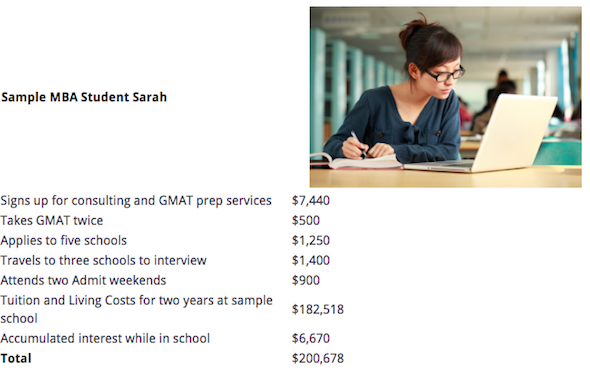
To give you a sense of what you need to plan for, weve compiled the following costs for sample applicant, Sarah:
Stay tuned for future posts in this series, where well take a closer look at the range of financing options available to MBA studentsincluding school-based financial aid, private scholarships and loan programsas well as specific resources for international students.
Other entries in the series:
- Financing Your MBA Part II
- Financing Your MBA Part III
- Financing Your MBA Part IV
- Financing Your MBA Part V
The postFinancing Your MBA, Part 1appeared first onClear Admit Blog.