BREAKING: Target Test Prep releases Brand New 2026 On Demand GMAT prep course
RedeemThe Importance of Getting to 'No' on the GMAT - Part 2
 Last time, we talked about how crucial it is to develop the instinct to go for the No when taking the GMAT.
If you havent read the first installment, do so right now, then come back here to learn more.
I left you with this GMATPrep problem from the free exams.
*If 0 < r < 1 < s < 2, which of the following must be less than 1?I. [pmath]r/s[/pmath]
II. rs
III. s r
(A) I only
(B) II only
(C) III only
(D) I and II
(E) I and III
Lets talk about it now!
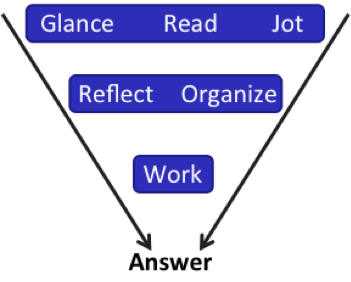
What did you think when you first Glanced at this thing? I thought, Ugh, roman numerals. These questions annoy me because they often take longer to do. In fact, unless I can spot some kind of shortcut, I may bail and move on. Im not interested in doing the work of 3 problems for the price of 1!
When I Read this one, though, I realized it wasnt too terrible. I Jotted this down while I read:
0 < r < 1 < s < 2 MUST be < 1?
And then I Reflected. First, I glanced at the statements and saw that they all contain both r and s. I also glanced down at the answers and thought, Hmm, I bet roman numeral I works; its in three of the answer choices.
Then, I looked back at the stuff I jotted down and thought about what it tells me. The value of r is between 0 and 1; its a fraction. The value of s is between 1 and 2. All right, thats also technically a fraction or decimal, but its a very different category than r, which is a fraction between 0 and 1. Fractions between 0 and 1 can do funny things to certain math operations.
They want to know what must be less than 1, so that would either be another fraction between 0 and 1, the number 0, or something negative.
I think Ive got my thoughts all Organized. Time to Work on this thing!
I. [pmath]r/s[/pmath]
Time to test cases. What if r = [pmath]1/2[/pmath]and s = [pmath]3/2[/pmath]? Then:
[pmath]r/s={1/2}/{3/2}={1/2}*{2/3}=1/3[/pmath]
Yes, thats less than 1. Can I get a no? In order to do that, Id have to get 1 or something greater than 1.
I cant get 1 because r and s dont equal each other. What about something greater than 1?
Think it through. Turns out, thats impossible! The numerator is the starting point. Its between 0 and 1. Then, divide by the denominator. Thats greater than 1. Dividing by a number greater than 1 will always have the effect of making the numerator smaller. If the numerator is already smaller than 1, then the final number cant be larger than 1.
Done! The first roman numeral must be less than 1. Eliminate answers (B) and (C). (Note: if you had to guess on this one, guess that it works, since roman numeral I appears in three of the five answer choices.)
In fact, glancing at those answers before you start to solve may help you to manage your time. You might be annoyed by the amount of work necessary to solve this one and decide that youll only try roman numeral I, since it shows up in three of the answers. Then, when youve eliminated either two or three of the answers after evaluating just one statement, you might guess and move on.
II. rs
Test cases again! Remember that r still has to be between 0 and 1 and s still has to be between 1 and 2.
Case 1: r = 1/2 and s = 3/2. The product is 3/4, which is less than 1.
Can you find a no? Try before you keep reading.
In this case, a variation on testing cases might be valuable: test extremes. The upper limit for r is something just a little bit less than 1. Likewise, the upper limit for s is something just a little bit less than 2. What would happen if r and s actually equaled 1 and 2, respectively?
Then, the product would be 2. So the product of a number just a little bit less than 1 and another number just a little bit less than 2 should be a little less than 2but greater than 1. This statement, then, does not have to be less than 1.
You can also test numbers to prove this. Make both numbers as big as you can while still making the math not-too-terrible to do. If s = 1.8 and r = 0.9, then think of the math as taking 90% of 1.8. Thats greater than 1, even if you dont do the exact math to figure out what that product is. :)
Eliminate answer (D).
III. s r
Last one! Okay, remind yourself again: s is between 1 and 2 and r is between 0 and 1. (Careful. Note that the order of the variables is reversed now.)
Case 1: If s = 3/2 and r = 1/2, then the difference is 1. Hey, for the first time, the first case is not less than 1! This statement also doesnt qualify, so eliminate answer (E).
The correct answer is (A).
Key Takeaways for Getting to No:
(1) You can use the Getting to "No" technique on some Problem Solving (PS) questions, too, not just Data Sufficiency. When you see PS questions that ask what must or could be true (or cannot be true), dont just go for the Yes! Think about how to Get to No. (Remember the Skeptical Scientist takeaway from part 1 of this series.)
(2) If you are actively trying to Get to "No" but cant, then the chances are pretty good that this statement actually must be less than 1 (or whatever the problem asks you to find). In your quest to find that No, you may even be able to prove why you cant get there, as we did for roman numeral I in the problem above.
* GMATPrep questions courtesy of the Graduate Management Admissions Council. Usage of this question does not imply endorsement by GMAC.