BREAKING: Target Test Prep releases Brand New 2026 On Demand GMAT prep course

Redeem

Target Test Prep · GMAT

Choose how you want to prepare

Learn live with an expert or move at your own pace. Every option includes the complete TTP study system.

★★★★★5.0559 reviews
GMATBootcamp Starts Sep 28
Chris Peckover, Target Test Prep GMAT expert
LIVE ONLINE BOOTCAMP

Live Online Bootcamp Class with Top GMAT Expert Chris Peckover

15 live classes from Sep 28, 2026

Schedule
Mon to Fri · 7:00 to 10:00 PM ET
Included
Live classes + 6 months of TTP OnDemand
  • Boost your GMAT score in less than one month in a live online class
  • 6 months access to TTP OnDemand video courses included
View bootcamp & enroll
Limited cohort · enrollment openTarget Test Prep
EALiveTeach 5 seats left
Logan Thompson
EXECUTIVE ASSESSMENT

Sep 6 to Dec 6, 2026

with Logan Thompson

Schedule
Sun · 9:30 AM to 12:30 PM ET
Included
40 hours of live online classes plus six months of access to the complete TTP EA OnDemand course.
  • 165+ EA Score Guarantee
  • 4,100+ Quant, Verbal, and Integrated Reasoning practice questions
  • 400+ hours of in-depth video lessons
  • 3,000+ step-by-step video solutions
View EA class & enroll
Limited cohort · enrollment openTarget Test Prep
GMATOnDemand Start anytime
SELF-PACED MASTERCLASS

Target Test Prep GMAT OnDemand

Complete access from day one. Study on your schedule.

715+ score guarantee
$0to start then $127/mo
  • Personalized study plan and analytics
  • Thousands of lessons and practice questions

Compare the format, schedule, and included access before enrolling. Prices and seat counts shown reflect the supplied offer details.

Is there a faster way to answer this GMAT question?

Expert replies
by SBronson » Tue Jun 18, 2013 10:02 pm
There's gotta be a faster way to answer this question? Can anyone help?

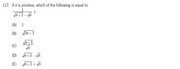
117. If n is positive, which of the following is equal to:

1/(Rad (n+1)− Rad n)?
(A) 1
(B) Rad (2n+1)
(C) Rad (n+1)/Rad n
(D) Rad (n+1) − rad n
(E) Rad (n+1) + Rad n

The official guide explanation is about half a page long.

Thanks!

-Samantha
Join the discussion
Source: — Problem Solving |

by GMATGuruNY » Tue Jun 18, 2013 11:54 pm
Image

Let n = 2.
Then:
1/(√n+1 - √n) = 1/(√3-√2) ≈ 1/(1.7 - 1.4) = 1/.3 = 10/3. This is our target.

Now plug n=2 into the answers to see which comes closest to our target of 10/3.

Only E works:
√(n+1) + √n = √3+√2 ≈ 1.7 + 1.4 = 3.1.

The correct answer is E.
Private tutor exclusively for the GMAT and GRE, with over 20 years of experience.
Followed here and elsewhere by over 1900 test-takers.
I have worked with students based in the US, Australia, Taiwan, China, Tajikistan, Kuwait, Saudi Arabia -- a long list of countries.
My students have been admitted to HBS, CBS, Tuck, Yale, Stern, Fuqua -- a long list of top programs.

As a tutor, I don't simply teach you how I would approach problems.
I unlock the best way for YOU to solve problems.

For more information, please email me (Mitch Hunt) at [email protected].
Student Review #1
Student Review #2
Student Review #3
Join the discussion

by Raj700 » Wed Jun 19, 2013 5:38 am
Nice! Thank you Mitch. That's so much easier. It certainly helps though to have rad 2 and rad 3 memorized.

-Raj
Join the discussion

by Ashke » Wed Jun 19, 2013 8:11 am
1/(Rad (n+1)- Rad n)

= (Rad (n+1)+ Rad n)/((Rad (n+1)- Rad n))*(Rad (n+1)+ Rad n))

= (Rad (n+1)+ Rad n)
Join the discussion

by fcabanski » Wed Jun 19, 2013 10:41 pm
Here's an even faster answer:

"OnlyEworks"

Seriously, though, plugging in is often faster than working the algebra. But if you remember how to rationalize the denominator, as Ashke showed, the algebra on this one takes about 10 seconds.
Expert GMAT tutor.
[email protected]

If you find one of my answers helpful, please click thank.

Contact me to discuss online GMAT tutoring.
Join the discussion