Live GMAT classes with Target Test Prep start Nov 21 and Nov 22. First class free.

See classes
Target Test Prep · GMAT

Choose how you want to prepare

Learn live with an expert or move at your own pace. Every option includes the complete TTP study system.

Newsweek Readers’ Choice Awards 2026 winner: Target Test Prep, #1 Test Prep

Target Test Prep was voted #1 Best Test Prep in the 2026 Newsweek Readers’ Choice™ Awards.

★★★★★5.0563 reviews
GMATLiveTeachStarts Nov 22
Josh Braslow, Target Test Prep GMAT expert
LIVE ONLINE CLASSES

Get Ready for GMAT Test Day Faster with Live Online Classes

with Josh Braslow, 20+ years in test prep

Nov 22 · Josh Braslow
Sun · 9:30 AM to 12:30 PM ET
Included
40 hours of live online classes + 6 months of TTP OnDemand
  • Attend the first class for free
  • Every class is recorded, so you never fall behind
View classes & enroll
Limited seats availableTarget Test Prep
EALiveTeachOnDemandStart anytime
EXECUTIVE ASSESSMENT

Target Test Prep EA OnDemand

Self-paced EA prep. Study on your schedule.

EXECUTIVE ASSESSMENT

with

165+ EA score guarantee
$05-day trial no automatic billing
Schedule
Included
40 hours of live online classes plus six months of access to the complete TTP EA OnDemand course.
  • 165+ EA Score Guarantee
  • 4,100+ Quant, Verbal, and Integrated Reasoning practice questions
  • 400+ hours of in-depth video lessons
  • 3,000+ step-by-step video solutions
View EA class & enroll Start free 5-day trial
Limited cohort · enrollment openTrial includes full course accessTarget Test Prep
GMATOnDemandStart anytime
SELF-PACED MASTERCLASS

Target Test Prep GMAT OnDemand

Complete access from day one. Study on your schedule.

715+ score guarantee
$0to start then $127/mo
  • Personalized study plan and analytics
  • Thousands of lessons and practice questions

Inequalities: Reciprocal Rule

Expert replies
by AkiB » Wed Jul 16, 2014 12:04 am
What is the largest integer n such that 1/2^n> 0.01?

a)5
b)6
c)7
d)10
e)51

The solution to this problem mentioned in the OG is as follows
Since 1/2^n > 0.01 is equivalent to 2n < 100, find
2"
the largest integer n such that 2" < 100. Using
trial and error, 2^6 = 64 and 64 < 100, but
2^7 = 128 and 128 > 100. Therefore, 6 is the largest
integer such that 2^n > 0.01.
The correct answer is B.

My question is

The inequality sign only flips if u multiply or divide by a negative number, so why does the sign flip in the above case.

Thanks
Join the discussion
Source: — Problem Solving |

by unknown13 » Wed Jul 16, 2014 12:14 am
Hi
IMO answer is B

as 0.01 = 1/100
and (1/2)^n for n = 7 is 1/128
and for n = 6 it is 1/64

so highest integer value will be 6

thanks and regards
Join the discussion

by [email protected] » Wed Jul 16, 2014 12:15 am
Hi AkiB,

This question asks us to compare fractions. The decimal .01 can be written as 1/100. Since 1/(2^N) and 1/100 both have numerators that equal 1, we can focus on the denominators. We're asked how big we can make N so that 1/(2^N) > 1/100. For the first fraction to be bigger than the second, the denominator must be SMALLER than 100, BUT we still have to make it as BIG as possible.

In answer to your question, the sign doesn't "flip"; you're actually cross-multiplying the inequality, so….

1/(2^N) > 1/100

becomes….

100 > 2^N

GMAT assassins aren't born, they're made,
Rich
Contact Rich at [email protected]
Image
Join the discussion

by Matt@VeritasPrep » Wed Jul 16, 2014 10:46 am
Here's a nice algebraic approach.

(1/2)� > .01 is really
(1/2)� > 1/100, or
1/2� > 1/100

Since 2� and 100 are both positive, when we cross-multiply, the sign WON'T flip. So we have

100 > 2�

We know that 2�=128 > 100 > 2�=64, so n must be 6.
Join the discussion

by GMATinsight » Wed Jul 16, 2014 6:36 pm
AkiB wrote:What is the largest integer n such that 1/2^n> 0.01?

a)5
b)6
c)7
d)10
e)51

The solution to this problem mentioned in the OG is as follows
Since 1/2^n > 0.01 is equivalent to 2n < 100, find
2"
the largest integer n such that 2" < 100. Using
trial and error, 2^6 = 64 and 64 < 100, but
2^7 = 128 and 128 > 100. Therefore, 6 is the largest
integer such that 2^n > 0.01.
The correct answer is B.

My question is

The inequality sign only flips if u multiply or divide by a negative number, so why does the sign flip in the above case.

Thanks

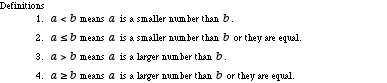
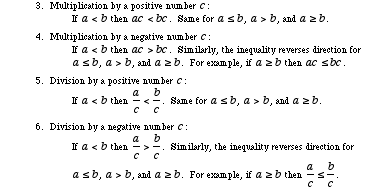
For better understanding of the rules of Inequality, Please see the rules below:

Inequality Rules

Image
Image

Transitive Property of Inequalities

If a < b and b < c , then a < c.
If a ≤ b and b ≤ c , then a ≤ c.
If a > b and b > c , then a > c.
If a ≥ b and b ≥ c , then a ≥ c.
"GMATinsight"Bhoopendra Singh & Sushma Jha
Most Comprehensive and Affordable Video Course 2000+ CONCEPT Videos and Video Solutions
Whatsapp/Mobile: +91-9999687183 l [email protected]
Contact for One-on-One FREE ONLINE DEMO Class Call/e-mail
Most Efficient and affordable One-On-One Private tutoring fee - US$40-50 per hour
Join the discussion