BREAKING: Target Test Prep releases Brand New 2026 On Demand GMAT prep course

Redeem

In the figure above, triangle ABC is equilateral, and point

Expert replies
by BTGmoderatorDC » Sun Oct 14, 2018 5:41 pm

Timer

00:00

Answers

A

B

C

D

E

Stats

Difficulty

Image

In the figure above, triangle ABC is equilateral, and point P is equidistant from vertices A, B, and C. If triangle ABC is rotated clockwise about point P, what is the minimum number of degrees the triangle must be rotated so that point B will be in the position where point A is now?

(A) 60
(B) 120
(C) 180
(D) 240
(E) 270

OA D

Source: Official Guide
Join the discussion
Source: — Problem Solving |

BTGmoderatorDC wrote:Image
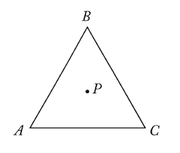
In the figure above, triangle ABC is equilateral, and point P is equidistant from vertices A, B, and C. If triangle ABC is rotated clockwise about point P, what is the minimum number of degrees the triangle must be rotated so that point B will be in the position where point A is now?

(A) 60
(B) 120
(C) 180
(D) 240
(E) 270

OA D

Source: Official Guide
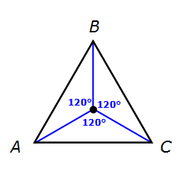
It may help to add some lines to the diagram.

First add lines from the center to the 3 vertices.
Image
Aside, we know that each angle is 120º since all three (equivalent) angles must add to 360º

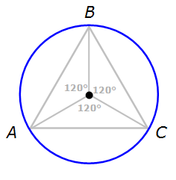
Then draw a circle so that the triangles vertices are on the circle.
Image

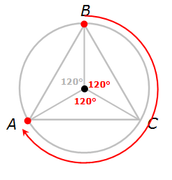
From here, we can see that . ..
Image
. . . the triangle must be rotated clockwise 240º in order for point B to be in the position where point A is now.

Answer: D

Cheers,
Brent
Last edited by Brent@GMATPrepNow on Sat Mar 21, 2020 5:43 am, edited 1 time in total.
Brent Hanneson - Creator of GMATPrepNow.com
Image
Join the discussion

by Scott@TargetTestPrep » Tue Oct 16, 2018 5:17 pm
BTGmoderatorDC wrote:Image

In the figure above, triangle ABC is equilateral, and point P is equidistant from vertices A, B, and C. If triangle ABC is rotated clockwise about point P, what is the minimum number of degrees the triangle must be rotated so that point B will be in the position where point A is now?

(A) 60
(B) 120
(C) 180
(D) 240
(E) 270
We have a triangle with 3 vertices. Thus, when one vertex is rotated clockwise to the next vertex (for example, B is rotated clockwise to C), the number of degrees is 360/3 = 120. So, in order for point B to be in the position where point A is now, it must be rotated by 120 x 2 = 240 degrees.

Answer: D

Scott Woodbury-Stewart
Founder and CEO
[email protected]

Image

See why Target Test Prep is rated 5 out of 5 stars on BEAT the GMAT. Read our reviews

ImageImage
Join the discussion