BREAKING: Target Test Prep releases Brand New 2026 On Demand GMAT prep course

Redeem

Target Test Prep · GMAT

Choose how you want to prepare

Learn live with an expert or move at your own pace. Every option includes the complete TTP study system.

★★★★★5.0559 reviews
GMATLiveTeach 7 seats left
Chris Peckover
NEXT LIVE COHORT

Oct 13 to Jan 7, 2027

with Chris Peckover

Schedule
Tue, Thu · 8:00 to 10:00 PM ET
Included
40 live hours + 6 months of GMAT OnDemand
  • Live instruction and real-time questions
  • Class recordings and assigned practice
View class & enroll
Limited cohort · enrollment openTarget Test Prep
EALiveTeach 5 seats left
Logan Thompson
EXECUTIVE ASSESSMENT

Sep 6 to Dec 6, 2026

with Logan Thompson

Schedule
Sun · 9:30 AM to 12:30 PM ET
Included
40 hours of live online classes plus six months of access to the complete TTP EA OnDemand course.
  • 165+ EA Score Guarantee
  • 4,100+ Quant, Verbal, and Integrated Reasoning practice questions
  • 400+ hours of in-depth video lessons
  • 3,000+ step-by-step video solutions
View EA class & enroll
Limited cohort · enrollment openTarget Test Prep
GMATOnDemand Start anytime
SELF-PACED MASTERCLASS

Target Test Prep GMAT OnDemand

Complete access from day one. Study on your schedule.

715+ score guarantee
$0to start then $127/mo
  • Personalized study plan and analytics
  • Thousands of lessons and practice questions

Compare the format, schedule, and included access before enrolling. Prices and seat counts shown reflect the supplied offer details.

If x and y are positive integers and xy=36, what is the smal

Expert replies
by Max@Math Revolution » Mon Aug 27, 2018 1:37 am

Timer

00:00

Answers

A

B

C

D

E

Stats

Difficulty

[Math Revolution GMAT math practice question]

If x and y are positive integers and xy=36, what is the smallest possible value of x+y?

A. 6
B. 8
C. 10
D. 12
E. 18
Join the discussion
Source: — Problem Solving |

by fskilnik@GMATH » Mon Aug 27, 2018 4:57 am
Image
Fabio Skilnik :: GMATH method creator ( Math for the GMAT)
English-speakers :: https://www.gmath.net
Portuguese-speakers :: https://www.gmath.com.br
Join the discussion

by Brent@GMATPrepNow » Mon Aug 27, 2018 5:40 am
Max@Math Revolution wrote:[Math Revolution GMAT math practice question]

If x and y are positive integers and xy=36, what is the smallest possible value of x+y?

A. 6
B. 8
C. 10
D. 12
E. 18
Since there aren't many PAIRS of integers that have a product of 36, we can simply list the possibilities:

x = 1 and y = 36. Here, the SUM = 37
x = 2 and y = 18. Here, the SUM = 20
x = 3 and y = 12. Here, the SUM = 15
x = 4 and y = 9. Here, the SUM = 13
x = 6 and y = 6. Here, the SUM = 12

Answer: E

Cheers,
Brent
Brent Hanneson - Creator of GMATPrepNow.com
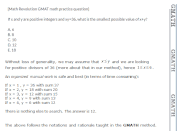
Image
Join the discussion

by Max@Math Revolution » Wed Aug 29, 2018 12:50 am
=>

When we know the product of two numbers, the sum of those numbers is a minimum when the two numbers are equal.

Since xy = 36, the minimum value of x + y occurs when x = y = 6. It is 6 + 6 = 12.

Therefore, D is the answer.
Answer: D
Join the discussion

by fskilnik@GMATH » Wed Aug 29, 2018 4:52 am
Max@Math Revolution wrote: When we know the product of two numbers, the sum of those numbers is a minimum when the two numbers are equal.
This is an immediate consequence of the famous Arithmetic-Geometric Mean inequality , therefore out-of-scope of the GMAT.

Important detail: the condition about integers (given in the question stem) is unnecessary, but the condition on positive (in fact nonnegative) numbers is essential.

For the interested readers:
[Arithmetic-Geometric Mean inequality] wrote: Given any positive integer \[N \geqslant 2\] and \[{x_1}\,,\,\,{x_2}\,,\, \ldots ,\,\,{x_N}\] nonnegative real numbers , we have:
\[\sqrt[{N\,}]{{{x_1}\, \cdot \,\,{x_2} \cdot \, \ldots \cdot \,\,{x_N}}}\,\,\, \leqslant \,\,\,\frac{{{x_1}\, + \,\,{x_2}\, + \, \ldots + \,{x_N}}}{N}\]
with equality if, and only if, all real numbers considered are equal.
In our case, \[N = 2\] and we have \[\sqrt {36} = \sqrt {xy} \leqslant \,\,\frac{{x + y}}{2}\] and (x+y) will be minimum exactly when (x+y)/2 is minimum...

This occurs (by the famous theorem above) only when x and y are equal, i.e., when \[6 = \sqrt {36} = \sqrt {xy} = \sqrt {{x^2}} \,\,\,\mathop = \limits^{x\, \geqslant \,0} \,x\,\,\,\,\left( { = y} \right)\]

Therefore \[? = 6 + 6\] as mentioned.

I hope you find all this interesting.

Regards,
fskilnik.
Fabio Skilnik :: GMATH method creator ( Math for the GMAT)
English-speakers :: https://www.gmath.net
Portuguese-speakers :: https://www.gmath.com.br
Join the discussion

by Jeff@TargetTestPrep » Wed Sep 05, 2018 9:44 am
Max@Math Revolution wrote:[Math Revolution GMAT math practice question]

If x and y are positive integers and xy=36, what is the smallest possible value of x+y?

A. 6
B. 8
C. 10
D. 12
E. 18
The possible combinations of x and y are:

1, 36

2, 18

3, 12

4, 9

6, 6

So the smallest possible value of x + y is 12.

Alternate Solution:

It is possible to interpret the problem in the following way: Among all the rectangles that have an area of 36, what is the smallest possible sum for the length and width? We know that among all rectangles that have the same area, the square has the smallest perimeter. If the perimeter is the smallest, then so will be the sum of length and width (since perimeter of a rectangle is simply twice the sum of length and width). Thus, the smallest possible value is 6 + 6 = 12.

Answer: D

Jeffrey Miller
Head of GMAT Instruction
[email protected]

Image

See why Target Test Prep is rated 5 out of 5 stars on BEAT the GMAT. Read our reviews
Join the discussion