BREAKING: Target Test Prep releases Brand New 2026 On Demand GMAT prep course

Redeem

Target Test Prep · GMAT

Choose how you want to prepare

Learn live with an expert or move at your own pace. Every option includes the complete TTP study system.

★★★★★5.0563 reviews
Newsweek Readers’ Choice Awards 2026 winner: Target Test Prep, #1 Test Prep
NEWSWEEK READERS’ CHOICE AWARDS 2026

Target Test Prep was voted #1 Best Test Prep in the 2026 Newsweek Readers’ Choice™ Awards.

GMATLiveTeach Starts Oct 17
Chris Peckover, Target Test Prep GMAT expert
LIVE ONLINE CLASSES

Get Ready for GMAT Test Day Faster with Live Online Classes

with Chris Peckover, 100th-Percentile GMAT Scorer

Oct 17 · Chris Peckover
Sat · 11:00 AM to 2:00 PM ET
Oct 20 · Chris Peckover
Tue, Thu · 8:00 to 10:00 PM ET
Oct 25 · Josh Braslow
Sun · 1:00 to 4:00 PM ET
Included
40 hours of live online classes + 6 months of TTP OnDemand
  • Attend the first class for free
  • Every class is recorded, so you never fall behind
View classes & enroll
Limited seats availableTarget Test Prep
EALiveTeachOnDemand 5 seats left Start anytime
EXECUTIVE ASSESSMENT

Target Test Prep EA OnDemand

Self-paced EA prep. Study on your schedule.

Logan Thompson
EXECUTIVE ASSESSMENT

Sep 6 to Dec 6, 2026

with Logan Thompson

165+ EA score guarantee
$05-day trial no automatic billing
Schedule
Sun · 9:30 AM to 12:30 PM ET
Included
40 hours of live online classes plus six months of access to the complete TTP EA OnDemand course.
  • 165+ EA Score Guarantee
  • 4,100+ Quant, Verbal, and Integrated Reasoning practice questions
  • 400+ hours of in-depth video lessons
  • 3,000+ step-by-step video solutions
View EA class & enroll Start free 5-day trial
Limited cohort · enrollment openTrial includes full course accessTarget Test Prep
GMATOnDemand Start anytime
SELF-PACED MASTERCLASS

Target Test Prep GMAT OnDemand

Complete access from day one. Study on your schedule.

715+ score guarantee
$0to start then $127/mo
  • Personalized study plan and analytics
  • Thousands of lessons and practice questions

Compare the format, schedule, and included access before enrolling. Prices and seat counts shown reflect the supplied offer details.

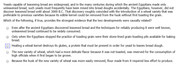
GPrep CR ques

Expert replies
Source: — Critical Reasoning |

by David@GMATPrepNow » Thu Aug 14, 2014 12:20 pm
Hi AnuragRatna,

Let me help you with the first question, about Egyptian bread. The passage presents a relationship between two things: the Egyptians' discovery of leavened bread, and the introduction of a new kind of wheat.

The first half of the passage suggests that the yeasts required to make leavened bread were present before the Egyptians discovered them. Therefore something prevented the Egyptians from noticing the yeasts, and thus being able to make leavened bread. The second half of the passage suggests that the Egyptians' discovery of the yeast roughly coincided with the introduction of a new and preferable kind of wheat (preferable because it was easier to use - it did not require being fired before baking).

The question asks us to find the answer that best establishes a causal relationship between the two things, i.e. which answer clearly reinforces the relationship that one of the things caused the other. Let's review the possible answers:

A. Even after the ancient Egyptians discovered leavened bread and the techniques for reliably producing it were well known, unleavened bread continued to be widely consumed.

Answer A is not relevant. We are not interested in what happened with bread consumption after the discovery. Eliminate A.

B. Only when the Egyptians stopped the practice of toasting grain were their stone-lined grain-toasting pits available for baking bread.

Having the pits available for baking bread does not suggest a causal relationship. The pits were likely to have been used for baking all kinds of bread, both leavened and unleavened. Eliminate B.

C. Heating a wheat kernel destroys its gluten, a protein that must be present in order for yeast to leaven bread dough.

Ah, here is something interesting! We are looking for something that was preventing the Egyptians from noticing the yeasts and their action on bread (i.e. as a leavening agent). When the Egyptians switched to a new kind of wheat that did not need to be heated - a process that kept the present yeast from leavening the bread - the yeast was allowed to act as a leavening agent in the bread. Answer C is correct!

D. The new variety of wheat, which had a more delicate flavor because it was not toasted, was reserved for the consumption of high officials when it first began to be grown.

This is not relevant. It's nice that the bread had a delicate flavor, but that does not suggest a causal relationship between yeast and bread. Eliminate D.

E. Because the husk of the new variety of wheat was more easily removed, flour made from it required less effort to produce.

This may explain why the Egyptians changed varieties of wheat, but it does not suggest a causal relationship between yeast and bread. Eliminate E.
Join the discussion

by GMATGuruNY » Fri Aug 15, 2014 1:52 am
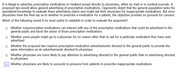
It is illegal to advertise prescription medications in Hedland except directly to physicians, either by mail or in medical journals. A proposed law would allow general advertising of prescription medications. Opponents object that the general population lacks the specialized knowledge to evaluate such advertisements and might ask their physicians for inappropriate medications. But since physicians have the final say as to whether to prescribe a medication for a patient, inappropriate prescriptions would not become more common.

Which of the following would it be most useful to establish in order to evaluate the argument?
Conclusion: Because PHYSICIANS DECIDE whether to prescribe medications, ADVERTISING TO PATIENTS cannot cause inappropriate prescriptions to become more common.
Assumption: That PATIENTS do not affect what PHYSICIANS DECIDE.

Rephrase the answer choices as STATEMENTS.
Rephrased as a statement, the correct answer choice will either STRENGTHEN or WEAKEN the assumption.

E, rephrased as a statement:
PHYSICIANS WILL GIVE IN TO A PATIENT'S DEMAND for a prescription medication chosen by the patient when the one originally prescribed by the physician fails to perform as desired.
Implication:
PATIENTS DO AFFECT what PHYSICIANS DECIDE, weakening the conclusion that advertising to patients cannot cause inappropriate prescriptions to become more common.

The correct answer is E.
Private tutor exclusively for the GMAT and GRE, with over 20 years of experience.
Followed here and elsewhere by over 1900 test-takers.
I have worked with students based in the US, Australia, Taiwan, China, Tajikistan, Kuwait, Saudi Arabia -- a long list of countries.
My students have been admitted to HBS, CBS, Tuck, Yale, Stern, Fuqua -- a long list of top programs.

As a tutor, I don't simply teach you how I would approach problems.
I unlock the best way for YOU to solve problems.

For more information, please email me (Mitch Hunt) at [email protected].
Student Review #1
Student Review #2
Student Review #3

Join the discussion