BREAKING: Target Test Prep releases Brand New 2026 On Demand GMAT prep course

Redeem

Target Test Prep · GMAT

Choose how you want to prepare

Learn live with an expert or move at your own pace. Every option includes the complete TTP study system.

★★★★★5.0559 reviews
GMATLiveTeach Starts Oct 17
Chris Peckover, Target Test Prep GMAT expert
LIVE ONLINE CLASSES

Get Ready for GMAT Test Day Faster with Live Online Classes

with Chris Peckover, 100th-Percentile GMAT Scorer

Oct 17 · Chris Peckover
Sat · 11:00 AM to 2:00 PM ET
Oct 20 · Chris Peckover
Tue, Thu · 8:00 to 10:00 PM ET
Oct 25 · Josh Braslow
Sun · 1:00 to 4:00 PM ET
Included
40 hours of live online classes + 6 months of TTP OnDemand
  • Attend the first class for free
  • Every class is recorded, so you never fall behind
View classes & enroll
Limited seats availableTarget Test Prep
EALiveTeachOnDemand 5 seats left Start anytime
EXECUTIVE ASSESSMENT

Target Test Prep EA OnDemand

Self-paced EA prep. Study on your schedule.

Logan Thompson
EXECUTIVE ASSESSMENT

Sep 6 to Dec 6, 2026

with Logan Thompson

165+ EA score guarantee
$05-day trial no automatic billing
Schedule
Sun · 9:30 AM to 12:30 PM ET
Included
40 hours of live online classes plus six months of access to the complete TTP EA OnDemand course.
  • 165+ EA Score Guarantee
  • 4,100+ Quant, Verbal, and Integrated Reasoning practice questions
  • 400+ hours of in-depth video lessons
  • 3,000+ step-by-step video solutions
View EA class & enroll Start free 5-day trial
Limited cohort · enrollment openTrial includes full course accessTarget Test Prep
GMATOnDemand Start anytime
SELF-PACED MASTERCLASS

Target Test Prep GMAT OnDemand

Complete access from day one. Study on your schedule.

715+ score guarantee
$0to start then $127/mo
  • Personalized study plan and analytics
  • Thousands of lessons and practice questions

Compare the format, schedule, and included access before enrolling. Prices and seat counts shown reflect the supplied offer details.

Functions

Expert replies
by Aman verma » Sun Nov 24, 2013 2:15 am
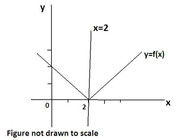
Image
Q: The graph of the function y = f(x) is symmetrical about the line x = 2, then which is/are correct:

(i) f(x + 2) = f(x - 2)
(ii) f(2 + x) = f(4 - x)
(iii)f(x) = f(-x)

(A) (i) only

(B) (ii)only

(C) (iii)only

(D) (i),(iii) Both

(E) (i),(ii) and (iii)

NB: I have made up the graph, but I am not sure it's absolutely correct. Also I request to provide the graphs of the correct solution besides that of the question.
800. Arjun's-Bird-Eye
Join the discussion
Source: — Problem Solving |

by Aman verma » Sun Nov 24, 2013 9:36 am
Can anyone suggest a solution to this one ?OA[spoiler](B)[/spoiler]
800. Arjun's-Bird-Eye
Join the discussion

by GMATSUCKER » Mon Nov 25, 2013 12:43 am
Aman verma wrote:Can anyone suggest a solution to this one ?OA[spoiler](B)[/spoiler]
Is this a GMAT question ? If this is not a GMAT question then what's the source ?
GMAT, GMAT, GMAT, GMAT, GMAT, GMAT, GMAT, GMAT, GMAT, GMAT, GMAT, GMAT, GMAT, GMAT, GMAT, GMAT, GMAT, GMAT, GMAT, GMAT, GMAT, GMAT, GMAT, GMAT
What's life without GMAT !!!!!!!!
Join the discussion

by Aman verma » Mon Nov 25, 2013 10:31 am
Image
Okay, I came up with this graph which satisfies option (B) but unfortunately it satisfies all the three equations. The solution to this problem lies in creating the correct graph and then we can check the equation. Alternatively we can solve this algebraically, but I don't know how to do so. So what could be the possible solution. How to solve this. What is the correct graph ?
800. Arjun's-Bird-Eye
Join the discussion

by GMATGuruNY » Mon Nov 25, 2013 12:10 pm
I believe that the problem should read as follows:
Aman verma wrote: Q: If the graph of the function y = f(x) is symmetrical about the line x = 2, then which of the following MUST be true?

(i) f(x + 2) = f(x - 2)
(ii) f(2 + x) = f(2 - x)
(iii)f(x) = f(-x)

(A) (i) only

(B) (ii)only

(C) (iii)only

(D) (i),(iii) Both

(E) (i),(ii) and (iii)
Symmetry about x=2 implies the following:
If the value of x is k places TO THE LEFT OR RIGHT of x=2, the value of f(x) must be THE SAME in each case.
For example:
f(1) = f(3).
Here, the x-values (1 and 3) are each ONE PLACE away from x=2, so the value of f(x) must be the same in each case.
f(0) = f(4).
Here, the x-values (0 and 4) are each TWO PLACES away from x=2, so the value of f(x) must be the same in each case.
f(-1) = f(5).
Here, the x-values (-1 and 5) are each THREE PLACES away from x=2, so the value of f(x) must be the same in each case.

Implication:
x-values that are the SAME DISTANCE from x=2 MUST yield the same value for f(x).
x-values that are DIFFERENT DISTANCES from x=2 do NOT have to yield the same value for f(x).

(i) f(x + 2) = f(x - 2)
If x=1, we get:
f(1+2) = f(1-2).
f(3) = f(-1).
Doesn't work:
3 and -1 are DIFFERENT distances from x=2, so f(3) does not have to be equal to f(-1).
The correct answer choice cannot include (i).
Eliminate A, D and E.

(ii) f(2 + x) = f(2 - x)
If x=1, we get:
f(2+1) = f(2-1).
f(3) = f(1).
This works.
3 and 1 are each the SAME distance from x=2, so f(3) must be equal to f(1).

If x=10, we get:
f(2+10) = f(2-10).
f(12) = f(-8).
This works.
12 and -8 are each the SAME distance from x=2, so f(12) must be equal to f(-8).

The cases above illustrate that the correct answer choice must include (ii).
Eliminate C.

The correct answer is B.
Last edited by GMATGuruNY on Mon Nov 25, 2013 2:02 pm, edited 1 time in total.
Private tutor exclusively for the GMAT and GRE, with over 20 years of experience.
Followed here and elsewhere by over 1900 test-takers.
I have worked with students based in the US, Australia, Taiwan, China, Tajikistan, Kuwait, Saudi Arabia -- a long list of countries.
My students have been admitted to HBS, CBS, Tuck, Yale, Stern, Fuqua -- a long list of top programs.

As a tutor, I don't simply teach you how I would approach problems.
I unlock the best way for YOU to solve problems.

For more information, please email me (Mitch Hunt) at [email protected].
Student Review #1
Student Review #2
Student Review #3
Join the discussion

by Aman verma » Mon Nov 25, 2013 1:57 pm
GMATGuruNY wrote:I believe that the problem should read as follows:
Aman verma wrote: Q: The graph of the function y = f(x) is symmetrical about the line x = 2, then which of the following MUST be true?

(i) f(x + 2) = f(x - 2)
(ii) f(2 + x) = f(2 - x)
(iii)f(x) = f(-x)

(A) (i) only

(B) (ii)only

(C) (iii)only

(D) (i),(iii) Both

(E) (i),(ii) and (iii)
Symmetry about x=2 implies the following:
If the value of x is k places TO THE LEFT OR RIGHT of x=2, the value of f(x) must be THE SAME in each case.
For example:
f(1) = f(3).
Here, the x-values (1 and 3) are each ONE PLACE away from x=2, so the value of f(x) must be the same in each case.
f(0) = f(4).
Here, the x-values (0 and 4) are each TWO PLACES away from x=2, so the value of f(x) must be the same in each case.
f(-1) = f(5).
Here, the x-values (-1 and 5) are each THREE PLACES away from x=2, so the value of f(x) must be the same in each case.

Implication:
x-values that are the SAME DISTANCE from x=2 MUST yield the same value for f(x).
x-values that are DIFFERENT DISTANCES from x=2 do NOT have to yield the same value for f(x).

(i) f(x + 2) = f(x - 2)
If x=1, we get:
f(1+2) = f(1-2).
f(3) = f(-1).
Doesn't work:
3 and -1 are DIFFERENT distances from x=2, so f(3) does not have to be equal to f(-1).
The correct answer choice cannot include (i).
Eliminate A, D and E.

(ii) f(2 + x) = f(2 - x)
If x=1, we get:
f(2+1) = f(2-1).
f(3) = f(1).
This works.
3 and 1 are each the SAME distance from x=2, so f(3) must be equal to f(1).

If x=10, we get:
f(2+10) = f(2-10).
f(12) = f(-8).
This works.
12 and -8 are each the SAME distance from x=2, so f(12) must be equal to f(-8).

The cases above illustrate that the correct answer choice must include (ii).
Eliminate C.

The correct answer is B.
Awesome!

And I guess there must be some misprint in my book. Cause even I was not getting any logical answer for option (ii). Thanks for clarifying the underlying concept and pointing out the mistake for option(ii). That explanation of K places was awesome. I am really grateful to you. I was having difficulty interpreting graphs of this type. Now please tell me which graph is correct:-the 1st one or the 2nd one ? I now personally think the first one is correct which is similar to that of Modulus X.
800. Arjun's-Bird-Eye
Join the discussion