BREAKING: Target Test Prep releases Brand New 2026 On Demand GMAT prep course

Redeem

Target Test Prep · GMAT

Choose how you want to prepare

Learn live with an expert or move at your own pace. Every option includes the complete TTP study system.

★★★★★5.0559 reviews
GMATLiveTeach 7 seats left
Chris Peckover
NEXT LIVE COHORT

Oct 13 to Jan 7, 2027

with Chris Peckover

Schedule
Tue, Thu · 8:00 to 10:00 PM ET
Included
40 live hours + 6 months of GMAT OnDemand
  • Live instruction and real-time questions
  • Class recordings and assigned practice
View class & enroll
Limited cohort · enrollment openTarget Test Prep
EALiveTeach 5 seats left
Logan Thompson
EXECUTIVE ASSESSMENT

Sep 6 to Dec 6, 2026

with Logan Thompson

Schedule
Sun · 9:30 AM to 12:30 PM ET
Included
40 hours of live online classes plus six months of access to the complete TTP EA OnDemand course.
  • 165+ EA Score Guarantee
  • 4,100+ Quant, Verbal, and Integrated Reasoning practice questions
  • 400+ hours of in-depth video lessons
  • 3,000+ step-by-step video solutions
View EA class & enroll
Limited cohort · enrollment openTarget Test Prep
GMATOnDemand Start anytime
SELF-PACED MASTERCLASS

Target Test Prep GMAT OnDemand

Complete access from day one. Study on your schedule.

715+ score guarantee
$0to start then $127/mo
  • Personalized study plan and analytics
  • Thousands of lessons and practice questions

Compare the format, schedule, and included access before enrolling. Prices and seat counts shown reflect the supplied offer details.

Farmers Orchard Problem

Expert replies
by NeilWatson » Sat Mar 01, 2014 7:38 pm

Timer

00:00

Answers

A

B

C

D

E

Stats

Difficulty

Each year for 4 years, a farmer increased the number of trees in a certain orchard by 1/4 of the number of trees in the orchard the previous year. If all of the trees thrived and there were 6,250 trees in the end of the 4 year period, how many trees did he start with in the first year?

While I understand the logic of this problem (each year the amount increased by 1.25) I am confused by the explanation. I broke the problem down as follows:
1st year - x
2nd year - 1.25x
3rd year - 1.25^2 x
4th year - 1.25^3 x

According to the textbook, my reasoning is wrong. Can someone explain?
Join the discussion
Source: — Problem Solving |

by GMATGuruNY » Sat Mar 01, 2014 7:53 pm
Each year for 4 years, a farmer increased the number of trees in a certain orchard by 1/4 of the number of trees in the orchard of the preceding year. If all of the trees thrived and there were 6250 trees in the orchard at the end of 4 year period, how many trees were in the orchard at the beginning of the 4 year period?

A. 1250
B. 1563
C. 2250
D. 2560
E. 2752
We can PLUG IN THE ANSWERS, which represent the original number of trees.
Since the number of trees increases by 1/4 each year, the correct answer must be a multiple of 4.
The last 2 digits of a multiple of 4 must themselves form a multiple of 4.
Eliminate A (1250) and C (2250), since 50 is not a multiple of 4.
Eliminate B (1563), since 63 is not a multiple of 4.

Answer choice D: 2560
After the 1st year, the number of trees = 2560 + (1/4)2560 = 3200.
After the 2nd year, the number of trees = 3200 + (1/4)3200 = 4000.
After the 3rd year, the number of trees = 4000 + (1/4)4000 = 5000.
After the 4th year, the number of trees = 5000 + (1/4)5000 = 6250.
Success!

The correct answer is D.

Note that we had to try only ONE answer choice -- a very efficient way to solve the problem.
While I understand the logic of this problem (each year the amount increased by 1.25) I am confused by the explanation. I broke the problem down as follows:
1st year - x
2nd year - 1.25x
3rd year - 1.25^2 x
4th year - 1.25^3 x
The number of trees increases by 1/4 EACH YEAR FOR 4 YEARS.
Thus, it increases by 1/4 a total of 4 times.
To increase a value by 1/4 is the same as multiplying the value by 5/4.
Thus, the original number of trees -- x -- is multiplied by 5/4 four times, yielding a final total of 6250 trees:
(5/4)(5/4)(5/4)(5/4)x = 6250
x = (6250*4*4*4*4)/(5*5*5*5) = 10*256 = 2560.

The correct answer is D.
Private tutor exclusively for the GMAT and GRE, with over 20 years of experience.
Followed here and elsewhere by over 1900 test-takers.
I have worked with students based in the US, Australia, Taiwan, China, Tajikistan, Kuwait, Saudi Arabia -- a long list of countries.
My students have been admitted to HBS, CBS, Tuck, Yale, Stern, Fuqua -- a long list of top programs.

As a tutor, I don't simply teach you how I would approach problems.
I unlock the best way for YOU to solve problems.

For more information, please email me (Mitch Hunt) at [email protected].
Student Review #1
Student Review #2
Student Review #3

Join the discussion

by [email protected] » Sat Mar 01, 2014 8:05 pm
Hi NeilWatson,

Mitch has properly explained a couple of different approaches to solving this problem (including TESTING the answers - which is a tactic that I'm a big fan of).

Your approach would have been correct if you had completed the task. The number of trees increases for 4 YEARS. This would translate into:

Start = X
1st yr = 1.25(X)
2nd yr = 1.25^2(X)
3rd yr = 1.25^3(X)
4th yr = 1.25^4(X)

The drawback to using decimals is that you'd have to do LOTS of work to calculate 1.25^4, whereas using fractions (or the answers) would have probably been faster.

GMAT assassins aren't born, they're made,
Rich
Contact Rich at [email protected]
Image
Join the discussion

by Abhishek009 » Mon Mar 03, 2014 9:14 am
NeilWatson wrote:Each year for 4 years, a farmer increased the number of trees in a certain orchard by 1/4 of the number of trees in the orchard the previous year. If all of the trees thrived and there were 6,250 trees in the end of the 4 year period, how many trees did he start with in the first year?
A = P ( 1 + r /100)^n

6250 = P ( 1 + 1/4)^4

6250 = P ( 5/4)^4

P = 6250 * (4/5)* (4/5)* (4/5)* (4/5)

P = 6250/625 * 256

P = 2560

So the Farmer started with 2560 trees answer is (c)
Abhishek
Join the discussion

by Scott@TargetTestPrep » Fri Jun 26, 2015 8:51 am
NeilWatson wrote:Each year for 4 years, a farmer increased the number of trees in a certain orchard by 1/4 of the number of trees in the orchard the previous year. If all of the trees thrived and there were 6,250 trees in the end of the 4 year period, how many trees did he start with in the first year?

While I understand the logic of this problem (each year the amount increased by 1.25) I am confused by the explanation. I broke the problem down as follows:
1st year - x
2nd year - 1.25x
3rd year - 1.25^2 x
4th year - 1.25^3 x

According to the textbook, my reasoning is wrong. Can someone explain?
Solution:

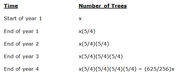
This problem is testing us on exponential growth. A good way to navigate this problem is to set up a growth chart. We are given that the number of trees increased by ¼, or 25 percent, each year. To obtain the number of trees this year, we multiply last year's number of trees by 125%, or 1.25, which can be fractionally expressed as 5/4.

Let's let x be the number of trees at the beginning (of the first year) of the 4-year period.

Image

We are given that there were 6,250 trees at the end of year 4 so we can set up the following equation:

(625/256)x = 6,250

625x = 6,250(256)

x = 10(256) = 2,560

Thus, there were 2,560 trees at the beginning of the 4-year period.

Answer:D

Scott Woodbury-Stewart
Founder and CEO
[email protected]

Image

See why Target Test Prep is rated 5 out of 5 stars on BEAT the GMAT. Read our reviews

ImageImage
Join the discussion

by Brent@GMATPrepNow » Fri Jun 26, 2015 9:29 am
Each year for 4 years, a farmer increased the number of trees in a certain orchard by 1/4 of the number of trees in the orchard of the preceding year. If all of the trees thrived and there were 6250 trees in the orchard at the end of 4 year period, how many trees were in the orchard at the beginning of the 4 year period?

A. 1250
B. 1563
C. 2250
D. 2560
E. 2752
Here's another approach:

First notice that, if the number of trees increases by 1/4, then the new number is 5/4 times the original number.

Let x = the # of trees in the orchard at the beginning of the 4 year period.
(5/4)x = # of trees after 1 year
(5/4)(5/4)x = # of trees after 2 years
(5/4)(5/4)(5/4)x = # of trees after 3 years
(5/4)(5/4)(5/4)(5/4)x = # of trees after 4 years

We're told that, after 4 years, there are 6250 trees, so we now know that:
(5/4)(5/4)(5/4)(5/4)x = 6250
(625/256)x = 6250
x = 6250(256/625)
x = 2560 = D

Cheers,
Brent
Brent Hanneson - Creator of GMATPrepNow.com
Image
Join the discussion

by Matt@VeritasPrep » Mon Jun 29, 2015 3:38 pm
Neil, you've got the right idea: the hiccup is that your numbers are the numbers for the BEGINNING of each year. Since we have the number AFTER four years, you would need to add a fifth year, since the number at the beginning of the fifth year = the number after four years.
Join the discussion