BREAKING: Target Test Prep releases Brand New 2026 On Demand GMAT prep course

Redeem

Target Test Prep · GMAT

Choose how you want to prepare

Learn live with an expert or move at your own pace. Every option includes the complete TTP study system.

★★★★★5.0559 reviews
GMATLiveTeach Starts Oct 17
Chris Peckover, Target Test Prep GMAT expert
LIVE ONLINE CLASSES

Get Ready for GMAT Test Day Faster with Live Online Classes

with Chris Peckover, 100th-Percentile GMAT Scorer

Oct 17 · Chris Peckover
Sat · 11:00 AM to 2:00 PM ET
Oct 20 · Chris Peckover
Tue, Thu · 8:00 to 10:00 PM ET
Oct 25 · Josh Braslow
Sun · 1:00 to 4:00 PM ET
Included
40 hours of live online classes + 6 months of TTP OnDemand
  • Attend the first class for free
  • Every class is recorded, so you never fall behind
View classes & enroll
Limited seats availableTarget Test Prep
EALiveTeachOnDemand 5 seats left Start anytime
EXECUTIVE ASSESSMENT

Target Test Prep EA OnDemand

Self-paced EA prep. Study on your schedule.

Logan Thompson
EXECUTIVE ASSESSMENT

Sep 6 to Dec 6, 2026

with Logan Thompson

165+ EA score guarantee
$05-day trial no automatic billing
Schedule
Sun · 9:30 AM to 12:30 PM ET
Included
40 hours of live online classes plus six months of access to the complete TTP EA OnDemand course.
  • 165+ EA Score Guarantee
  • 4,100+ Quant, Verbal, and Integrated Reasoning practice questions
  • 400+ hours of in-depth video lessons
  • 3,000+ step-by-step video solutions
View EA class & enroll Start free 5-day trial
Limited cohort · enrollment openTrial includes full course accessTarget Test Prep
GMATOnDemand Start anytime
SELF-PACED MASTERCLASS

Target Test Prep GMAT OnDemand

Complete access from day one. Study on your schedule.

715+ score guarantee
$0to start then $127/mo
  • Personalized study plan and analytics
  • Thousands of lessons and practice questions

Compare the format, schedule, and included access before enrolling. Prices and seat counts shown reflect the supplied offer details.

Data Sufficiency

Expert replies
Source: — Data Sufficiency |

by GMATGuruNY » Sun Sep 15, 2013 7:49 am
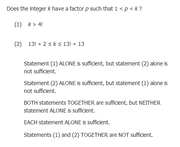
Does the integer k have a factor p such that 1 < p < k ?

(1) k > 4!
(2) 13! + 2 ≤ k ≤ 13! + 13
If k has NO FACTOR greater than 1 and less than k, then the only factors of k are 1 AND K ITSELF, implying that k is PRIME.
Question rephrased: Is k prime?

Statement 1: k > 4!
4! = 4*3*2 = 24.
If k = 29, then k is prime.
If k = 25, then k is not prime.
INSUFFICIENT.

Statement 2: 13! + 2 ≤ k ≤ 13! + 13
Apply a bit of REASON.
The values here are HUGE.
There is no way for us to prove that a huge number is prime.
Thus, every value of k that satisfies statement 2 must be NON-PRIME, since it would be impossible for us to prove that any of these values ARE prime.
SUFFICIENT.

The correct answer is B.

A useful take-away:
If a DS problem asks whether a HUGE NUMBER is prime, the answer almost certainly will be NO, since there is no way for us to prove that a huge number actually IS prime (unless we're told rather directly that it has no factors other than 1 and itself).

Here's the mathematical reasoning behind statement 2:
13! + 2 = 2(13*12*11*10*9*8*7*6*5*4*3*1 + 1) = 2 * integer.
Thus, 2 is a factor of 13! + 2.

13! + 3 = 3(13*12*11*10*9*8*7*6*5*4*2*1 + 1) = 3 * integer.
Thus, 3 is a factor of 13! + 3.

13! + 4 = 4(13*12*11*10*9*8*7*6*5*3*2*1 + 1) = 4 * integer.
Thus, 4 is a factor of 13! + 4.

The same reasoning can be applied to every value that satisfies statement 2.
Thus, none of the values that satisfy statement 2 will be prime.
Private tutor exclusively for the GMAT and GRE, with over 20 years of experience.
Followed here and elsewhere by over 1900 test-takers.
I have worked with students based in the US, Australia, Taiwan, China, Tajikistan, Kuwait, Saudi Arabia -- a long list of countries.
My students have been admitted to HBS, CBS, Tuck, Yale, Stern, Fuqua -- a long list of top programs.

As a tutor, I don't simply teach you how I would approach problems.
I unlock the best way for YOU to solve problems.

For more information, please email me (Mitch Hunt) at [email protected].
Student Review #1
Student Review #2
Student Review #3
Join the discussion

by Brent@GMATPrepNow » Sun Sep 15, 2013 7:51 am
Does the integer k have a factor p such that 1 < p < k ?

(1) k > 4!
(2) 13! + 2 ≤ k ≤ 13! + 13
Target question: Does the integer k have a factor p such that 1 < p < k ?

This question is a great candidate for rephrasing the target question. (We have a free video with tips on rephrasing the target question: https://www.gmatprepnow.com/module/gmat- ... cy?id=1100)

Let's look at a few cases to get a better idea of what the target question is asking.
- Try k = 6. Since 2 is a factor of 6, we can see that k DOES have a factor p such that 1<p<k.
- Try k = 10 Since 5 is a factor of 10, we can see that k DOES have a factor p such that 1<p<k.
- Try k = 16. Since 4 is a factor of 14, we can see that k DOES have a factor p such that 1<p<k.
- Try k = 5. Since 1 and 5 are the ONLY factors of 5, we can see that k does NOT have a factor p such that 1<p<k.
Aha, so if k is a prime number, then it CANNOT satisfy the condition of having a factor p such that 1 < p < k
In other words, the target question is really asking us whether k is a non-prime integer (aka a "composite integer")

REPHRASED target question: Is integer k a non-prime integer?

Statement 1: k > 4!
In other words, k > 24
This does not help us determine whether or not k is a non-prime integer? No.
Consider these two conflicting cases:
Case a: k = 25, in which case k is a non-prime integer
Case b: k = 29, in which case k is a prime integer
Since we cannot answer the target question with certainty, statement 1 is NOT SUFFICIENT

Statement 2: 13! + 2 ≤ k ≤ 13! + 13
Let's examine a few possible values for k.

k = 13! + 2
= (13)(12)(11)....(5)(4)(3)(2)(1) + 2
= 2[(13)(12)(11)....(5)(4)(3)(1) + 1]
Since k is a multiple of 2, k is a non-prime integer

k = 13! + 3
= (13)(12)(11)....(5)(4)(3)(2)(1) + 3
= 3[(13)(12)(11)....(5)(4)(2)(1) + 1]
Since k is a multiple of 3, k is a non-prime integer

k = 13! + 4
= (13)(12)(11)....(5)(4)(3)(2)(1) + 4
= 4[(13)(12)(11)....(5)(3)(2)(1) + 1]
Since k is a multiple of 4, k is a non-prime integer

As you can see, this pattern can be repeated all the way up to k = 13! + 13. In EVERY case, k is a non-prime integer

Since we can answer the target question with certainty, statement 2 is SUFFICIENT

Answer = B

Cheers,
Brent
Brent Hanneson - Creator of GMATPrepNow.com
Image
Join the discussion

by gulshank1 » Mon Sep 16, 2013 7:35 am
Thank You Gurus !! Once I rephrased, half of the question was solved, that was the catch :)
The link was very helpful.
Join the discussion