BREAKING: Target Test Prep releases Brand New 2026 On Demand GMAT prep course

Redeem

Area of a triangle

Expert replies
by Rastis » Wed May 27, 2015 7:31 am
What is the area of an equilateral triangle with a height of 8?

a) 48

b) 64

c) 64/root3

d) 128

e) 128/root3

The way I tackled this problem was that I cut the triangle in half creating two right triangles. I then recognized that since one of the sides was 8 and that you could derive the other sides of the smaller triangle by using the 3:4:5 concept, the bottom side was 6 (double 3 as 8 is doubling 4), which would make the entire bottom side of the triangle 12. Following the formula for area 1/2(8x12) I came up with 48, which is not the right answer.

Can someone explain to me how this approach is not correct?
Join the discussion
Source: — Problem Solving |

by DavidG@VeritasPrep » Wed May 27, 2015 7:59 am
The way I tackled this problem was that I cut the triangle in half creating two right triangles. I then recognized that since one of the sides was 8 and that you could derive the other sides of the smaller triangle by using the 3:4:5 concept
This is where you went wrong. When we drop a line down from the vertex of an equilateral triangle, we create two 30:60:90 triangles, not a 3:4:5. (Just because one of the sides is a multiple of 4, it doesn't mean you have a 3:4:5.)

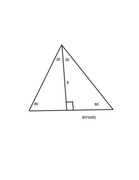
The ratio of the sides of the 30:60:90 triangle are x: x*root3:2x. The height of 8, in this case, is opposite the 60 degree angle, and so corresponds to the x*root3. If x*root3 = 8, then x = 8/(root3). 8/root3 is the measure of the side opposite the 30 degree angle. See here:


Image


Therefore, the area of each 30:60:90 triangle will be [8*8/(root3)]/2 = 32/root 3. If each of the 30:60:90 triangles has an area of 32/root 3, the area of the full triangle will be 64/root 3.
Last edited by DavidG@VeritasPrep on Wed May 27, 2015 11:03 am, edited 1 time in total.
Veritas Prep | GMAT Instructor

Veritas Prep Reviews
Save $100 off any live Veritas Prep GMAT Course
Join the discussion

by Ian Stewart » Wed May 27, 2015 10:25 am
You can solve even if you don't know the 30-60-90 ratios. When you draw a height between two equal sides of any isosceles triangle, and in particular in an equilateral triangle, you are always cutting the base exactly in half. So if the length of one side of the equilateral triangle here is x, then when we draw the height, we are cutting the base into two shorter lines each of length x/2. So each right triangle has sides of lengths x/2, 8 and x. Using Pythagoras we can find x:

(x/2)^2 + 8^2 = x^2
x^2/4 + 64 = x^2
64 = 3x^2/4
x^2 = 4*64/3
x = 2*8/√3 = 16/√3

Since the height is 8, and the base is x, the area is

bh/2 = (16 / √3 ) * 8 / 2 = 64 / √3

Mathematicians don't write fractions with square roots in the denominator, so the answer really ought to be written (multiplying on top and bottom of the fraction we just found by √3 ) as 64√3 / 3 .
For online GMAT math tutoring, or to buy my higher-level Quant books and problem sets, contact me at ianstewartgmat at gmail.com

ianstewartgmat.com
Join the discussion

by Ian Stewart » Wed May 27, 2015 10:27 am
DavidG@VeritasPrep wrote:
Therefore, the area of each 30:60:90 triangle will be [8*8/(root3)]/2 = 32 root 3. If each of the 30:60:90 triangles has an area of 32 root 3, the area of the full triangle will be 64 root 3.
David - I think you have a couple of typos at the end here, so you might want to edit your post - instead of "32 root3" and "64 root3", I think you meant to write "32 / root3" and "64 / root3".
For online GMAT math tutoring, or to buy my higher-level Quant books and problem sets, contact me at ianstewartgmat at gmail.com

ianstewartgmat.com
Join the discussion

by DavidG@VeritasPrep » Wed May 27, 2015 11:02 am
David - I think you have a couple of typos at the end here, so you might want to edit your post - instead of "32 root3" and "64 root3", I think you meant to write "32 / root3" and "64 / root3".
Good catch, Ian. Just edited.
Veritas Prep | GMAT Instructor

Veritas Prep Reviews
Save $100 off any live Veritas Prep GMAT Course
Join the discussion