BREAKING: Target Test Prep releases Brand New 2026 On Demand GMAT prep course

Redeem

Which of the following equations represents a line

Expert replies
by AAPL » Wed Jan 16, 2019 5:53 am

Timer

00:00

Answers

A

0%

B

0%

C

0%

D

0%

E

0%

Stats

Difficulty

0% CorrectAvg —

0% IncorrectAvg —

Manhattan Prep

Image

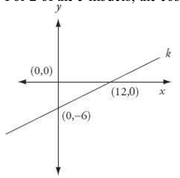
Which of the following represents a line perpendicular to line k in the figure above?
$$\text{A. } 3y+2x=-12$$
$$\text{B. } 2y+x=0$$
$$\text{C. } 2y-x=0$$
$$\text{D. } y+2x=12$$
$$\text{E. } y-2x=12$$
OA D
Join the discussion
Source: — Problem Solving |

by [email protected] » Wed Jan 16, 2019 10:49 am
Hi All,

We're asked which of the 5 answers is the equation for a line that is perpendicular to line K in the figure above. This question is based on line/graphing rules.

To start, a PERPENDICULAR line is one that has an "opposite inverse" slope (sometime called a "negative reciprocal" slope). For example, if we start with a line that has a slope of 3, then a perpendicular line to that line would have a slope of -1/3.

Here, we can determine the slope of the given line... (change in Ys)/(change in Xs) = (-6 - 0)/(0 - 12) = -6/-12 = +1/2

Since the given line has a slope of +1/2, we know that the perpendicular line will have a slope of -2/1 = -2.

At this point, it would help to convert the answer choices into "slope intercept" format --> re: Y = (M)(X) + B. We need a line that begins with Y = -2X...... It shouldn't take too much work to find the one answer that fits that pattern...

Final Answer: D

GMAT assassins aren't born, they're made,
Rich
Contact Rich at [email protected]
Image
Join the discussion