Hello AAPL.
Let's take a look at your question.
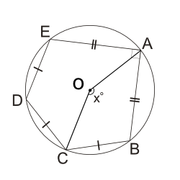
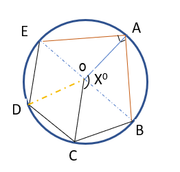
For the Inscribed angle theorem, we have that m(EOB)=2*m(EAB)=2*90º=180º.
Now, the triangle EAB is equilateral and it has a right angle, so the m(AEB)=m(EBA)=45º. If we consider the line AO, then m(EOA)=m(BOA)=90º.
So, xº=90+yº, where yº=m(COB).
Using again the Inscribed angle theorem we have that 180º=m(EOB)=2*m(EDB), it implies that m(EDB)=90º.
Now, the triangles DCB and DCE are isosceles, and m(DEC)=m(DCE)=m(CDB)=m(DBC)=Rº.
If we look the triangle DCE we can get that Rº+Rº+Rº+m(BDE)=180º, it implies that Rº=30º.
So, m(CDE)=120º.
Finally, using the Inscribed angle theorem, we have that the complementary angle in COE satisfy that 90º+90º+yº=2*m(CDE)=2*120=240º. That is to say, yº=60º.
So we get xº= 90º + yº = 90º+60º=150º.
The correct answer is A.
I hope this explanation may help you.
You have to take care when you read it.
I'm available if you'd like a follow-up.
Regards.