BREAKING: Target Test Prep releases Brand New 2026 On Demand GMAT prep course

Redeem

Target Test Prep · GMAT

Choose how you want to prepare

Learn live with an expert or move at your own pace. Every option includes the complete TTP study system.

★★★★★5.0559 reviews
GMATLiveTeach 7 seats left
Chris Peckover
NEXT LIVE COHORT

Oct 13 to Jan 7, 2027

with Chris Peckover

Schedule
Tue, Thu · 8:00 to 10:00 PM ET
Included
40 live hours + 6 months of GMAT OnDemand
  • Live instruction and real-time questions
  • Class recordings and assigned practice
View class & enroll
Limited cohort · enrollment openTarget Test Prep
EALiveTeach 5 seats left
Logan Thompson
EXECUTIVE ASSESSMENT

Sep 6 to Dec 6, 2026

with Logan Thompson

Schedule
Sun · 9:30 AM to 12:30 PM ET
Included
Live EA class + 6 months of EA OnDemand
  • Expert-led weekly online sessions
  • EA Masterclass access between classes
View EA class & enroll
Limited cohort · enrollment openTarget Test Prep
GMATOnDemand Start anytime
SELF-PACED MASTERCLASS

Target Test Prep GMAT OnDemand

Complete access from day one. Study on your schedule.

130-point score guarantee
$0to start then $127/mo
  • Personalized study plan and analytics
  • Thousands of lessons and practice questions

Compare the format, schedule, and included access before enrolling. Prices and seat counts shown reflect the supplied offer details.

What is the unit digit in (7^95 - 3^58) ?

Expert replies
by sachin_yadav » Mon Jun 17, 2013 11:23 am
What is the unit digit in (7^95 - 3^58) ?

(a). 0
(b). 4
(c). 6
(d). 7
(e). 9

What is the right approach for this one ? I solved many easier ones but finding this one hard.

Thanks & Regards
Sachin
Never surrender
Join the discussion
Source: — Problem Solving |

by fcabanski » Mon Jun 17, 2013 11:58 am
The bad news is you can't use a calculator on GMAT. The good news is most calculators won't show this answer - they will truncate and use scientific notation. Why is that good news? GMAT doesn't expect you to be a human calculator.


Identify the problem. It's an exponent problem and a product problem.


Set up the problem. Write what you know about the type/subject, and write the info the problem gives.

What do we know about exponents? They follow patterns.

Whenever there's a seemingly impossibly long pattern on the GMAT, check the first few numbers in the pattern. You'll find it isn't impossible.

The final digit of a number raised to some exponent can be, at most, one of 0,1,2,3,4,5,6,7,8,9 - that's a finite pattern with only 10 possibilities.

What do we know about products? The final digit of a product of two numbers is the final digit of the product of the final digits of each number.

348 x 976 has a final digit 8. That's the final digit of 8x6 = 48. So all we have to worry about here is the final digits of each number. And each "impossibly" large number has only 10 possibilities for its final digit. This isn't really hard.

What does the problem tell us?

7^95 - check the last digit pattern:

7^1 = 7
7^2 = 49
7^3 = 343
7^4 = 2401
7^5 = 16807 - the pattern already repeats. It repeats every 5th number exponent. So divide the exponent by 4. If the remainder is:
0 - last digit 1
1 - last digit 7
2 - last digit 9
3 - last digit 3

95 / 4 = 23 remainder 3. The last digit is 3


3^58 - check the last digit pattern.

3^1 = 3
3^2 = 9
3^3 = 27
3^4 = 81
3^5 = 243 It repeats every 5th number exponent. So divide the exponent by 4. If the remainder is:

0 - last digit 1
1 - last digit 3
2 - last digit 9
3 - last digit 7

58 / 4 = 14 R 2. The last digit is 9.


Solve the problem.

7^95 last digit is 3. 3^58 last digit is 9. 3 x 9 = 27. The last digit is 7. That's choice d.

3 x 9 = 27, The last digit is 7.

Keep in mind that all numbers raised to powers have a cycle. If you memorize the cycles, these problems are a breeze.

https://cat.wordpandit.com/concepts/cat- ... -a-number/

Expert GMAT tutor.
[email protected]

If you find one of my answers helpful, please click thank.

Contact me to discuss online GMAT tutoring.
Join the discussion

by sachin_yadav » Mon Jun 17, 2013 12:24 pm
Solve the problem.

7^95 last digit is 3. 3^58 last digit is 9. 3 x 9 = 27. The last digit is 7. That's choice d.

3 x 9 = 27, The last digit is 7.
Thanks fcabanski, but why will you multiply ? The question has a sign of subtraction.

Sachin
Never surrender
Join the discussion

by fcabanski » Mon Jun 17, 2013 3:46 pm
I multiplied because I wasn't paying attention. Or I multiplied because I was, er, testing you to see if you were paying attention. Yeah, that's it.

The problem is subtraction and exponents.

7^95 - last digit is 3.
3^58 - last digit is 9.

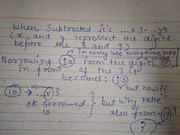
When subtracted it's ...x3 - ...y9 (x and y represent the digits before the 3 and 9). Borrowing 10 from the digit in front of the 3 it becomes:

13 - 9 = 4. That's answer b.
Expert GMAT tutor.
[email protected]

If you find one of my answers helpful, please click thank.

Contact me to discuss online GMAT tutoring.
Join the discussion

by Pawan DIXIT » Wed Feb 27, 2019 11:36 pm
fcabanski wrote:I multiplied because I wasn't paying attention. Or I multiplied because I was, er, testing you to see if you were paying attention. Yeah, that's it.

The problem is subtraction and exponents.

7^95 - last digit is 3.
3^58 - last digit is 9.

When subtracted it's ...x3 - ...y9 (x and y represent the digits before the 3 and 9). Borrowing 10 from the digit in front of the 3 it becomes:

13 - 9 = 4. That's answer b.
Image
Join the discussion

by Scott@TargetTestPrep » Wed Mar 06, 2019 6:55 pm
sachin_yadav wrote:What is the unit digit in (7^95 - 3^58) ?

(a). 0
(b). 4
(c). 6
(d). 7
(e). 9
We can evaluate 3^n for positive integer values of n. That is, let's look at the pattern of the units digits of powers of 3. When writing out the pattern, notice that we are ONLY concerned with the units digit of 3 raised to each power.

3^1 = 3

3^2 = 9

3^3 = 7

3^4 = 1

3^5 = 3

The pattern of the units digits of powers of 3 repeats every 4 exponents. The pattern is 3-9-7-1. In this pattern, all positive exponents that are multiples of 4 will have 1 as their units digit. Thus:

Following the pattern, we see that 3^56 has a units digit of 1, 3^57 has a units digit of 3, and 3^58 has a units digit of 9.

Next, we can evaluate 7^n for positive integer values of n. That is, let's look at the pattern of the units digits of powers of 7. When writing out the pattern, notice that we are ONLY concerned with the units digit of 7 raised to each power.

7^1 = 7

7^2 = 9

7^3 = 3

7^4 = 1

7^5 = 7

The pattern of the units digits of powers of 7 repeats every 4 exponents. The pattern is 7-9-3-1. In this pattern, all positive exponents that are multiples of 4 will have 1 as their units digit. Thus:

7^96 has a units digit of 1 and 7^95 has a units digit of 3.

So we have 3 - 9; however since 7^95 is larger than 3^58, we see that the number ending in 3 must be a larger number than the number ending in 9. In any case 13 - 9 = 4, 23 - 9 = 14, 103 - 9 = 94. So in all cases the units digit is 4.

Answer: B

Scott Woodbury-Stewart
Founder and CEO
[email protected]

Image

See why Target Test Prep is rated 5 out of 5 stars on BEAT the GMAT. Read our reviews

ImageImage
Join the discussion