BREAKING: Target Test Prep releases Brand New 2026 On Demand GMAT prep course

Redeem

what is the area of the un-grazed, un-shaded region?

Expert replies
by AAPL » Mon Jan 29, 2018 7:18 am
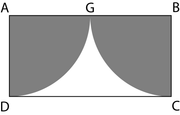
Image

Zoom here, https://postimg.cc/image/3sluthknf/

Two goats are each tied at corners A and B of a fenced rectangular field of area 50. The goat's tethers allow them to graze within circular regions of radius 5, centered at A and B, respectively. The two grazing areas meet at point G, but do not overlap. If the goats graze the entire shaded area within their respective reach by the end of the day, what is the area of the un-grazed, un-shaded regiion?

$$A.\ 50-25\pi$$
$$B.\ 25\left(2-\frac{\pi}{2}\right)$$
$$C.\ 25\left(2-\frac{\pi}{4}\right)$$
$$D.\ 12.5\pi$$
$$E.\ 25\pi$$

The OA is B.

I know that I just need determine the area of the two semicircular regions and it will be
$$2\cdot\left(\frac{1}{4}\pi\cdot r^2\right)=\frac{1}{2}\pi\cdot r^2=\frac{25}{2}\pi$$
Then the area of the un-shaded region will be,
$$50-\frac{25}{2}\pi\ =\ 25\left(2-\frac{\pi}{2}\right)$$

But, is there a strategic approach to this PS question? Can any experts help me, please? Thanks!
Join the discussion
Source: — Problem Solving |

by EconomistGMATTutor » Fri Feb 02, 2018 11:32 am
Two goats are each tied at corners A and B of a fenced rectangular field of area 50. The goat's tethers allow them to graze within circular regions of radius 5, centered at A and B, respectively. The two grazing areas meet at point G, but do not overlap. If the goats graze the entire shaded area within their respective reach by the end of the day, what is the area of the un-grazed, un-shaded regiion?

$$A.\ 50-25\pi$$
$$B.\ 25\left(2-\frac{\pi}{2}\right)$$
$$C.\ 25\left(2-\frac{\pi}{4}\right)$$
$$D.\ 12.5\pi$$
$$E.\ 25\pi$$

The OA is B.
Hi AAPL,
Let's take a look at your question.

In the rectangle ABCD,
Let
BC =AD = x
Then
BG = AG = x because these are the radii of the circular area.
Hence we can write the dimensions of the rectangular area as:
Width = BC = x
Length = AB = x + x = 2x

The area equation can be written as:
$$Area\ =\ Length\ \times\ Width$$
$$Area\ =\ \left(2x\right)\times\ \left(x\right)$$
$$50\ =\ 2x^2$$
$$x^2=25$$
$$x=5$$
Therefore,
$$Width=5$$
$$Length=10$$

Now we will use the width of the rectangle as the radius of the circular area to find the area of shaded region. We can see that the shaded area consists of two quarter circle which makes a total of half the circle. So we can find its are as half the area of a circle.
$$\text{Area of shaded region}=\ \frac{1}{2}\pi r^2$$
$$\text{Area of shaded region}=\ \frac{1}{2}\pi\left(5\right)^2$$
$$\text{Area of shaded region}=\ \frac{25}{2}\pi$$

Now we can find the area of the region that is not shaded by subtracting the above area from the total area of the rectangle.
$$\text{Area of un-shaded region}=50-\ \frac{25}{2}\pi$$
$$\text{Area of unshaded region}=25\left(2-\ \frac{\pi}{2}\right)$$

Therefore, Option B is correct.

Hope it helps.
I am available if you'd like any follow up.
GMAT Prep From The Economist
We offer 70+ point score improvement money back guarantee.
Our average student improves 98 points.

Image
Join the discussion