safina wrote:
The waiter at a restaurant has noticed that 60% of the couples order dessert and coffee. However, 20% of the couples who order dessert don't order coffee. What is the probability that the next couples the waiter seats will not order dessert?
A) 20%
B) 25%
C) 40%
D) 60%
E) 75%
Here's another way to set up the Double Matrix.
Before showing this, I'll mention that the Double Matrix Method can be used for most questions featuring a population in which each member has two characteristics associated with it.
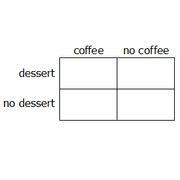
Here, we have a population of couples, and the two characteristics are:
- dessert or no dessert
- coffee or no coffee
So, we can begin my setting up our diagram as follows:
NOTICE that the question does
not ask us to find the actual number of couples who didn't have dessert. It asks us to find a probability. This means we can assign whatever value we wish to the total number of couples.
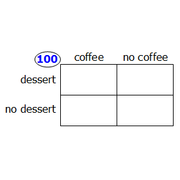
So, let's say there are 100 couples and add this to our diagram:
60% of the couples order dessert and coffee
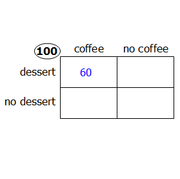
60% of 100 = 60, so 60 couples order dessert AND coffee.
Add that to the diagram to get:
20% of the couples who order dessert don't order coffee.
Hmmm, we don't know how many couples order dessert, so it's hard to find 20% of that value.
So, let's assign a variable.
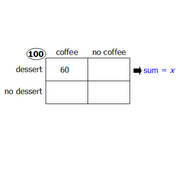
Let's let x = number of couples who order dessert, and add it to our diagram:

So, x of the 100 couples order dessert.
20% of the couples who order dessert don't order coffee.
If x couples order dessert, then 20% of x don't order coffee.
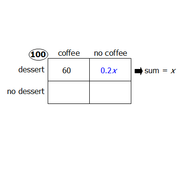
In other words, 0.2x = number of couples don't order coffee.
Add this to our diagram:
At this point, we see that the top two boxes add to x.
So, we can write the equation: 60 + 0.2x = x
Rearrange to get 60 = 0.8x
Rewrite 0.8 as fraction to get: 60 = (4/5)x
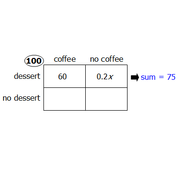
Multiply both sides by 5/4 to get: 75 = x
If x = 75, then we know that 75 of the 100 couples order dessert:
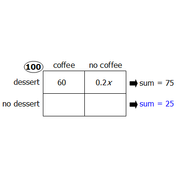
This means that 25 of the 100 couples DON'T order dessert:
So, P(couple doesn't order dessert) = 25/100 = 25% =
B
Cheers,
Brent
---------------------------------------------------------
To learn more about this technique, watch our free video:
https://www.gmatprepnow.com/module/gmat- ... ems?id=919
Once you're familiar with the Double Matrix Method, you can attempt these additional practice questions:
Easy Problem Solving questions
-
https://www.beatthegmat.com/the-aam-aadm ... 72242.html
-
https://www.beatthegmat.com/finance-majo ... 67425.html
Medium Problem Solving questions
-
https://www.beatthegmat.com/probability- ... 73360.html
-
https://www.beatthegmat.com/posted-speed ... 72374.html
-
https://www.beatthegmat.com/motel-t271938.html
-
https://www.beatthegmat.com/of-the-appli ... 70255.html
-
https://www.beatthegmat.com/opening-nigh ... 64869.html
-
https://www.beatthegmat.com/ds-french-ja ... 22297.html
Difficult Problem Solving questions
-
https://www.beatthegmat.com/ratio-problem-t268339.html
-
https://www.beatthegmat.com/overlapping- ... 65223.html
-
https://www.beatthegmat.com/fractions-t264254.html
-
https://www.beatthegmat.com/overlapping- ... 64092.html
-
https://www.beatthegmat.com/mba/2011/05/ ... question-2
Easy Data Sufficiency questions
-
https://www.beatthegmat.com/for-what-per ... 70596.html
-
https://www.beatthegmat.com/ds-quest-t187706.html
Medium Data Sufficiency questions
-
https://www.beatthegmat.com/sets-matrix-ds-t271914.html
-
https://www.beatthegmat.com/each-of-peop ... 71375.html
-
https://www.beatthegmat.com/a-manufacturer-t270331.html
-
https://www.beatthegmat.com/in-costume-f ... 69355.html
-
https://www.beatthegmat.com/mba/2011/05/ ... question-1
Difficult Data Sufficiency questions
-
https://www.beatthegmat.com/double-set-m ... 71423.html
-
https://www.beatthegmat.com/sets-t269449.html
-
https://www.beatthegmat.com/mba/2011/05/ ... question-3