BREAKING: Target Test Prep releases Brand New 2026 On Demand GMAT prep course

Redeem

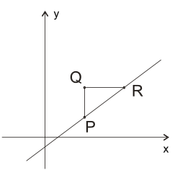
In the figure above, segments PQ and QR are each parallel to

Expert replies
by BTGmoderatorDC » Sun Jan 20, 2019 12:11 am

Timer

00:00

Answers

A

B

C

D

E

Stats

Difficulty

Image

In the figure above, segments PQ and QR are each parallel to one of the coordinate axes. What is the ratio of the length of QR to PQ?

(1) The slope of the line that passes through points P and R is 0.75.
(2) The coordinates of point P are (4,2).

OA A

Source: Ecpnomist GMAT
Join the discussion
Source: — Data Sufficiency |

by Jay@ManhattanReview » Sun Jan 20, 2019 4:03 am
BTGmoderatorDC wrote:Image

In the figure above, segments PQ and QR are each parallel to one of the coordinate axes. What is the ratio of the length of QR to PQ?

(1) The slope of the line that passes through points P and R is 0.75.
(2) The coordinates of point P are (4,2).

OA A

Source: Ecpnomist GMAT
We have to get the value of the ratio of the length of QR to PQ.

Let's take each statement one by one.

(1) The slope of the line that passes through points P and R is 0.75.

Say the coordinates of points P are (x1, y1) and the coordinates of points R are (x2, y2); thus, the coordinates of points Q would be (x1, y2).

Thus, QR = (x2 - x1) and QP = (y2 - y1)

Thus, QR/QP = (x2 - x1)/(y2 - y1)

It is given that the slope of the line that passes through points P and R is 0.75; thus, QP/QR = slope = (y2 - y1)/(x2 - x1) = 0.75

Thus, QR/QP = 1/0.75 = 4/3. Sufficient.

(2) The coordinates of point P are (4,2).

We do not have information about x2 and y2. Insufficient.

The correct answer: A

Hope this helps!

-Jay
_________________
Manhattan Review

Locations: Manhattan Review Kukatpally | GMAT Prep Jayanagar | GRE Prep Tarnaka | Madhapur GRE Coaching | and many more...

Schedule your free consultation with an experienced GMAT Prep Advisor! Click here.
Join the discussion

by ceilidh.erickson » Mon Jan 21, 2019 1:59 pm
It is generally true in Data Sufficiency that if the question asks you for a PROPORTION, you do not need concrete values to answer it.

In this case, we're asked for a RATIO of horizontal and vertical lengths, but not for actual values. We can think of any slope as a RATIO of vertical to horizontal (rise/run). For example, a slope of 2/3 means "rise 2, run 3." We could go from (0, 0) to (2, 3) to (4, 6) to (8, 9), etc. Between any two of these points, the ratio of the vertical distance to the horizontal distance will be 2 to 3.

Thus, when the question asks "What is the ratio of the length of QR to PQ?", we could rephrase as:
what is the slope of line PR?

-----------------------------------------------------------------------------------------
(1) The slope of the line that passes through points P and R is 0.75.

This answers our target question. Sufficient.
-----------------------------------------------------------------------------------------
(2) The coordinates of point P are (4,2).

A single set of values tells us nothing about proportions. Insufficient.
-----------------------------------------------------------------------------------------
The answer is A.
Ceilidh Erickson
EdM in Mind, Brain, and Education
Harvard Graduate School of Education
Join the discussion