BREAKING: Target Test Prep releases Brand New 2026 On Demand GMAT prep course

Redeem

Target Test Prep · GMAT

Choose how you want to prepare

Learn live with an expert or move at your own pace. Every option includes the complete TTP study system.

★★★★★5.0559 reviews
GMATLiveTeach Starts Oct 17
Chris Peckover, Target Test Prep GMAT expert
LIVE ONLINE CLASSES

Get Ready for GMAT Test Day Faster with Live Online Classes

with Chris Peckover, 100th-Percentile GMAT Scorer

Oct 17 · Chris Peckover
Sat · 11:00 AM to 2:00 PM ET
Oct 20 · Chris Peckover
Tue, Thu · 8:00 to 10:00 PM ET
Oct 25 · Josh Braslow
Sun · 1:00 to 4:00 PM ET
Included
40 hours of live online classes + 6 months of TTP OnDemand
  • Attend the first class for free
  • Every class is recorded, so you never fall behind
View classes & enroll
Limited seats availableTarget Test Prep
EALiveTeachOnDemand 5 seats left Start anytime
EXECUTIVE ASSESSMENT

Target Test Prep EA OnDemand

Self-paced EA prep. Study on your schedule.

Logan Thompson
EXECUTIVE ASSESSMENT

Sep 6 to Dec 6, 2026

with Logan Thompson

165+ EA score guarantee
$05-day trial no automatic billing
Schedule
Sun · 9:30 AM to 12:30 PM ET
Included
40 hours of live online classes plus six months of access to the complete TTP EA OnDemand course.
  • 165+ EA Score Guarantee
  • 4,100+ Quant, Verbal, and Integrated Reasoning practice questions
  • 400+ hours of in-depth video lessons
  • 3,000+ step-by-step video solutions
View EA class & enroll Start free 5-day trial
Limited cohort · enrollment openTrial includes full course accessTarget Test Prep
GMATOnDemand Start anytime
SELF-PACED MASTERCLASS

Target Test Prep GMAT OnDemand

Complete access from day one. Study on your schedule.

715+ score guarantee
$0to start then $127/mo
  • Personalized study plan and analytics
  • Thousands of lessons and practice questions

Compare the format, schedule, and included access before enrolling. Prices and seat counts shown reflect the supplied offer details.

GMAT Prep Exam Pack 2 DS Problem

Expert replies
Source: — Data Sufficiency |

by GMATGuruNY » Mon Aug 22, 2016 8:16 am
Question stem, rephrased:
What is A� : A₂ : A₃?

Statement 1: A₂ = A₃
Thus, A₂ : A₃ = 1:1.
No information about A�.
INSUFFICIENT.

Statement 2: A₂ + A₃ = 2A�
Case 1: A�=2, A₂=1, A₃=3
In this case, A� : A₂ : A₃ = 2:1:3.
Case 2: A�=2, A₂=2, A₃=2
In this case, A� : A₂ : A₃ = 2:2:2 = 1:1:1.
Since A� : A₂ : A₃ can be different values, INSUFFICIENT.

Statements combined:
Substituting A₂ = A₃ into A₂ + A₃ = 2A�, we get:
A₂ + A₂ = 2A�
2A₂ = 2A�
A₂ = A�.
Since A� = A₂ and A₂ = A₃, A� = A₂ = A₃.
Thus:
A� : A₂ : A₃ = 1:1:1.
SUFFICIENT.

The correct answer is C.
Private tutor exclusively for the GMAT and GRE, with over 20 years of experience.
Followed here and elsewhere by over 1900 test-takers.
I have worked with students based in the US, Australia, Taiwan, China, Tajikistan, Kuwait, Saudi Arabia -- a long list of countries.
My students have been admitted to HBS, CBS, Tuck, Yale, Stern, Fuqua -- a long list of top programs.

As a tutor, I don't simply teach you how I would approach problems.
I unlock the best way for YOU to solve problems.

For more information, please email me (Mitch Hunt) at [email protected].
Student Review #1
Student Review #2
Student Review #3
Join the discussion

by MartyMurray » Wed Aug 24, 2016 10:03 pm
The answer to this seemed pretty straightforward, but I was wondering whether, since we are dealing with concentric circles, there is some way that one both of the statements could be sufficient on its or their own.

I proved that neither is sufficient by using the following ideas.

Statement 1: A₂ = A₃

Even if there is some reason that A�, A₂ and A₃ have to be related, A� could be 0, clearly. In that case A�/A₂ would be 0 and A₂/A₃ would be 1.

Meanwhile, A� does not have to be 0. If A� is not 0, then A�/A₂ is not 0. So already we have two different values for one of the ratios.

Insufficient.

Statement 2: A₂ + A₃ = 2A�

In this case, either A₂ or A₃ could be 0. If A₂ = 0, we get a different set of ratios from what we get if A₃ = 0.

Insufficient.

So, no, the fact that they are concentric circles does not make either statement sufficient on its own.

What a funny question, having all that stuff about circles, radii, cm and areas obscuring what is essentially the most basic ratio question ever. The question could have been simply, "A�, A₂ and A₃ are numbers. What is the ratio A� : A₂ : A₃?", but noooo. They give you all that other information, and you have to prove that it's useless. LOL
Marty Murray
Perfect Scoring Tutor With Over a Decade of Experience
MartyMurrayCoaching.com
Contact me at [email protected] for a free consultation.
Join the discussion

by Ovid » Thu Jul 20, 2017 12:11 pm
Circle 1, Circle 2 and Circle 3 have the same center, and have a radius r1<r2<r3. Let A1 be the area of circle 1, let A2 be the area of the region within Circle 2 and outside Circle 1, and let A3 be the area of the region within Circle 3 and outside Circle 2."

I found your explanation helpful, GMATGuruNY.

However, wanted to ask about the condition provided in the question stem that states, "r1<r2<r3."

Given the definition of a circle is πr^2, and substituting the definition of a circle into the ratio of the three circle's areas, I inferred that:

= A1 : A2 : A3
and replacing area with the definition of a circle:
= π(radius 1)^2: π(radius 2)^2 : π(radius 3)^2
results in the inequality below, given what we know about the relative sizes of the radii.
= A1 < A2 < A3

However, my logic is not correct given A2 = A3 in Statement 1.

How can A2 = A3 when the radii cannot be equal?

Thanks
Join the discussion

by GMATGuruNY » Thu Jul 20, 2017 12:28 pm
Ovid wrote:Circle 1, Circle 2 and Circle 3 have the same center, and have a radius r1<r2<r3. --, let A2 be the area of the region within Circle 2 and outside Circle 1, and let A3 be the area of the region within Circle 3 and outside Circle 2."

I found your explanation helpful, GMATGuruNY.

However, wanted to ask about the condition provided in the question stem that states, "r1<r2<r3."

Given the definition of a circle is πr^2, and substituting the definition of a circle into the ratio of the three circle's areas, I inferred that:

= A1 : A2 : A3
and replacing area with the definition of a circle:
= π(radius 1)^2: π(radius 2)^2 : π(radius 3)^2
results in the inequality below, given what we know about the relative sizes of the radii.
= A1 < A2 < A3

However, my logic is not correct given A2 = A3 in Statement 1.

How can A2 = A3 when the radii cannot be equal?

Thanks
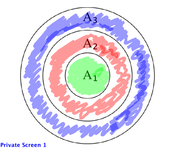
A₂ and A₃ do not represent the areas of the two larger circles.
Reread this portion of the prompt:
Let A� be the area of circle 1.
Let Aâ‚‚ be the area of the region within Circle 2 and outside Circle 1.
Let A₃ be the area of the region within Circle 3 and outside Circle 2.

These statements imply the following figure:
Image
In accordance with the prompt:
A� = the green portion above.
Aâ‚‚ = the red portion above.
A₃ = the blue portion above.
Private tutor exclusively for the GMAT and GRE, with over 20 years of experience.
Followed here and elsewhere by over 1900 test-takers.
I have worked with students based in the US, Australia, Taiwan, China, Tajikistan, Kuwait, Saudi Arabia -- a long list of countries.
My students have been admitted to HBS, CBS, Tuck, Yale, Stern, Fuqua -- a long list of top programs.

As a tutor, I don't simply teach you how I would approach problems.
I unlock the best way for YOU to solve problems.

For more information, please email me (Mitch Hunt) at [email protected].
Student Review #1
Student Review #2
Student Review #3
Join the discussion

















