Don't know how to approach this problem. Started off by assuming basic values for r1 and r2, but got stuck. Please help.
TIA.
TIA.
- Attachments
-
BREAKING: Target Test Prep releases Brand New 2026 On Demand GMAT prep course
RedeemTarget Test Prep · GMAT
Learn live with an expert or move at your own pace. Every option includes the complete TTP study system.

with Chris Peckover, 100th-Percentile GMAT Scorer

Self-paced EA prep. Study on your schedule.

with Logan Thompson
Complete access from day one. Study on your schedule.
Compare the format, schedule, and included access before enrolling. Prices and seat counts shown reflect the supplied offer details.


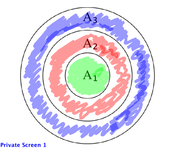
A₂ and A₃ do not represent the areas of the two larger circles.Ovid wrote:Circle 1, Circle 2 and Circle 3 have the same center, and have a radius r1<r2<r3. --, let A2 be the area of the region within Circle 2 and outside Circle 1, and let A3 be the area of the region within Circle 3 and outside Circle 2."
I found your explanation helpful, GMATGuruNY.
However, wanted to ask about the condition provided in the question stem that states, "r1<r2<r3."
Given the definition of a circle is πr^2, and substituting the definition of a circle into the ratio of the three circle's areas, I inferred that:
= A1 : A2 : A3
and replacing area with the definition of a circle:
= π(radius 1)^2: π(radius 2)^2 : π(radius 3)^2
results in the inequality below, given what we know about the relative sizes of the radii.
= A1 < A2 < A3
However, my logic is not correct given A2 = A3 in Statement 1.
How can A2 = A3 when the radii cannot be equal?
Thanks
New here Create free account



















