BREAKING: Target Test Prep releases Brand New 2026 On Demand GMAT prep course

Redeem

Target Test Prep · GMAT

Choose how you want to prepare

Learn live with an expert or move at your own pace. Every option includes the complete TTP study system.

★★★★★5.0559 reviews
GMATLiveTeach Starts Oct 17
Chris Peckover, Target Test Prep GMAT expert
LIVE ONLINE CLASSES

Get Ready for GMAT Test Day Faster with Live Online Classes

with Chris Peckover, 100th-Percentile GMAT Scorer

Oct 17 · Chris Peckover
Sat · 11:00 AM to 2:00 PM ET
Oct 20 · Chris Peckover
Tue, Thu · 8:00 to 10:00 PM ET
Oct 25 · Josh Braslow
Sun · 1:00 to 4:00 PM ET
Included
40 hours of live online classes + 6 months of TTP OnDemand
  • Attend the first class for free
  • Every class is recorded, so you never fall behind
View classes & enroll
Limited seats availableTarget Test Prep
EALiveTeachOnDemand 5 seats left Start anytime
EXECUTIVE ASSESSMENT

Target Test Prep EA OnDemand

Self-paced EA prep. Study on your schedule.

Logan Thompson
EXECUTIVE ASSESSMENT

Sep 6 to Dec 6, 2026

with Logan Thompson

165+ EA score guarantee
$05-day trial no automatic billing
Schedule
Sun · 9:30 AM to 12:30 PM ET
Included
40 hours of live online classes plus six months of access to the complete TTP EA OnDemand course.
  • 165+ EA Score Guarantee
  • 4,100+ Quant, Verbal, and Integrated Reasoning practice questions
  • 400+ hours of in-depth video lessons
  • 3,000+ step-by-step video solutions
View EA class & enroll Start free 5-day trial
Limited cohort · enrollment openTrial includes full course accessTarget Test Prep
GMATOnDemand Start anytime
SELF-PACED MASTERCLASS

Target Test Prep GMAT OnDemand

Complete access from day one. Study on your schedule.

715+ score guarantee
$0to start then $127/mo
  • Personalized study plan and analytics
  • Thousands of lessons and practice questions

Compare the format, schedule, and included access before enrolling. Prices and seat counts shown reflect the supplied offer details.

Geometry

Expert replies
by RiyaR » Sun Oct 05, 2014 3:58 am
A circle with a radius of 4 has an equilateral traingle inscribed in it. What is the perimeter of the inscribed equilateral triangle?

A) 6 root 2
B) 6 root 3
C) 12 root 3
D) 12 root2
E) 24
Join the discussion
Source: — Problem Solving |

by GMATGuruNY » Sun Oct 05, 2014 4:08 am
Check my posts below:

Ballparking method:
https://www.beatthegmat.com/ps-triangle-t98932.html (2 posts)
Alternate method:
https://www.beatthegmat.com/difficult-ge ... 95817.html
Private tutor exclusively for the GMAT and GRE, with over 20 years of experience.
Followed here and elsewhere by over 1900 test-takers.
I have worked with students based in the US, Australia, Taiwan, China, Tajikistan, Kuwait, Saudi Arabia -- a long list of countries.
My students have been admitted to HBS, CBS, Tuck, Yale, Stern, Fuqua -- a long list of top programs.

As a tutor, I don't simply teach you how I would approach problems.
I unlock the best way for YOU to solve problems.

For more information, please email me (Mitch Hunt) at [email protected].
Student Review #1
Student Review #2
Student Review #3
Join the discussion

Geometry

by Brent@GMATPrepNow » Sun Oct 05, 2014 7:39 am
RiyaR wrote:A circle with a radius of 4 has an equilateral triangle inscribed in it. What is the perimeter of the inscribed equilateral triangle?

A) 6√2
B) 6√3
C) 12√3
D) 12√2
E) 24
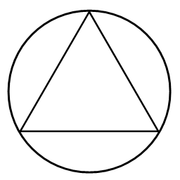
So, here's what the diagram looks like.
Image

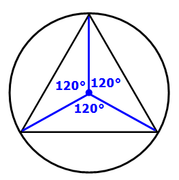
If we draw lines from the center to each vertex, we get the following:
Image

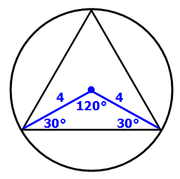
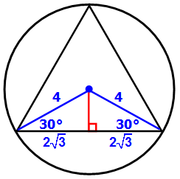
Since the radii have length 4, we can add that here:
Image

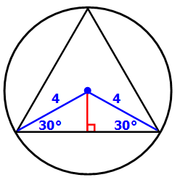
Now we'll draw a line from the center that is PERPENDICULAR to one side of the tirangle.
Image
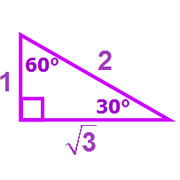
We now have a SPECIAL 30-60-90 right triangle.

Here's the base version of this SPECIAL TRIANGLE
Image

We can see that the each 30-60-90 triangle in the diagram is TWICE as big as the base version. So, each side opposite the 60º angle must have length 2√3
Image

This means ONE side of the equilateral triangle has length 4√3, so the PERIMETER = 4√3 + 4√3 + 4√3 = 12√3

Answer: C

Cheers,
Brent
Last edited by Brent@GMATPrepNow on Thu Apr 19, 2018 1:18 pm, edited 1 time in total.
Brent Hanneson - Creator of GMATPrepNow.com
Image
Join the discussion

by [email protected] » Sun Oct 05, 2014 10:15 am
Hi RiyaR,

The answer choices to this question are written in such a way so that you can logically get to the correct answer and avoid most of the math. Here's why:

We're told that the radius of the circle = 4, so the diameter = 8.

An equilateral triangle inscribed into a circle will have 3 equal sides that are each GREATER than the radius but LESS than the diameter. We're asked to figure out the perimeter of the triangle.

3(radius) = 12 --> too small
3(diameter) = 24 --> too big

With this, we can eliminate A and B (too small) and E (too big)

With the remaining two answers (12root3 and 12root2), we have to think about which root we're likely to be dealing with. An equilateral triangle has three 60 degree angles in it, so we should be able to break this triangle into smaller triangles (probably a bunch of 30/60/90 triangles - which include a root3 in the "math" for figuring out some of the side lengths). It stands to reason that root3 would be part of the final calculation.

Final Answer: C

GMAT assassins aren't born, they're made,
Rich
Contact Rich at [email protected]
Image
Join the discussion

by Jacob003 » Tue Oct 07, 2014 9:50 am
Vertices of a quadrilateral ABCD are A(0, 0), B(4, 5), C(9, 9) and D(5, 4). What is the shape of the quadrilateral?
you can check for more questions here https://questionbank.4gmat.com/mba_prep_ ... s/geometry/
Join the discussion

by bakhtawer » Tue Dec 29, 2015 2:37 am
Hi I can't seem to find videos for Coordinate geometry in the geometry module.Could anyone guide me >
Join the discussion

by Brent@GMATPrepNow » Tue Dec 29, 2015 5:49 am
IMO, coordinate geometry is more about solutions to equations than it is to geometry.
We (GMAT Prep Now) place it in our Algebra & Equation-Solving module (https://www.gmatprepnow.com/module/gmat- ... on-solving)

See videos #43 to #54

Cheers,
Brent
Last edited by Brent@GMATPrepNow on Tue May 17, 2016 3:54 pm, edited 1 time in total.
Brent Hanneson - Creator of GMATPrepNow.com
Image
Join the discussion

by [email protected] » Tue Dec 29, 2015 10:09 pm
Hi bakhtawer,

You've mentioned that you can't find certain videos in the materials that you're using - but what resources are you currently using to study for the GMAT?

GMAT assassins aren't born, they're made,
Rich
Contact Rich at [email protected]
Image
Join the discussion

by prada » Tue May 17, 2016 2:37 pm
Hey Guys, maybe there is some concepts I am missing but how did Brent conclude that the angles of the triangle are 120 degrees? From there the vertices would be radii? Is there some rule about inscribed equilateral triangles I don't know? I was trying to imagine the shape of the inscribed triangle in my head and I was thinking hmmmm maybe the base of the triangle could be the diameter of the circle maybe not? thx
Join the discussion

by [email protected] » Tue May 17, 2016 11:03 pm
Hi prada,

There are a few specific rules at play in this question that help to make the deductions that come later:

1) The triangle is EQUILATERAL, which means that the 3 sides are the SAME length (and by extension, none of them could be the diameter of the circle - since a diameter is the longest distance between any two points on the circle, you can't make a triangle with three of those lengths).
2) Since the triangle is INSCRIBED, and each of the vertices is the same distance from the center of the circle, that triangle can be 'cut into' three identical ISOSCELES triangles.
3) Those 3 identical isosceles triangles are centered around the center of the circle. Since a circle is 360 degrees, and the triangles are identical, each of those 'central' angles is 120 degrees (and by extension, each of the triangles is a 30/30/120 triangle - and each of THOSE triangles can be cut into two 30/60/90 triangles).

GMAT assassins aren't born, they're made,
Rich
Contact Rich at [email protected]
Image
Join the discussion

by prada » Wed May 18, 2016 7:04 am
[email protected] wrote:Hi prada,

There are a few specific rules at play in this question that help to make the deductions that come later:

1) The triangle is EQUILATERAL, which means that the 3 sides are the SAME length (and by extension, none of them could be the diameter of the circle - since a diameter is the longest distance between any two points on the circle, you can't make a triangle with three of those lengths).
2) Since the triangle is INSCRIBED, and each of the vertices is the same distance from the center of the circle, that triangle can be 'cut into' three identical ISOSCELES triangles.
3) Those 3 identical isosceles triangles are centered around the center of the circle. Since a circle is 360 degrees, and the triangles are identical, each of those 'central' angles is 120 degrees (and by extension, each of the triangles is a 30/30/120 triangle - and each of THOSE triangles can be cut into two 30/60/90 triangles).

GMAT assassins aren't born, they're made,
Rich

Cool, thanks Rich. I dont recall ever seeing that info in Magoosh or MGMAT study guides. Of course that can be deduced by knowing the "elementary" rules and properties. These are things I need to study and think about more. thx
Join the discussion

by Gurpreet singh » Tue Jun 07, 2016 6:42 am
Formula for radius of an inscribed equilateral triangle =a/root3

ie r=a/root3

r=4
a=side of the traingle

ie
4=a/root3=4root3=a multiply both the sides by 3(perimeter of a traingle is sum of 3 sides)

ans-12root3[/spoiler][/list]
Join the discussion

by Matt@VeritasPrep » Tue Jun 07, 2016 11:07 pm
Brent@GMATPrepNow wrote:IMO, coordinate geometry is more about solutions to equations than it is to geometry.
Totally agree!

Also think that geometry seems to be dying on the GMAT: there is so much less of it these days, particularly the more elaborate questions. That can always change, but the more arcane (by GMAT standards) geometric properties seem less relevant than ever.
Join the discussion