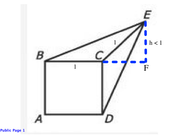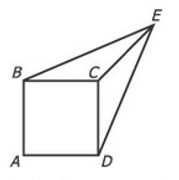
In the figure, each side of square ABCD has length 1, the length of line Segment CE is 1, and the length of line segment BE is equal to the length of line segment DE. What is the area of the triangular region BCE?
A. 1/3
B. √2/4
C. 1/2
D. √2/2
E. 3/4
Approach 1:
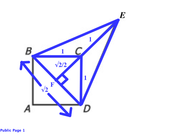
In square ABCD, since s=1, BD = √2 and CF = √2/2.
It is given that CE=1.
Thus, EF = √2/2 + 1.
∆BED = (1/2)(BD)(EF) = (1/2)(√2)(√2/2 + 1) = (1/2)(1 + √2) = 1/2 + √2/2.
∆BCD = (1/2)(square ABCD) = 1/2.
Quadrilateral BEDC = ∆BED - ∆BCD = (1/2 + √2/2) - 1/2 = √2/2.
∆BCE = (1/2)(quadrilateral BEDC) = (1/2)(√2/2) = √2/4.
The correct answer is
B.
Approach 2:
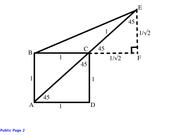
∆ECF:
Since AB || CF, ∠ECF = 45 degrees.
Thus, is a ∆ECF is a 45-45-90 triangle.
In a 45-45-90 triangle, the sides are in the following ratio:
x : x : x√2.
Since it is given the CE=1, EF = 1/√2 = (1*√2)/(√2*√2) = √2/2.
∆BCE:
If we consider BC the base, then EF is the corresponding height.
Thus, the area of ∆BCE = (1/2)(b)(h) = (1/2)(1)(√2/2) = √2/4.
The correct answer is
B.
Private tutor exclusively for the GMAT and GRE, with over 20 years of experience.
Followed here and elsewhere by over 1900 test-takers.
I have worked with students based in the US, Australia, Taiwan, China, Tajikistan, Kuwait, Saudi Arabia -- a long list of countries.
My students have been admitted to HBS, CBS, Tuck, Yale, Stern, Fuqua -- a long list of top programs.
As a tutor, I don't simply teach you how I would approach problems.
I unlock the best way for YOU to solve problems.
For more information, please email me (Mitch Hunt) at
[email protected].
Student Review #1
Student Review #2
Student Review #3