Geometry

This topic has expert replies
Senior | Next Rank: 100 Posts
Posts: 98
Joined: Sat May 31, 2014 8:29 pm
Thanked: 1 times
Followed by:2 members

Geometry

by RiyaR » Sat Oct 18, 2014 9:00 am
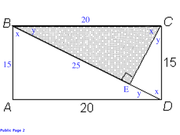
If ABCD is a rectangle, what is the area of the shaded region?

64

82

96

120

150
Image

Is the answer to this 96? I used the conceptof similarity
Attachments
Image.docx
(13.98 KiB) Downloaded 158 times
Source: — Problem Solving |

GMAT/MBA Expert

User avatar
Elite Legendary Member
Posts: 10392
Joined: Sun Jun 23, 2013 6:38 pm
Location: Palo Alto, CA
Thanked: 2867 times
Followed by:511 members
GMAT Score:800

by [email protected] » Sat Oct 18, 2014 11:01 am
Hi RiyaR,

Yes, you are correct. Each of the 3 triangles is [spoiler]a 3/4/5 right triangle[/spoiler].

GMAT assassins aren't born, they're made,
Rich
Contact Rich at [email protected]
Image

Legendary Member
Posts: 510
Joined: Thu Aug 07, 2014 2:24 am
Thanked: 3 times
Followed by:5 members

by j_shreyans » Sat Oct 18, 2014 10:36 pm
Hi Rich ,

Can you pls solve this?

I am using the same concept but not getting answer.

User avatar
GMAT Instructor
Posts: 15539
Joined: Tue May 25, 2010 12:04 pm
Location: New York, NY
Thanked: 13060 times
Followed by:1906 members
GMAT Score:790

by GMATGuruNY » Sun Oct 19, 2014 3:31 am
Let ∠ABD = x and ∠BDA = y, implying that x+y = 90.
The result is the following figure:
Image
Every triangle in the figure above has the same combination of angles:
x-y-90.
Implication:
All of the triangles are SIMILAR.
Corresponding sides in similar triangles are in the SAME RATIO.
Image
Since AB=15 and AD=20, ∆ABD is a multiple of a 3-4-5 triangle:
AB:AD:BD = 3:4:5 = 15:20:25.

Image
Since ∆BCE is similar to ∆ABD, ∆BCE must also be a multiple of a 3-4-5 triangle.
Since BC=20, we get:
CE:BE:BC = 3:4:5 = 12:16:20.
Thus, CE=12 and BE=16, implying that the area of ∆BCE = (1/2)(BE)(CE) = (1/2)(16)(12) = 96.

The correct answer is C.
Private tutor exclusively for the GMAT and GRE, with over 20 years of experience.
Followed here and elsewhere by over 1900 test-takers.
I have worked with students based in the US, Australia, Taiwan, China, Tajikistan, Kuwait, Saudi Arabia -- a long list of countries.
My students have been admitted to HBS, CBS, Tuck, Yale, Stern, Fuqua -- a long list of top programs.

As a tutor, I don't simply teach you how I would approach problems.
I unlock the best way for YOU to solve problems.

For more information, please email me (Mitch Hunt) at [email protected].
Student Review #1
Student Review #2
Student Review #3

GMAT/MBA Expert

User avatar
GMAT Instructor
Posts: 16207
Joined: Mon Dec 08, 2008 6:26 pm
Location: Vancouver, BC
Thanked: 5254 times
Followed by:1268 members
GMAT Score:770

by Brent@GMATPrepNow » Sun Oct 19, 2014 12:38 pm
Image[/url]
If ABCD is a rectangle, what is the area of the shaded region?
A) 64
B) 82
C) 96
D) 120
E) 150
IMPORTANT: the diagrams in problem solving questions are DRAWN TO SCALE unless stated otherwise.

So, even though this is a tricky question, we can quickly eliminate 3 of the answer choices and have a 50-50 chance of guessing correctly. Here's how:

Rectangle ABCD has dimensions 15 x 20, so its area = 300.
So, the area of ∆BCD = 150 (half of 300)
So, the shaded area must have an area that's LESS THAN 150
So, we can eliminate E

Answer choices A and B are both APPROXIMATELY half of 150.
Does it look like half of ∆BCD is shaded?
NO.
So. we can eliminate A and B.

This leaves us with a guess between C and D

FINAL NOTE: The diagram provided here is obviously not drawn to scale, so unless there's some missing text (saying "not drawn to scale") that was supposed to accompany the diagram , this is not a GMAT-quality question.

Cheers,
Brent
Brent Hanneson - Creator of GMATPrepNow.com
Image



















