GPREP PS- 1

This topic has expert replies
Master | Next Rank: 500 Posts
Posts: 379
Joined: Tue Sep 30, 2008 7:17 am
Location: NY
Thanked: 28 times
Followed by:11 members

GPREP PS- 1

by abhasjha » Mon Jul 21, 2014 10:27 am
For a display, identical cubic boxes are stacked in square layers. Each layer consists of cubic boxes arranged in rows that form a square, and each layer has 1 fewer row and 1 fewer box in each remaining row than the layer directly below it. If the bottom of the layer has 81 boxes and the top of the layer has only 1 box, how many boxes are in display?

A. 236
B. 260
C. 269
D. 276
E. 285


can some one draw the diagramm and then make me understand ... how you find solution ?
Also any short cuts - (formula to solve this ) ???
Source: — Problem Solving |

User avatar
Legendary Member
Posts: 1100
Joined: Sat May 10, 2014 11:34 pm
Location: New Delhi, India
Thanked: 205 times
Followed by:24 members

by GMATinsight » Mon Jul 21, 2014 10:51 am
abhasjha wrote:For a display, identical cubic boxes are stacked in square layers. Each layer consists of cubic boxes arranged in rows that form a square, and each layer has 1 fewer row and 1 fewer box in each remaining row than the layer directly below it. If the bottom of the layer has 81 boxes and the top of the layer has only 1 box, how many boxes are in display?

A. 236
B. 260
C. 269
D. 276
E. 285


can some one draw the diagramm and then make me understand ... how you find solution ?
Also any short cuts - (formula to solve this ) ???
Since every row is a square therefore if the bottom layer has 81 squares i.e. 9^2 then the next row will have 8^2 [because every row has one lesser box]

Therefore the cubes in rows will be
81 = 9^2
64 = 8^2
49 = 7^2...
.....and so on
4 = 2^2
1 = 1^2

Sum of all Squares = 9^2 + 8^2 + 7^2 + .....+ 3^2 + 2^2 + 1^1

Sum of Squares of first n positive Consecutive Integers = (1/6)(n)(n+1)(2n+1)

Sum of Squares of first 9 positive Consecutive Integers = (1/6)(9)(9+1)(2x9+1) = 285

Answer: Option E
"GMATinsight"Bhoopendra Singh & Sushma Jha
Most Comprehensive and Affordable Video Course 2000+ CONCEPT Videos and Video Solutions
Whatsapp/Mobile: +91-9999687183 l [email protected]
Contact for One-on-One FREE ONLINE DEMO Class Call/e-mail
Most Efficient and affordable One-On-One Private tutoring fee - US$40-50 per hour

User avatar
GMAT Instructor
Posts: 15539
Joined: Tue May 25, 2010 12:04 pm
Location: New York, NY
Thanked: 13060 times
Followed by:1906 members
GMAT Score:790

by GMATGuruNY » Mon Jul 21, 2014 11:11 am
abhasjha wrote:For a display, identical cubic boxes are stacked in square layers. Each layer consists of cubic boxes arranged in rows that form a square, and each layer has 1 fewer row and 1 fewer box in each remaining row than the layer directly below it. If the bottom of the layer has 81 boxes and the top of the layer has only 1 box, how many boxes are in display?

A. 236
B. 260
C. 269
D. 276
E. 285
The 81 cubes that form the bottom layer look as follows:
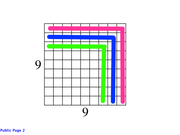
Image

The next layer is formed by removing one entire row, along with one box from each of the remaining rows.
This is the equivalent of removing the pink shaded region in the figure above.
The result is the following figure:
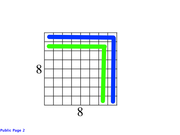
Image
In this layer, the number of cubes = 8² = 64.

To form the next layer, we must remove the blue shaded region.
The result in the following figure:
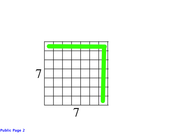
Image
In this layer, the number of cubes = 7² = 49.

By now we should see the pattern.
81, 64 and 49 are consecutive PERFECT SQUARES.
Implication:
The total number of cubes is equal to the sum of the perfect squares between 81 and 1, inclusive:
81+64+49+36+25+16+9+4+1 = 285.

The correct answer is E.
Private tutor exclusively for the GMAT and GRE, with over 20 years of experience.
Followed here and elsewhere by over 1900 test-takers.
I have worked with students based in the US, Australia, Taiwan, China, Tajikistan, Kuwait, Saudi Arabia -- a long list of countries.
My students have been admitted to HBS, CBS, Tuck, Yale, Stern, Fuqua -- a long list of top programs.

As a tutor, I don't simply teach you how I would approach problems.
I unlock the best way for YOU to solve problems.

For more information, please email me (Mitch Hunt) at [email protected].
Student Review #1
Student Review #2
Student Review #3

GMAT/MBA Expert

User avatar
GMAT Instructor
Posts: 8083
Joined: Sat Apr 25, 2015 10:56 am
Location: Los Angeles, CA
Thanked: 43 times
Followed by:29 members

Re: GPREP PS- 1

by Scott@TargetTestPrep » Wed Mar 25, 2020 4:24 am
abhasjha wrote:
Mon Jul 21, 2014 10:27 am
For a display, identical cubic boxes are stacked in square layers. Each layer consists of cubic boxes arranged in rows that form a square, and each layer has 1 fewer row and 1 fewer box in each remaining row than the layer directly below it. If the bottom of the layer has 81 boxes and the top of the layer has only 1 box, how many boxes are in display?

A. 236
B. 260
C. 269
D. 276
E. 285


can some one draw the diagramm and then make me understand ... how you find solution ?
Also any short cuts - (formula to solve this ) ???
We see that the bottommost layer has 9 x 9 = 81 boxes and the topmost layer is 1 x 1 = 1 box. Therefore, each layer must be a perfect square number of boxes from 1 to 81, inclusive. That is, if we count the layers from top to bottom, they have 1, 4, 9, 16, 25, 36, 49, 64, and 81 boxes. Therefore, the total number of boxes is:

1 + 4 + 9 + 16 + 25 + 36 + 49 + 64 + 81

Instead of adding the actual numbers, let’s add their units digits:

1 + 4 + 9 + 6 + 5 + 6 + 9 + 4 + 1 = 5 + 15 + 5 + 15 + 5 = 45

We see the sum must have a units digit of 5; therefore, choice E is the correct answer.

Answer: E

Scott Woodbury-Stewart
Founder and CEO
[email protected]

Image

See why Target Test Prep is rated 5 out of 5 stars on BEAT the GMAT. Read our reviews

ImageImage



















