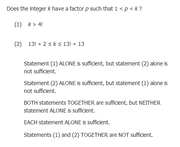
Does the integer k have a factor p such that 1 < p < k ?
(1) k > 4!
(2) 13! + 2 ≤ k ≤ 13! + 13
Target question: Does the integer k have a factor p such that 1 < p < k ?
This question is a great candidate for rephrasing the target question.
(We have a free video with tips on rephrasing the target question: https://www.gmatprepnow.com/module/gmat- ... cy?id=1100)
Let's look at a few cases to get a better idea of what the target question is asking.
- Try k = 6. Since 2 is a factor of 6, we can see that k DOES have a factor p such that 1<p<k.
- Try k = 10 Since 5 is a factor of 10, we can see that k DOES have a factor p such that 1<p<k.
- Try k = 16. Since 4 is a factor of 14, we can see that k DOES have a factor p such that 1<p<k.
- Try k = 5. Since 1 and 5 are the ONLY factors of 5, we can see that k does NOT have a factor p such that 1<p<k.
Aha, so if k is a prime number, then it CANNOT satisfy the condition of having a factor p such that 1 < p < k
In other words, the target question is really asking us whether k is a non-prime integer (aka a "composite integer")
REPHRASED target question: Is integer k a non-prime integer?
Statement 1: k > 4!
In other words, k > 24
This does not help us determine whether or not k is a non-prime integer? No.
Consider these two conflicting cases:
Case a: k = 25, in which case
k is a non-prime integer
Case b: k = 29, in which case
k is a prime integer
Since we cannot answer the
target question with certainty, statement 1 is NOT SUFFICIENT
Statement 2: 13! + 2 ≤ k ≤ 13! + 13
Let's examine a few possible values for k.
k = 13! + 2
= (13)(12)(11)....(5)(4)(3)(
2)(1) +
2
=
2[(13)(12)(11)....(5)(4)(3)(1) + 1]
Since k is a multiple of
2,
k is a non-prime integer
k = 13! + 3
= (13)(12)(11)....(5)(4)(
3)(2)(1) +
3
=
3[(13)(12)(11)....(5)(4)(2)(1) + 1]
Since k is a multiple of
3,
k is a non-prime integer
k = 13! + 4
= (13)(12)(11)....(5)(
4)(3)(2)(1) +
4
=
4[(13)(12)(11)....(5)(3)(2)(1) + 1]
Since k is a multiple of
4,
k is a non-prime integer
As you can see, this pattern can be repeated all the way up to k = 13! + 13. In EVERY case,
k is a non-prime integer
Since we can answer the
target question with certainty, statement 2 is SUFFICIENT
Answer =
B
Cheers,
Brent