
BREAKING: Target Test Prep releases Brand New 2026 On Demand GMAT prep course

Redeem

Two trains travel at constant speeds. What is the ratio of t

Expert replies
by fskilnik@GMATH » Tue Mar 26, 2019 9:45 am

Timer

00:00

Answers

A

B

C

D

E

Stats

Difficulty

GMATH practice exercise (Quant Class 19)

Two trains travel at constant speeds. What is the ratio of the slower speed to the faster speed?

(1) The time it takes for one train to pass the other when they are in the same direction is 3h.
(2) The time it takes for one train to pass the other when they are in opposite directions is 2h.

Answer: [spoiler]______(C)__[/spoiler]
Fabio Skilnik :: GMATH method creator ( Math for the GMAT)
English-speakers :: https://www.gmath.net
Portuguese-speakers :: https://www.gmath.com.br
Join the discussion
Source: — Data Sufficiency |

fskilnik@GMATH wrote:GMATH practice exercise (Quant Class 19)

Two trains travel at constant speeds. What is the ratio of the slower speed to the faster speed?

(1) The time it takes for one train to pass the other when they are in the same direction is 3h.
(2) The time it takes for one train to pass the other when they are in opposite directions is 2h.
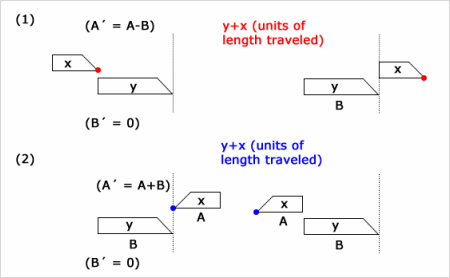
$${\rm{faster}}\,\,{\rm{train}}\,\,\left\{ \matrix{
\,x\,\,{\rm{m}}\,\,\left( {{\rm{length}}\,{\rm{:}}\,\,{\rm{meters}}} \right) \hfill \cr
\,A\,{\rm{mph}}\,\,\,\left( {{\rm{speed}}\,{\rm{:}}\,\,{\rm{meters}}\,\,{\rm{per}}\,\,{\rm{hour}}} \right) \hfill \cr} \right.$$
$${\rm{slower}}\,\,{\rm{train}}\,\,\left\{ \matrix{
\,y\,\,{\rm{m}}\,\,\left( {{\rm{length}}\,{\rm{:}}\,\,{\rm{meters}}} \right) \hfill \cr
\,B\,{\rm{mph}}\,\,\,\left( {{\rm{speed}}\,{\rm{:}}\,\,{\rm{meters}}\,\,{\rm{per}}\,\,{\rm{hour}}} \right) \hfill \cr} \right.$$
$$? = {B \over A}\,\,\,\,\,\,\,\left[ {A > B > 0} \right]$$

Image

$$\left. \matrix{
\left( 1 \right)\,\,A - B = {{y + x} \over 3}\,\,\,\,\, \Rightarrow \,\,\,\,\,{\rm{trivial}}\,\,{\rm{bifurcation}}\,\, \hfill \cr
\left( 2 \right)\,\,A + B = {{y + x} \over 2}\,\,\,\,\, \Rightarrow \,\,\,\,\,{\rm{trivial}}\,\,{\rm{bifurcation}} \hfill \cr} \right\}\,\,\,\,\,\mathop \Rightarrow \limits^{\left( {1 + 2} \right)} \,\,\,\,3\left( {A - B} \right) = 2\left( {A + B} \right)\,\,\,\,\, \Rightarrow \,\,\,\,\,A = 5B\,\,\,\,\, \Rightarrow \,\,\,\,\,{\rm{SUFF}}.$$

The correct answer is (C).


We follow the notations and rationale taught in the GMATH method.

Regards,
Fabio.
Fabio Skilnik :: GMATH method creator ( Math for the GMAT)
English-speakers :: https://www.gmath.net
Portuguese-speakers :: https://www.gmath.com.br

Join the discussion
















