BREAKING: Target Test Prep releases Brand New 2026 On Demand GMAT prep course

Redeem

At least 100 students at a certain high school study Japanes

Expert replies
by kaudes11114 » Sun Mar 09, 2014 5:17 am

Timer

00:00

Answers

A

B

C

D

E

Stats

Difficulty

At least 100 students at a certain high school study Japanese. If 4 percent of the students at the school who study French also study Japanese, do more students at the school study French than Japanese?
(1) 16 students at the school study both French and Japanese.
(2) 10 percent of the students at the school who study Japanese also study French.

Please help to solve
Join the discussion
Source: — Data Sufficiency |

by theCodeToGMAT » Sun Mar 09, 2014 7:58 am
[spoiler]{B}[/spoiler]
Attachments
solution.JPG
R A H U L
Join the discussion

by Brent@GMATPrepNow » Sun Mar 09, 2014 8:18 am
I'd like to point out that Rahul has done an excellent job demonstrating a technique known as the Double Matrix Method (aka Group Grid approach). This technique can be used for most questions featuring a population in which each member has two characteristics associated with it.
Here, we have a population of students, and the two characteristics are:
- study French or don't study French
- study Japanese or don't study Japanese

To learn more about the Double Matrix Method, watch our free video: https://www.gmatprepnow.com/module/gmat- ... ems?id=919

Once you're familiar with this technique, you can attempt these additional practice questions:

Easy Problem Solving questions
- https://www.beatthegmat.com/the-aam-aadm ... 72242.html
- https://www.beatthegmat.com/finance-majo ... 67425.html

Medium Problem Solving questions
- https://www.beatthegmat.com/probability- ... 73360.html
- https://www.beatthegmat.com/posted-speed ... 72374.html
- https://www.beatthegmat.com/motel-t271938.html
- https://www.beatthegmat.com/of-the-appli ... 70255.html
- https://www.beatthegmat.com/opening-nigh ... 64869.html
- https://www.beatthegmat.com/ds-french-ja ... 22297.html

Difficult Problem Solving questions
- https://www.beatthegmat.com/ratio-problem-t268339.html
- https://www.beatthegmat.com/overlapping- ... 65223.html
- https://www.beatthegmat.com/fractions-t264254.html
- https://www.beatthegmat.com/overlapping- ... 64092.html
- https://www.beatthegmat.com/mba/2011/05/ ... question-2

Easy Data Sufficiency questions
- https://www.beatthegmat.com/for-what-per ... 70596.html
- https://www.beatthegmat.com/ds-quest-t187706.html

Medium Data Sufficiency questions
- https://www.beatthegmat.com/sets-matrix-ds-t271914.html
- https://www.beatthegmat.com/each-of-peop ... 71375.html
- https://www.beatthegmat.com/a-manufacturer-t270331.html
- https://www.beatthegmat.com/in-costume-f ... 69355.html
- https://www.beatthegmat.com/mba/2011/05/ ... question-1

Difficult Data Sufficiency questions
- https://www.beatthegmat.com/double-set-m ... 71423.html
- https://www.beatthegmat.com/sets-t269449.html
- https://www.beatthegmat.com/mba/2011/05/ ... question-3
Brent Hanneson - Creator of GMATPrepNow.com
Image
Join the discussion

by GMATGuruNY » Sun Mar 09, 2014 12:15 pm
kaudes11114 wrote:At least 100 students at a certain high school study Japanese. If 4 percent of the students at the school who study French also study Japanese, do more students at the school study French than Japanese?
(1) 16 students at the school study both French and Japanese.
(2) 10 percent of the students at the school who study Japanese also study French.

Please help to solve
Alternate approach:

Let F = the total number of students who study French, J = the total number of students who study Japanese, and B = the total number of students who study both languages.
Since 4% of the students who study French study both languages, B = .04F.

Statement 1: 16 students study both French and Japanese
Thus:
.04F = 16
F = 400.
No information about J.
INSUFFICIENT.

Statement 2: 10% of students at school who study Japanese also study French
Thus, B = .1J.
Since it is also true that B = .4F, we get:
.04F = .1J
F/J = 10/4 = 5/2.
Thus, F>J.
SUFFICIENT.

The correct answer is B.
Private tutor exclusively for the GMAT and GRE, with over 20 years of experience.
Followed here and elsewhere by over 1900 test-takers.
I have worked with students based in the US, Australia, Taiwan, China, Tajikistan, Kuwait, Saudi Arabia -- a long list of countries.
My students have been admitted to HBS, CBS, Tuck, Yale, Stern, Fuqua -- a long list of top programs.

As a tutor, I don't simply teach you how I would approach problems.
I unlock the best way for YOU to solve problems.

For more information, please email me (Mitch Hunt) at [email protected].
Student Review #1
Student Review #2
Student Review #3
Join the discussion

by eitijan » Sat May 07, 2016 4:43 am
Hi Everyone

I found theCodeToGMAT approach a little insufficient.
Correct me if I am wrong
In statement 2, we are able to find F= 250 but we dont know about exact number of J (at least 100 means 100 or greater than 100, it could be 150(less than F) or 251 (greater than F)) .
Kindly comment.
Join the discussion

kaudes11114 wrote:At least 100 students at a certain high school study Japanese. If 4 percent of the students at the school who study French also study Japanese, do more students at the school study French than Japanese?

(1) 16 students at the school study both French and Japanese.
(2) 10 percent of the students at the school who study Japanese also study French.
A student asked me to provide a step-by-step solution using the Double Matrix method, so here goes....
This technique can be used for most questions featuring a population in which each member has two characteristics associated with it (aka overlapping sets questions).
Here, we have a population of students, and the two characteristics are:
- studies Japanese or does NOT study Japanese
- studies French or does NOT study French

Let's let J = the TOTAL number of students taking Japanese
And let F = the TOTAL number of students taking French

When we sketch our diagram, we get:
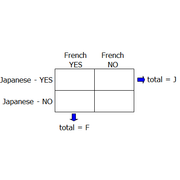
Image

Target question: Is F greater than J?

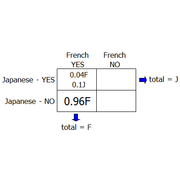
Given: 4 percent of the students at the school who study French also study Japanese
Since we let F = the TOTAL number of students taking French, we can say that 4% of F = number of students taking BOTH French and Japanese.
In other words, 0.04F = number of students taking BOTH French and Japanese
We can also say that 96% of the students who study French do NOT study Japanese
In other words, 0.96F = number of students taking French but NOT Japanese

So, our diagram now looks like this:
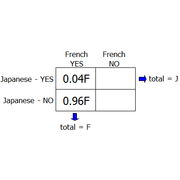
Image

Statement 1: 16 students at the school study both French and Japanese
Since 0.04F = number of students taking BOTH French and Japanese, we can write: 0.04F =16
When we solve this equation for F, we get F = 400
So, 0.96F = 384
So, our diagram now looks like this:
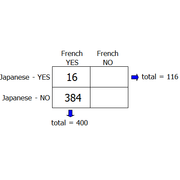
Image

Is this enough information to determine whether or not F is greater than J?
No.

For example, we COULD fill in the remaining boxes this way...
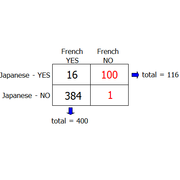
Image
In this case, F = 400 and J = 116, which means F IS greater than J

However, we COULD also fill in the remaining boxes this way...
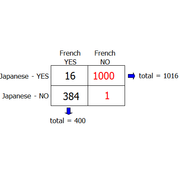
Image
In this case, F = 400 and J = 1016, which means F is NOT greater than J

Since we cannot answer the target question with certainty, statement 1 is NOT SUFFICIENT

Statement 2: 10 percent of the students at the school who study Japanese also study French.
J = the TOTAL number of students taking Japanese
So, 0.1J = number of students taking BOTH French and Japanese

Notice that we already determined that 0.04F = number of students taking BOTH French and Japanese
So, we now have two ways to represent the SAME value.
Image

So, it MUST be the case that 0.1J = 0.04F
Let's see what this tells us.
First, to make things easier, let's multiply both sides by 100 to get: 10J = 4F
Divide both sides by 10 to get: J = 4F/10
Divide both sides by F to get: J/F = 4/10
From this, we can conclude that F IS greater than J
Since we can answer the target question with certainty, statement 2 is SUFFICIENT

Answer: B

Cheers,
Brent

Brent Hanneson - Creator of GMATPrepNow.com
Image
Join the discussion

by Scott@TargetTestPrep » Wed May 01, 2019 4:09 pm
kaudes11114 wrote:At least 100 students at a certain high school study Japanese. If 4 percent of the students at the school who study French also study Japanese, do more students at the school study French than Japanese?
(1) 16 students at the school study both French and Japanese.
(2) 10 percent of the students at the school who study Japanese also study French.
We can let f = the number of students who study French and j = number of who study Japanese, and we need to determine whether f is greater than j. Furthermore, we are given that j ≥ 100 and 4 percent of the students at the school who study French also study Japanese; in other words, 4 percent of the students at the school who study French study both languages.

Statement One Alone:

16 students at the school study both French and Japanese.

We can create the equation:

0.04f = 16

4f = 1600

f = 400

However, since we don't know the value of j (except that it's at least 100), statement one alone is not sufficient.

Statement Two Alone:

10 percent of the students at the school who study Japanese also study French.

In other words, 10 percent of the students at the school who study Japanese study both languages. Even though we don't know the exact number of students who study both languages, we know that it's 0.04f. Therefore,

0.1j = 0.04f

10j = 4f

2.5j = f

We see that the number of students who study French is 2.5 times those who study Japanese. So f is indeed greater than j. Statement two alone is sufficient.

Answer: B

Scott Woodbury-Stewart
Founder and CEO
[email protected]

Image

See why Target Test Prep is rated 5 out of 5 stars on BEAT the GMAT. Read our reviews

ImageImage
Join the discussion



















